A basement window well leaking is usually a drainage problem in the well itself: water collects faster than the gravel and drain below can carry it away, rises to the bottom of the window and spills over the sill. Less often, the well is close to dry and water still gets in through a failed window seal, a rotted frame or a gap between the window and the foundation around it.
Both look the same from inside, a wet wall under the window, but they have different fixes. Clearing a well will not help a cracked seal, and new caulk will not stop a well that fills to the top in every storm.
For other places basement water starts, see the overview of why a basement gets wet. This page stays with the window.
How a Window Well Is Supposed to Handle Water
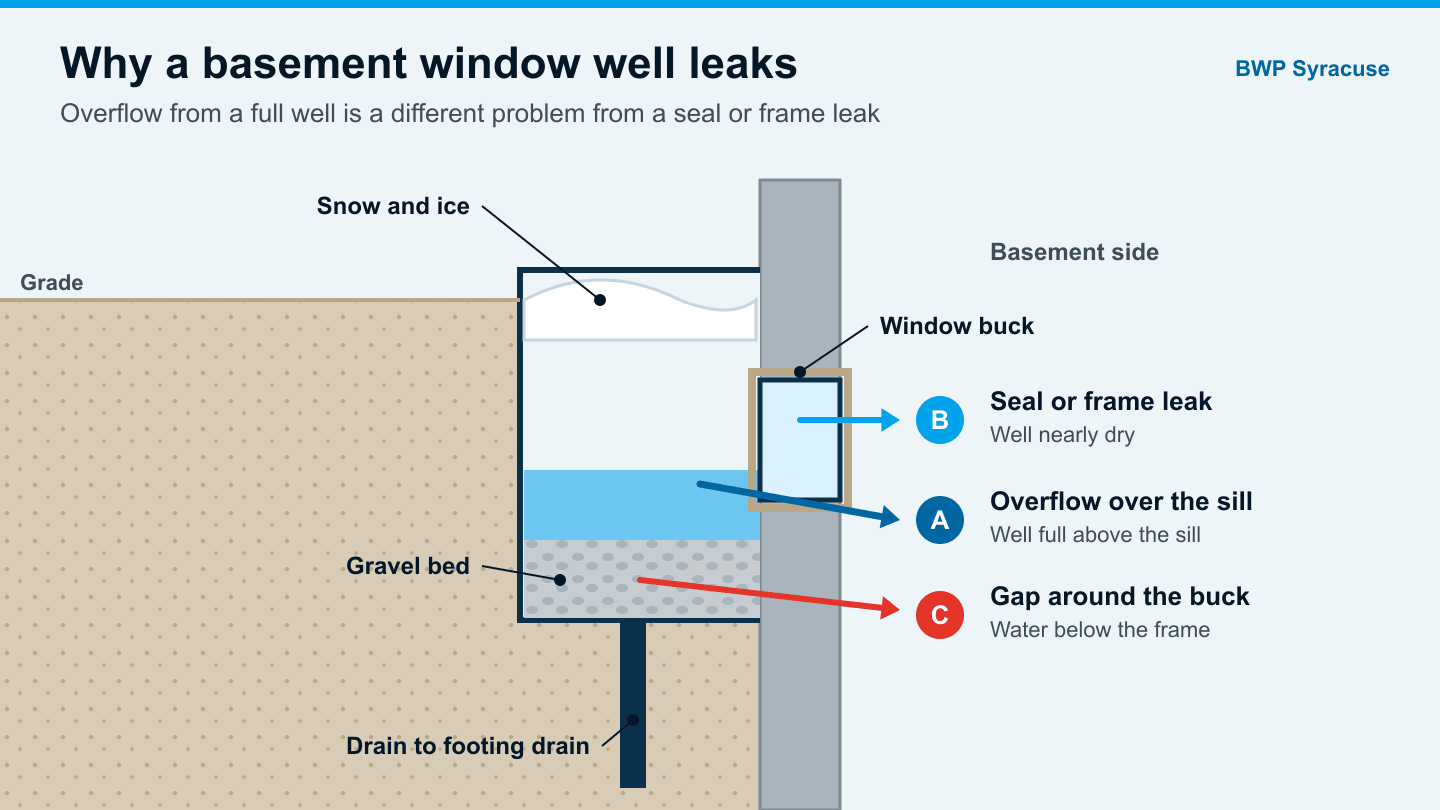
A window well is the metal or plastic liner around a basement window that sits below ground level. It holds the soil back so light can reach the window, and because it is open to the sky, rain and snow fall straight into it. The bottom of the well is meant to deal with that water. Most wells have several inches of washed gravel at the base so water can soak down into the soil. Better installations add a vertical drain pipe under the gravel that connects to the footing drain, which is the perforated pipe that runs along the base of the foundation and carries groundwater to a sump or to daylight.
The window sits in a frame set into the foundation wall. In poured concrete that frame is often a wood or vinyl window buck, a box set in the form before the wall was poured. In block and older stone walls the frame may be mortared or simply caulked into the opening. The joint between the frame and the masonry is a common weak spot once the materials age.
Why a Basement Window Well Starts Leaking
Most leaking wells fail for one of the reasons below. Several of them can stack up in the same well.
Blocked gravel or a buried drain
Leaves, grass clippings and soil settle into the gravel over the years and fill the gaps between the stones, so water that once soaked in now sits on top. A drain under the gravel can clog the same way.
No drain at all
Many wells were installed with gravel only, set on top of the backfill soil. That works on sandy ground and struggles on dense clay, which absorbs water slowly. In heavy clay the gravel fills like a bowl during a long rain, and the water level climbs toward the window.
Roof runoff and poor grading
An overflowing gutter above the window, a downspout discharging nearby or ground that slopes toward the house all send water into the well. The top edge of the well should sit a few inches above the soil so runoff flows around it rather than over the lip.
Snow piling and melting ice
Snow drifts into wells, and shoveled or plowed snow often lands right on top of them. When it melts, the gravel beneath may still be frozen, so the water cannot soak in. Ice can also form a dam across the gravel and around the sill, holding meltwater against the window.
Failed window seals and rotted frames
The glazing seal, the frame corners and the caulk between frame and wall all age. Wood bucks in older homes can rot from years of wet wells. Once that happens, water running down the window glass or splashing on the sill can enter at a small height, well below the point where the well overflows.
Gaps around the buck or the foundation opening
The well liner is usually bolted to the foundation, and the window opening in the wall is a break in the concrete or block. If the well has pulled away from the wall, or the masonry around the frame has cracked, water moving down through the soil can follow that path to the edge of the window.
Overflow or Seal Leak? How to Tell Them Apart
The clearest clue is the water level in the well compared with where water enters inside. Check both during or just after a storm, when the evidence is still there.
| Clue | Well overflow | Window seal or frame leak | Gap around buck or foundation opening |
|---|---|---|---|
| Water in the well | Pooled up to or above the sill | Little or none | Little or none |
| Where it appears inside | Over the sill, sheet of water down the wall | Corners of the frame, bottom of the glass | Below or beside the frame, at the masonry |
| When it happens | Long or heavy rain, snowmelt | Wind-driven rain, water running down glass | After the soil is soaked, can lag the storm |
| Stains inside | Wide stain across the full window width | Narrow streaks from corners | Damp masonry, mineral deposits under the frame |
| First thing to check | Gravel and drain | Caulk, glazing, frame wood | Well attachment, cracks around the opening |
A full well with an undamaged frame points to drainage. A nearly dry well with water at the corners points to the window. Water below the frame with a dry well and a dry window points to the wall around the opening, which can overlap with an ordinary foundation crack.
Safe Inspection Steps for a Leaking Window Well
The goal is to identify which of the three paths is active without making the leak worse or getting hurt. Do this on a dry day for the well work and during a storm for the observation.
- Check the basement side first. If water has reached outlets, extension cords or appliances near the window, do not touch them and do not stand in the water. Shut off power to that area only from a dry spot at the panel, or call an electrician.
- Look into the well from above. Note the water level, how much debris is on the gravel and whether the top of the liner sits above the surrounding soil. Do not climb into a deep well without a stable ladder, and never step onto a well cover.
- Clear the debris by hand. Wear gloves. Remove leaves, soil and trash down to the gravel, and look for a drain grate or pipe opening under it.
- Run a hose test. On a dry day, run a garden hose slowly into the empty well for 10 to 15 minutes while someone watches inside. If the water soaks away and nothing appears inside, the gravel is doing its job. If the well fills quickly, drainage is the problem.
- Test the window separately. Spray the glass and frame for a few minutes with the well empty. Water inside now points to the seal, the frame or the caulk joint rather than the well.
- Inspect the frame inside. Press gently on the wood buck or sill with a screwdriver tip. Soft, punky wood means rot, which caulk will not fix.
- Look at the outside joint. Check whether the liner has pulled away from the wall and whether the masonry around the opening has cracks.
How to read the result: a well that fills during the hose test needs drainage work; a leak that appears only during the spray test needs window work; a leak that appears in neither test but shows up after long rain suggests soil water reaching the opening or the wall below it. If the window is your only egress (emergency exit) window from a bedroom, keep any fix from blocking that exit.
Syracuse Winters and Window Wells
Snow is the reason window wells cause so much trouble here. The National Weather Service lists a 1991 to 2020 normal of 127.8 inches (opens in a new tab) of annual snowfall for Syracuse. A lot of that lands in or beside window wells, especially on the side of the house where the driveway gets cleared.
A common field pattern is a well that behaves all summer and floods in the first warm spell of February or March, when slush sits on gravel that is still frozen. Freeze-thaw cycles add another layer: ice that forms against the frame each night can open the caulk joint a little more each time.
Older homes with block or stone foundations often have shallow wells that were never connected to a drain, and many valley neighborhoods sit on dense clay. Neither guarantees a leak, but both make overflow more likely when snowmelt and rain arrive together.
Prevention That Helps
- Keep the well clean. Clear leaves in late fall before the first snow, and check again after big windstorms.
- Shovel snow away from wells. Do not pile driveway snow next to the house over the wells. After a big storm, scoop the snow out of the well before a thaw.
- Fix the water above it. Clean gutters over the window and extend downspouts so they discharge several feet from the foundation. The spring thaw checklist covers the outside items in order.
- Keep the liner above grade. Soil, mulch and stone beds tend to rise over time. The top of the liner should sit a few inches above them.
- Add a clear cover. A cover sized to the well keeps out snow and debris. If the window is an egress window, use a cover that can be opened easily from inside.
The Limits of Covers and Caulk
Covers and caulk are often the right first step, but they have limits. A cover reduces what falls into the well. It does not stop water entering from below when the soil around the well is saturated, and it does not help if the gap is around the frame rather than over the sill.
Caulk can close a small gap between frame and wall. It will not hold back a well full of water, and it does nothing for a rotted buck, where the wood behind the caulk is the problem. A leak that returns a season after caulking usually means the real path was somewhere else.
When a Leaking Window Well Needs a Professional
Some window well problems are homeowner jobs and some are not. Call for help when:
- The well fills during a hose test even after the gravel is cleared, which suggests the drain is blocked, missing or never connected.
- The well liner has pulled away from the foundation or the soil around it has sunk.
- The window buck is rotted, or the masonry around the opening is cracked.
- Water appears below the window with a dry well, pointing to a foundation path.
- The window is an egress window and needs to be replaced or rebuilt.
Repairs can include connecting the well to the footing drain or an interior drainage system, resetting the liner, replacing the frame and window, or sealing cracks around the opening, depending on what the inspection finds. If you want a second set of eyes on which path the water is taking, a free inspection can sort out the well, the window and the wall before you pick a fix.
A window well that drains in July and floods in March is telling you about its gravel, not your window, so check the well before you replace the glass.
Frequently Asked Questions
Should a window well have water standing in it after rain?
No. A working window well should be empty or close to it within a few hours after rain stops. Water that sits for a day or longer means the gravel bed is clogged, the drain under it is blocked or there is no drain at all, and the well is one heavy storm away from overflowing.
Will a window well cover stop the leak?
A clear cover keeps out leaves, most rain and a lot of snow, so it often reduces how much water the well has to handle. It does nothing about groundwater rising from below, roof water overshooting onto the cover or a gap between the window frame and the foundation. Treat it as prevention, not a repair.
Can I just caulk around the basement window?
Caulk can close a small gap where the frame meets the wall and is a reasonable short-term step. It will not hold back water that is pooled above the sill, and it usually fails again within a season or two when the gap is from a rotted buck or settled well. If water still appears with a dry well, the opening around the window needs a proper repair.
Why does my window well leak only in spring?
Snow packed into the well and against the house melts during thaws, often while the gravel underneath is still frozen. The water has nowhere to soak in, so it rises against the window. Rain falling on snow during a thaw makes it worse. A well that drains fine in July can still flood in March for this reason.