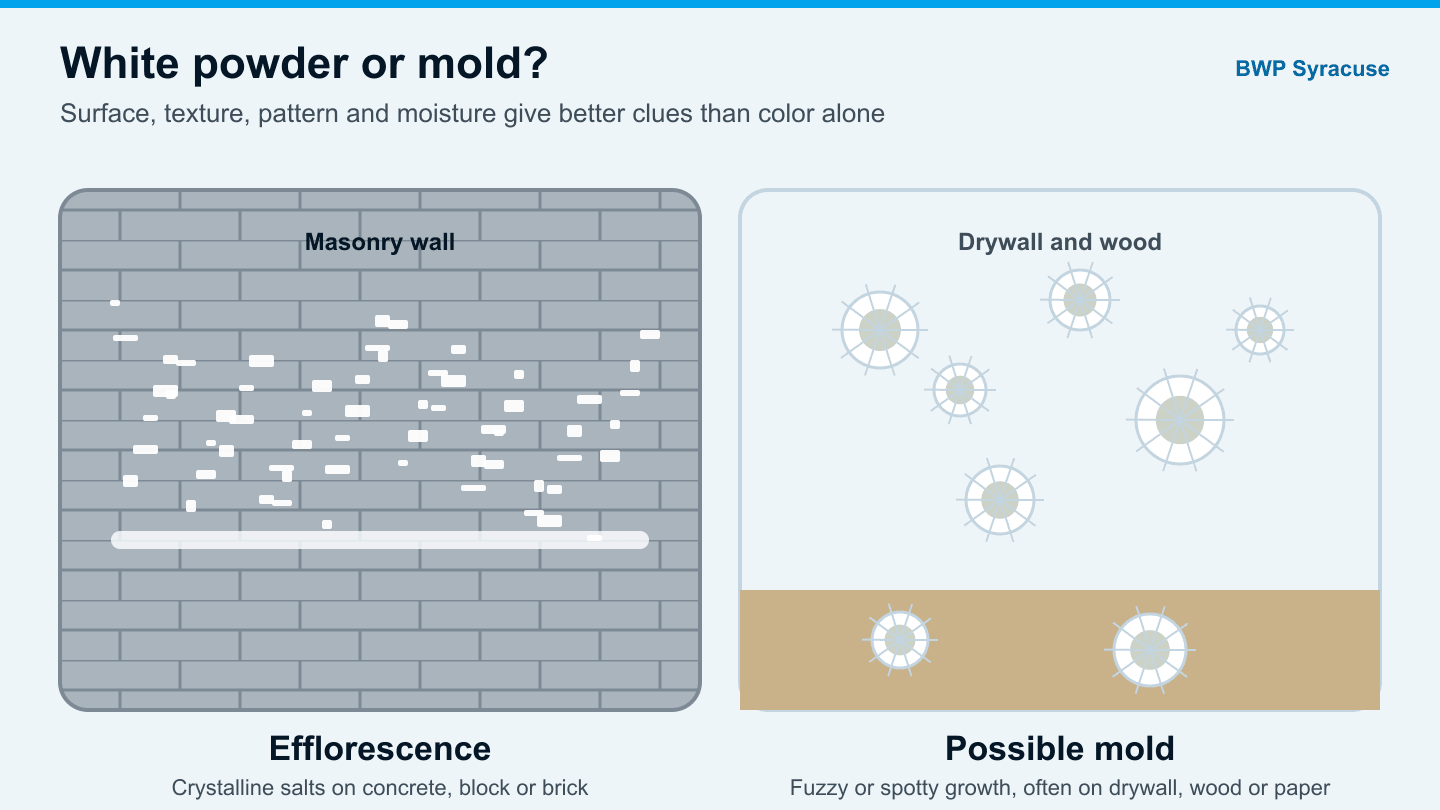
White powder on a basement wall is often efflorescence, a crust of mineral salts left behind when water moves through concrete or masonry and evaporates. Color alone cannot prove that, though, because some mold also looks white, so the surface it is on, its texture, the moisture pattern around it and whether it comes back are better clues than the color.
The good news is that both answers lead to the same place. Whether the white material is salt or growth, it exists because that surface is getting wet.
Efflorescence in Brief
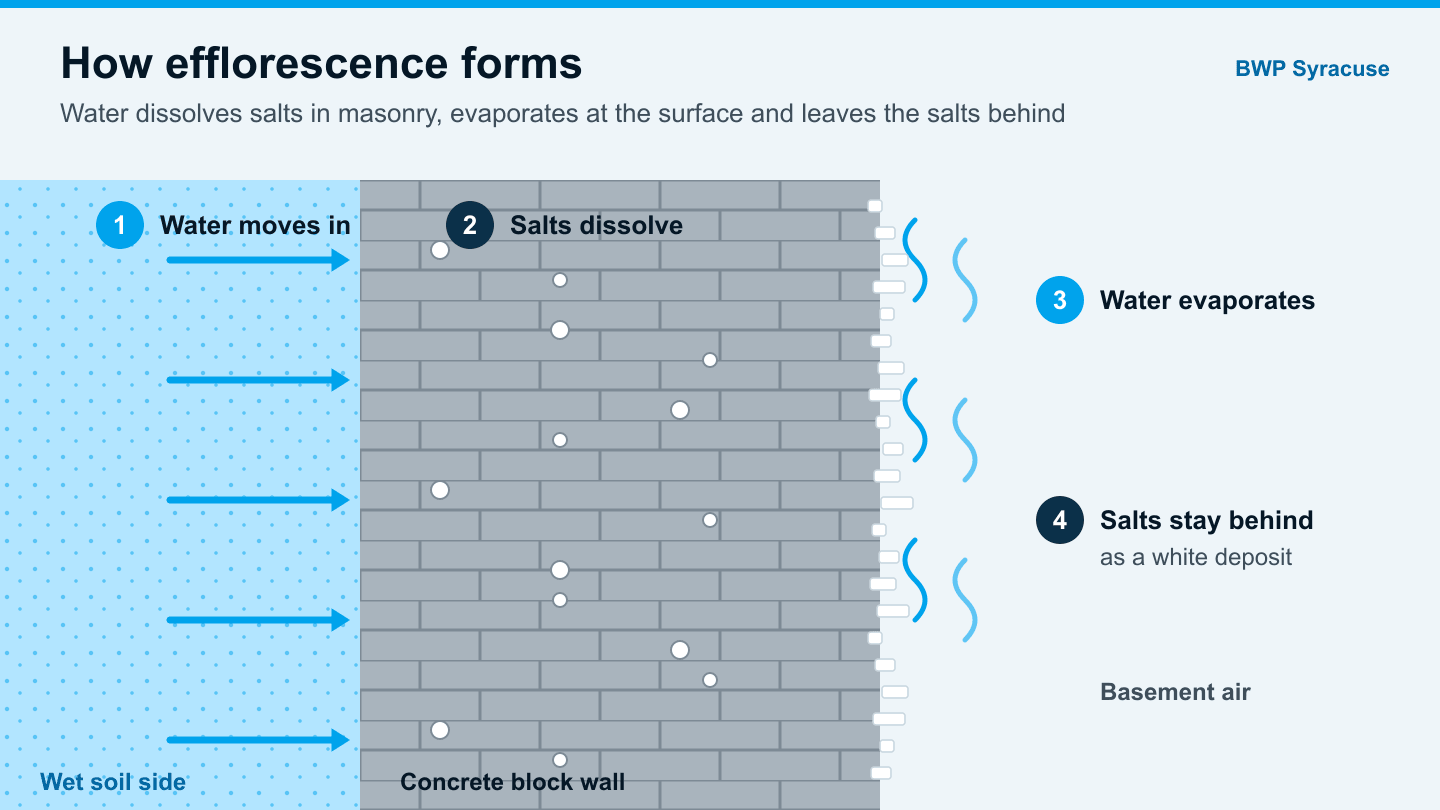
Efflorescence forms when water picks up soluble salts inside concrete, block, brick or mortar, carries them to the surface and evaporates, leaving the salts behind. The Brick Industry Association’s technical note on efflorescence causes and prevention (opens in a new tab) describes it as water containing dissolved salts brought to the surface of masonry, where the water evaporates and the salts remain.
In a basement, the water usually comes from damp soil against the outside of the wall, groundwater wicking up from the footing or water entering through a crack. Deposits often form a band near the floor, a streak below a crack or a haze along mortar joints, and they tend to return after cleaning as long as moisture keeps moving through the wall.
Surface efflorescence is generally a cosmetic concern for the wall itself, although salts crystallizing beneath the surface can contribute to flaking or spalling. It is a mineral deposit, not a living growth. The full explanation of how it forms, whether it harms masonry and how to clean it safely is in what efflorescence on basement walls means.
Why Mold Can Also Look White
Mold is not always black or green. Early growth, and growth on some surfaces, can look white, gray or pale and powdery. CDC’s mold overview (opens in a new tab) notes that mold can look like spots of many different colors and can smell musty.
The Brick Industry Association adds a caution from the masonry side: a number of stains that affect brick masonry are white in color and may be confused with efflorescence. White is a very weak clue in either direction.
Clue 1: What Surface Is It On?
The material underneath is one of the most useful clues.
Efflorescence needs masonry. It forms on concrete, concrete block, brick, stone and mortar, since those materials hold the soluble salts and let water move through them.
Mold needs something to feed on. Mold grows on organic material: the paper facing on drywall, wood framing and trim, cardboard, fabric, carpet, some paints and even dust and grime on a surface. Mold can appear on a concrete wall, but it typically grows on the dirt, dust or coatings on that concrete rather than on the bare mineral surface.
So white material on unpainted concrete or block is more often efflorescence. White material on drywall, wood, paper, insulation facing or a painted surface deserves more caution. This is a strong clue, not proof.
Clue 2: Texture and Shape
Look closely from a normal distance, with good light, without touching.
- Efflorescence usually looks crystalline, chalky or powdery. It can form a crust, fine needle-like crystals or a flat white haze. It often follows lines: mortar joints, the edges of a crack or a band at a consistent height.
- Possible mold usually looks fuzzy, cottony, spotty or patchy. It tends to form irregular colonies with soft edges, sometimes with slightly raised growth, and it can spread in circular patches rather than following a joint or crack.
Texture can be hard to judge on a thin deposit, and both materials can look similar at an early stage.
Clue 3: Moisture Patterns and Staining
Look at what is around the white material.
- A band along the base of the wall with a darker damp edge fits water wicking up from the footing, which fits efflorescence.
- A streak running down from a crack fits water entering at that crack and carrying salts.
- Water stains, bubbling paint or soft drywall around the white material point to a surface staying wet enough for growth.
- White patches on the lower part of drywall or baseboards after a leak or flood point toward mold.
- Growth on cold surfaces, such as pipes, the rim joist or exterior wall corners, fits condensation feeding mold.
Clue 4: Recurrence and Humidity
Both materials come back, but on different triggers. Efflorescence tends to reappear after wet periods, such as the spring thaw, in the same pattern along joints and cracks. Mold tends to return and spread in areas that stay damp or humid, and it often comes with a musty odor.
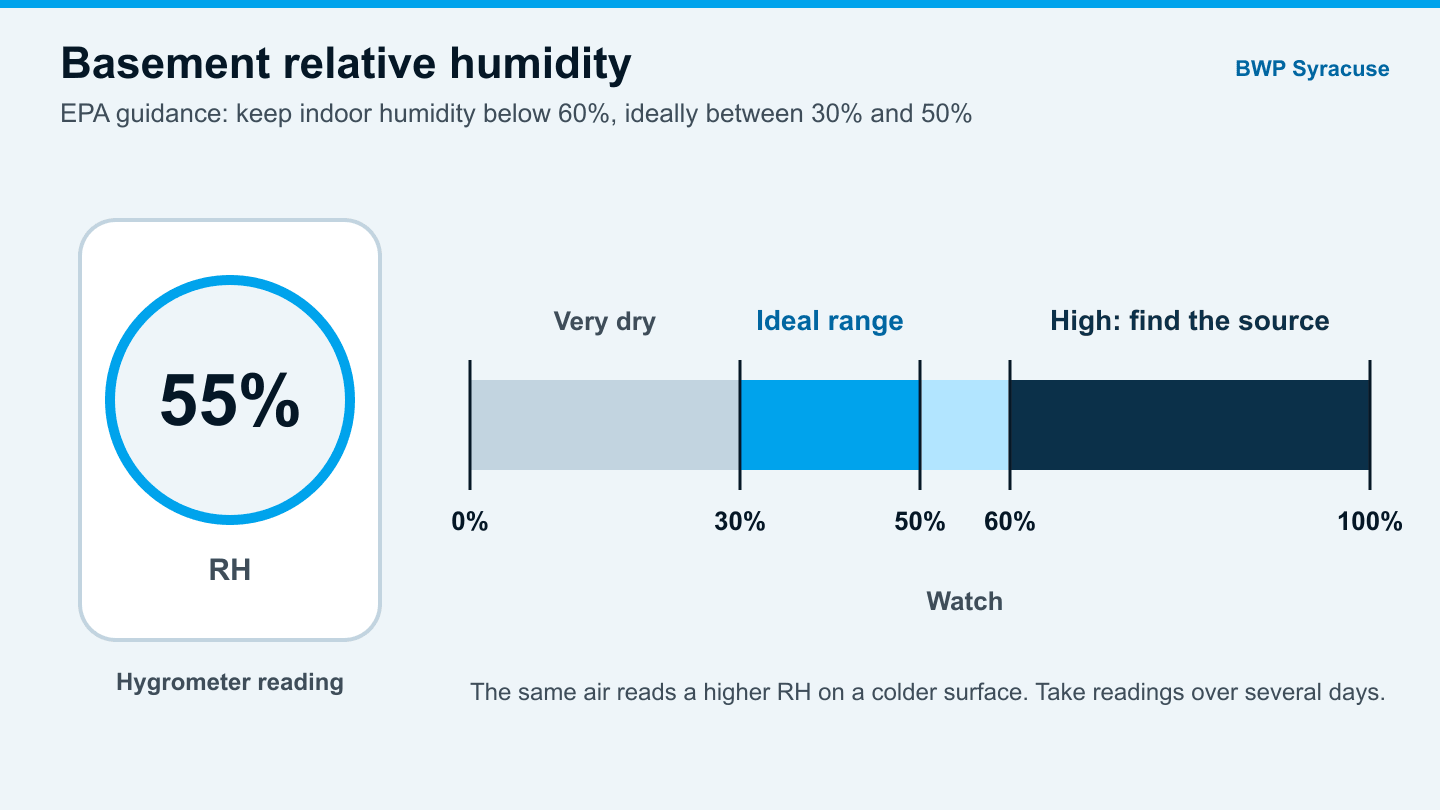
Basement humidity helps separate the two. Readings that stay above 60 percent for long periods make mold more likely on organic surfaces, and EPA guidance recommends keeping indoor humidity below 60 percent, ideally between 30 and 50 percent. How to measure that properly is in the guide to ideal basement humidity.
Efflorescence vs Possible Mold: Side by Side
No single row below proves what the material is. Several clues pointing the same way are much more reliable than any one of them.
| Feature | Efflorescence | Possible mold |
|---|---|---|
| Common surface | Bare concrete, block, brick, stone and mortar | Drywall paper, wood, cardboard, fabric, insulation facing, paint or dust on a surface |
| Appearance | White or grayish, often in bands, streaks or along joints and cracks | White, gray, green, black or other colors, often in spots or irregular patches |
| Texture | Chalky, powdery or crystalline, sometimes a hard crust | Often fuzzy, cottony or soft, sometimes flat and powdery early on |
| Moisture relationship | Forms where water moves through masonry and evaporates | Grows where a surface stays damp or humidity stays high |
| Health concern | Soluble salt deposits are described by NDSU Extension as harmless from a human health standpoint | Mold exposure can affect some people’s health, and color does not indicate how harmful it is |
| Does cleaning solve the source? | No, it returns while moisture keeps moving through the wall | No, it returns while the surface stays damp |
| Next step | Find the moisture path, then dry brush | Fix the moisture, avoid disturbing large areas, follow EPA cleanup guidance |
What You Can Safely Check
These checks are observations, not laboratory tests. Stop and treat the material as possible mold if you are unsure at any point.
- Observe without touching. Use a flashlight held at a low angle to see texture, and photograph the area with the date.
- Note the surface. Bare masonry, paint, drywall, wood or something stored against the wall.
- Check the surroundings. Look for damp edges, water stains, cracks above the deposit and soft or bubbling materials nearby.
- Measure the basement humidity for several days.
- Watch for return. On bare masonry only, gently dry brush a small area of what appears to be efflorescence while wearing gloves and eye protection, photograph it and see whether it returns after the next wet period.
The water and vinegar check, and its limits
NDSU Extension’s article Is It Mold or Isn’t It? (opens in a new tab) describes putting a few drops of water on the substance as one way to determine whether it is salt or mold. It explains that some salt deposits dissolve in water, while carbonate deposits cannot be removed effectively with water alone and respond to vinegar instead. It also states that if the substance does not dissolve in either water or vinegar, it may be mold.
“May be” is the important phrase. This check is a clue. A deposit that does not dissolve is not proven to be mold, and a thin film of growth mixed with dust will not always behave predictably. Only try it on a small area of bare masonry, wearing gloves, and skip it entirely if the material is fuzzy or growing on drywall, wood or paper.
What You Should Not Disturb
EPA’s brief guide to mold, moisture and your home (opens in a new tab) advises avoiding touching mold or moldy items with bare hands, and recommends an N-95 respirator, gloves and goggles without ventilation holes during cleanup. Before you know what the white material is:
- Do not smell it up close to check whether it is mold.
- Do not touch or rub it with bare hands.
- Do not dry brush or scrape material that might be mold, since that can release spores and fragments into the air.
- Do not tear out drywall or carpet to look for more growth without protection and a plan.
- Do not mix cleaning products. EPA warns never to mix chlorine bleach with cleaners that contain ammonia, since toxic fumes can be produced.
- Do not take samples of large growth yourself.
When Visible Mold Can Be Handled Without Testing
If the clues point to mold, testing is usually not the next step. EPA guidance says that in most cases, if visible mold growth is present, sampling is unnecessary. CDC’s mold cleanup guidelines (opens in a new tab) call for protective equipment, including at least a NIOSH-approved N95 respirator, and advise that people with asthma, COPD or weakened immune systems should not do the cleanup themselves.
EPA guidance says that if the moldy area is less than about 10 square feet, roughly a 3 foot by 3 foot patch, in most cases you can handle the job yourself following its guidelines. Porous materials such as ceiling tiles and carpet that stay moldy may need to be thrown away.
When Professional Help Makes Sense
Bring in help when:
- The suspected growth covers more than about 10 square feet.
- The material is inside wall cavities, under flooring or in HVAC ducts.
- The area was wet from sewage or contaminated floodwater.
- Anyone who would do the cleanup has asthma, allergies, COPD or a weakened immune system.
- You cannot tell what the material is, and it keeps spreading.
- The white deposits keep returning on masonry, pointing to an ongoing water path.
The right professional depends on the problem. Large mold growth calls for a mold remediation company. Recurring efflorescence and damp walls call for a moisture inspection to find where the water is coming from. Any health symptoms belong with a healthcare professional.
Why Bleach Is Not a Diagnosis or a Moisture Fix
Bleach changes the appearance of a surface, which makes it tempting as both a test and a treatment. It is neither. Bleach does not identify what the white material is, and it does nothing to stop water reaching the wall. On masonry, adding a wet chemical solution puts more water into the wall, which can feed more efflorescence later.
EPA states that the use of a biocide such as chlorine bleach is not recommended as a routine practice during mold cleanup. CDC advises that if bleach is used, the solution should be no more than 1 cup of bleach in 1 gallon of water, and that bleach should never be mixed with ammonia or any other cleanser.
What Does Not Work
- Treating white material as mold based only on color. Efflorescence and several other white deposits look similar, and a mold remediation bill for a salt deposit fixes nothing.
- Assuming white material is safe because it looks like efflorescence. Growth on drywall, wood or paint deserves caution regardless of color.
- Painting over either one. Paint covers the deposit or growth temporarily while moisture keeps arriving from behind.
- Cleaning without fixing the moisture. EPA states that if you clean up mold but do not fix the water problem, the mold problem will most likely come back, and efflorescence behaves the same way.
The Water Source Matters Either Way
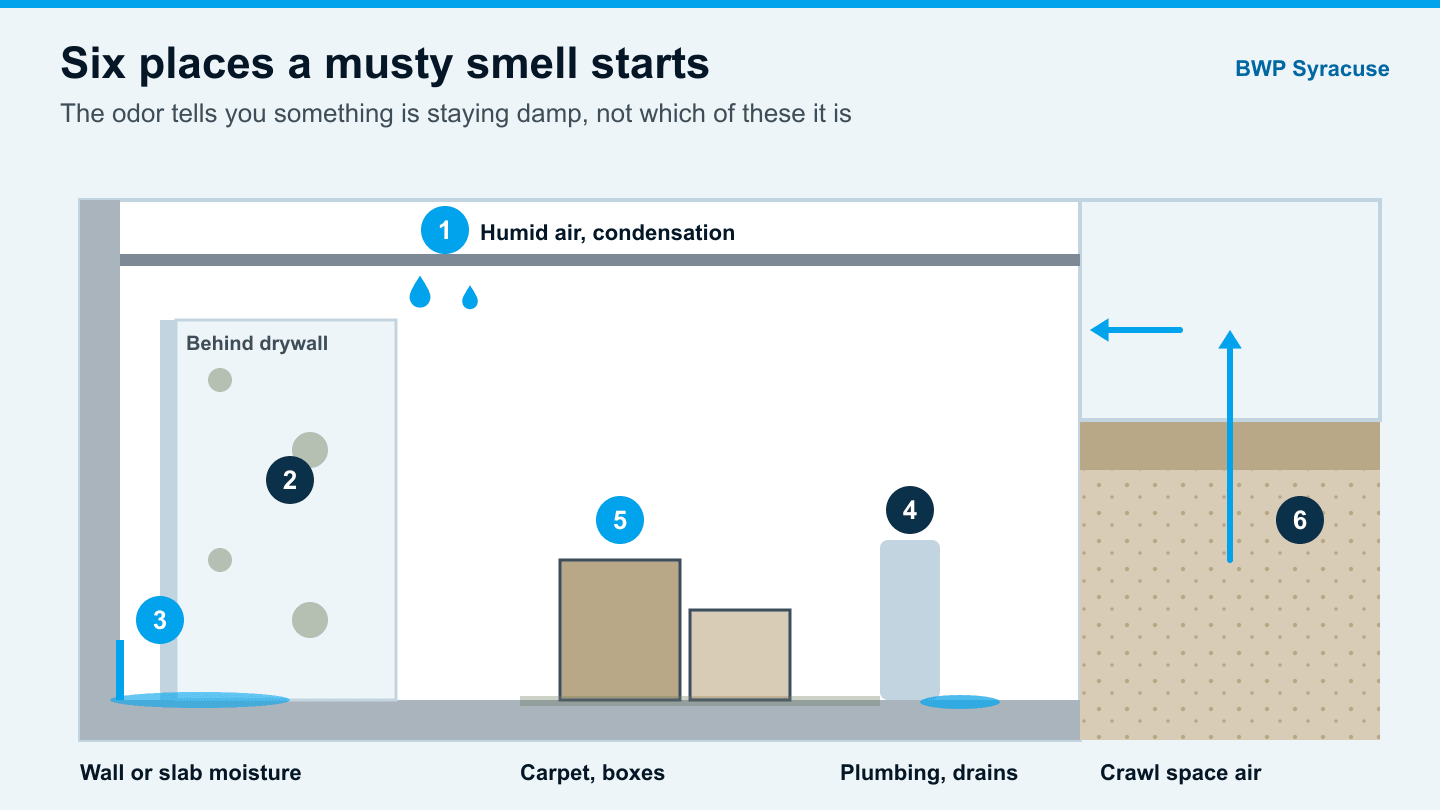
Efflorescence and mold both point back to moisture. A band of salt along the floor line may mean water wicking up from the footing or seeping at the seam. White growth on drywall may mean hidden seepage behind the wall or humidity condensing on a cold surface. A musty odor alongside either one is another sign that something is staying wet, and the six causes of a musty basement smell covers where that moisture usually hides. For the wider picture of what a basement shows before water collects, compare notes with the nine early signs a basement gives.
If the white material keeps returning and you cannot tell whether moisture is wicking through the wall, entering at a crack or condensing on the surface, a free moisture inspection can trace the water path before you choose between cleaning, remediation or a foundation repair.
Ask Why the Surface Is Wet
“What is the white material?” is a reasonable first question, and surface, texture, pattern and recurrence usually answer it better than color does. The more useful question is why this surface is staying wet enough for the material to appear. Answer that one, and the white powder on the basement wall stops coming back, whichever kind it turns out to be.
Frequently Asked Questions
Is white mold dangerous?
White mold is not automatically less harmful than mold of other colors. CDC NIOSH guidance states that the color of mold does not necessarily indicate whether it is more or less dangerous. Treat visible growth of any color as a moisture problem to fix, follow EPA cleanup guidance for small areas, and talk to a healthcare professional about any health concerns.
Should I test the white stuff on my basement wall for mold?
Usually not. EPA guidance says that in most cases, if visible mold growth is present, sampling is unnecessary, and CDC does not recommend routine mold testing. Fixing the moisture source and cleaning up small areas properly matters more than identifying the species. Professional sampling can make sense in specific investigations, such as hidden growth.
Can I use vinegar or bleach on white powder on a basement wall?
Dry brushing is the recommended first step for efflorescence, and bleach is not a routine mold treatment. Masonry guidance treats acids as a last resort that needs care, and EPA does not recommend biocides such as chlorine bleach as a routine practice in mold cleanup. If bleach is used, CDC advises no more than 1 cup per gallon of water, and bleach must never be mixed with ammonia or other cleaners.
Why does the white powder keep coming back?
The white powder comes back because water keeps reaching the wall. Efflorescence returns as long as moisture carries salts to the surface, and mold returns as long as a surface stays damp. EPA notes that if mold is cleaned up but the water problem is not fixed, the mold will most likely come back.
Can efflorescence and mold appear on the same wall?
Yes, both can appear in the same damp area, since both depend on moisture. Efflorescence might form on the concrete while mold grows on nearby drywall, paint, wood or dust. That is one more reason to identify the moisture source rather than treating the white material alone.
Does white powder on a basement wall mean the foundation is failing?
No, white mineral powder on its own is not a sign of structural failure. It shows that water has been moving through the concrete and leaving salts behind. Cracks that are widening, walls that bow inward or floors that shift are the structural signs to look for instead.
How quickly does white powder come back after cleaning?
It can return within days or weeks if water is still moving through the wall, often after the next heavy rain or during the spring thaw. If it does not come back after a full season, the moisture source has likely eased. Noting the date you cleaned it makes that easy to track.