Our emergency call volume multiplies by roughly six between late February and April. Syracuse gets around 127 inches of snow a year, more than any other major city in the country, and most of it leaves in a three-week window. That number comes out of NOAA’s climate records (opens in a new tab), and the reason behind it is lake-effect snow (opens in a new tab) off Lake Ontario. A meaningful share of those calls trace back to something that would have taken ten minutes to check in November.
Here is the walkthrough. Give it forty-five minutes on a dry weekend before the ground freezes, and watch the melt timing on the National Weather Service office that forecasts for Syracuse (opens in a new tab).
Outside the house
Clean the gutters properly. Not just the troughs, flush the downspouts until water runs freely out the bottom. A gutter packed with maple leaves in November becomes an ice dam (opens in a new tab) in January and a waterfall against your foundation in March.
Extend every downspout to eight feet minimum. Ten is better. This is the single highest-value item on this list and it costs about fifteen dollars per downspout. Then check that the discharge end is not buried in the snowbank you will pile there, a downspout draining into a snowdrift against the wall is worse than no downspout at all.
Check the grade. Soil should fall roughly one inch per foot for the first six feet from the wall. Settled soil next to the foundation becomes a meltwater pond in March. Add soil, not mulch, which holds water and freezes solid. If you want to know what you are working with, the USDA Web Soil Survey (opens in a new tab) will tell you how much dense clay (opens in a new tab) sits under your address, and clay is why meltwater here travels sideways instead of draining down.
Look at the window wells. They should have drainage stone at the bottom and covers on top. A well full of leaves and snow is a bucket held against your basement window. If one has already let water in, what to check on a leaking window well walks through it.
Plan where the snow goes. Whoever shovels your drive is making a waterproofing decision. Do not pile snow against the foundation, and keep it off the septic field and away from the sump discharge line. A buried outlet is one of the usual ways a sump pump discharge line freezes.
Inside the basement
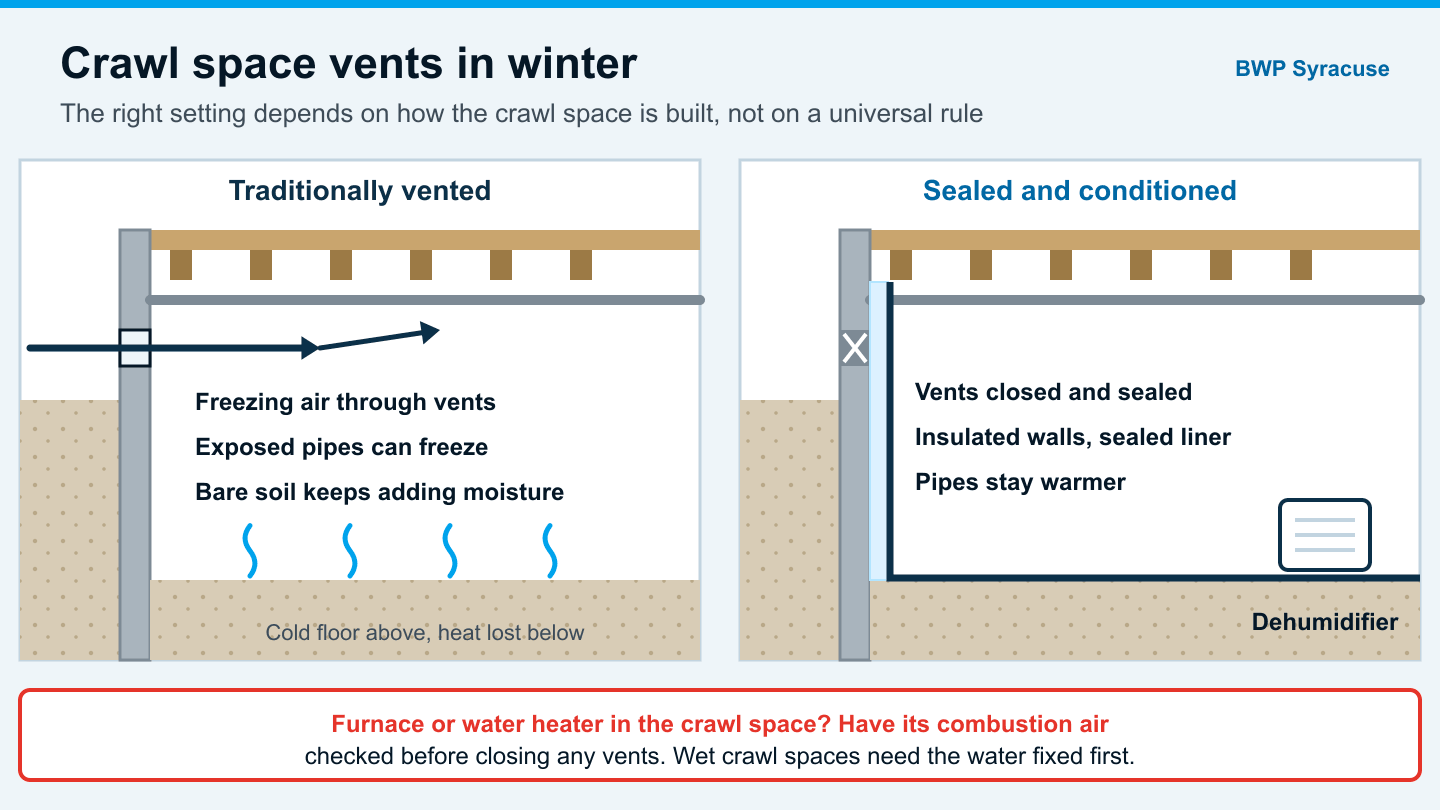
Walk the crawl space, if you have one. Take a flashlight and look at the joist ends where they bear on the sill plate (opens in a new tab), that is where rot starts and where it matters most. Press a screwdriver into anything dark or soft. If it goes in without resistance, that joist has lost section, and that is a crawl space repair rather than a maintenance item.
Check what the insulation is doing. Fiberglass batts hanging down or lying in the dirt are finished. They hold water, have lost all R-value (opens in a new tab), and are feeding whatever is growing down there. The Department of Energy’s Energy Saver guidance (opens in a new tab) covers what should replace them, and sealing the space properly is what stops it happening again.
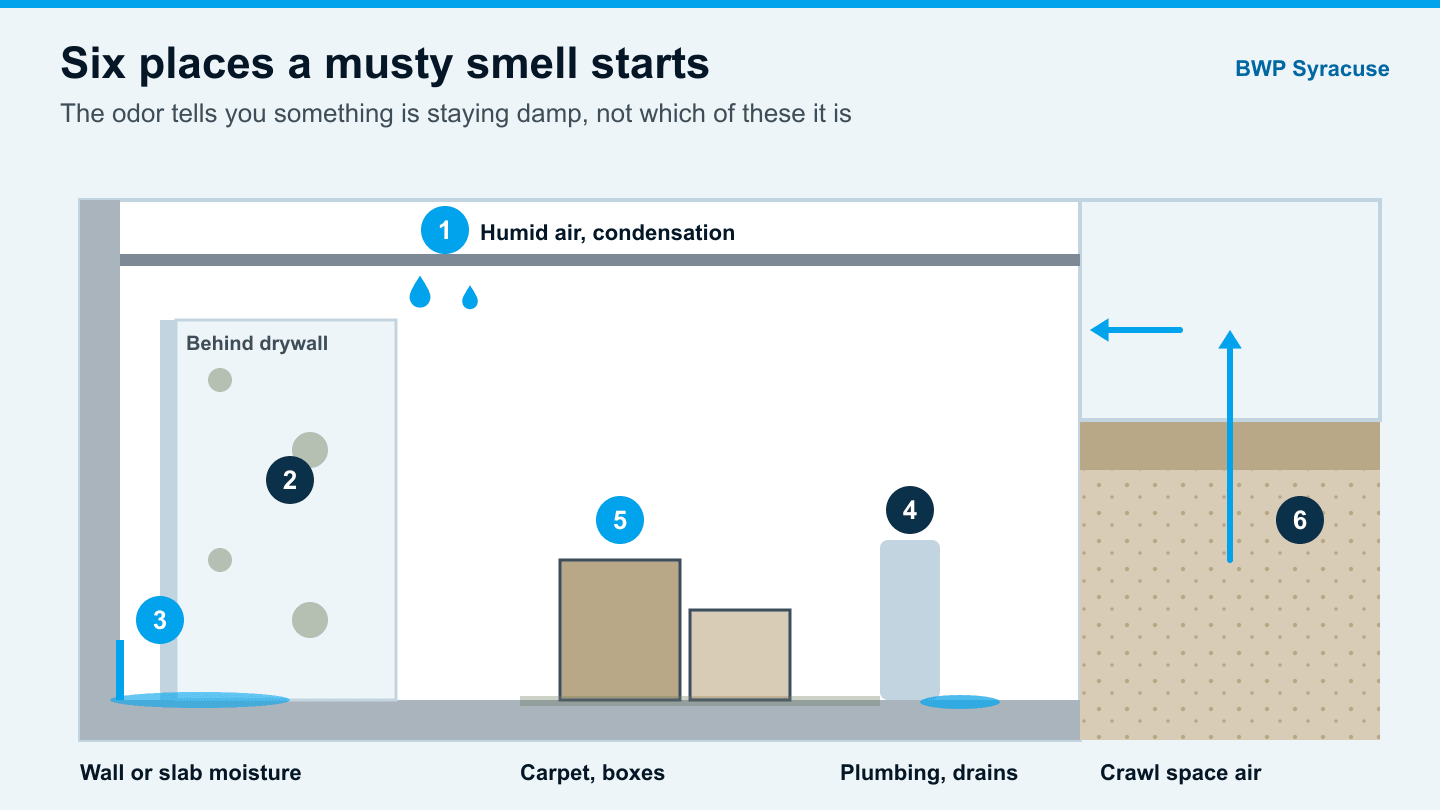
Look at the cove joint with a flashlight. The seam where the basement wall meets the floor is the single most common entry point in Syracuse. A dark line there is rarely condensation (what the cove joint is telling you covers the look-alikes), and telling a crack problem from a pressure problem is the next thing to work out.
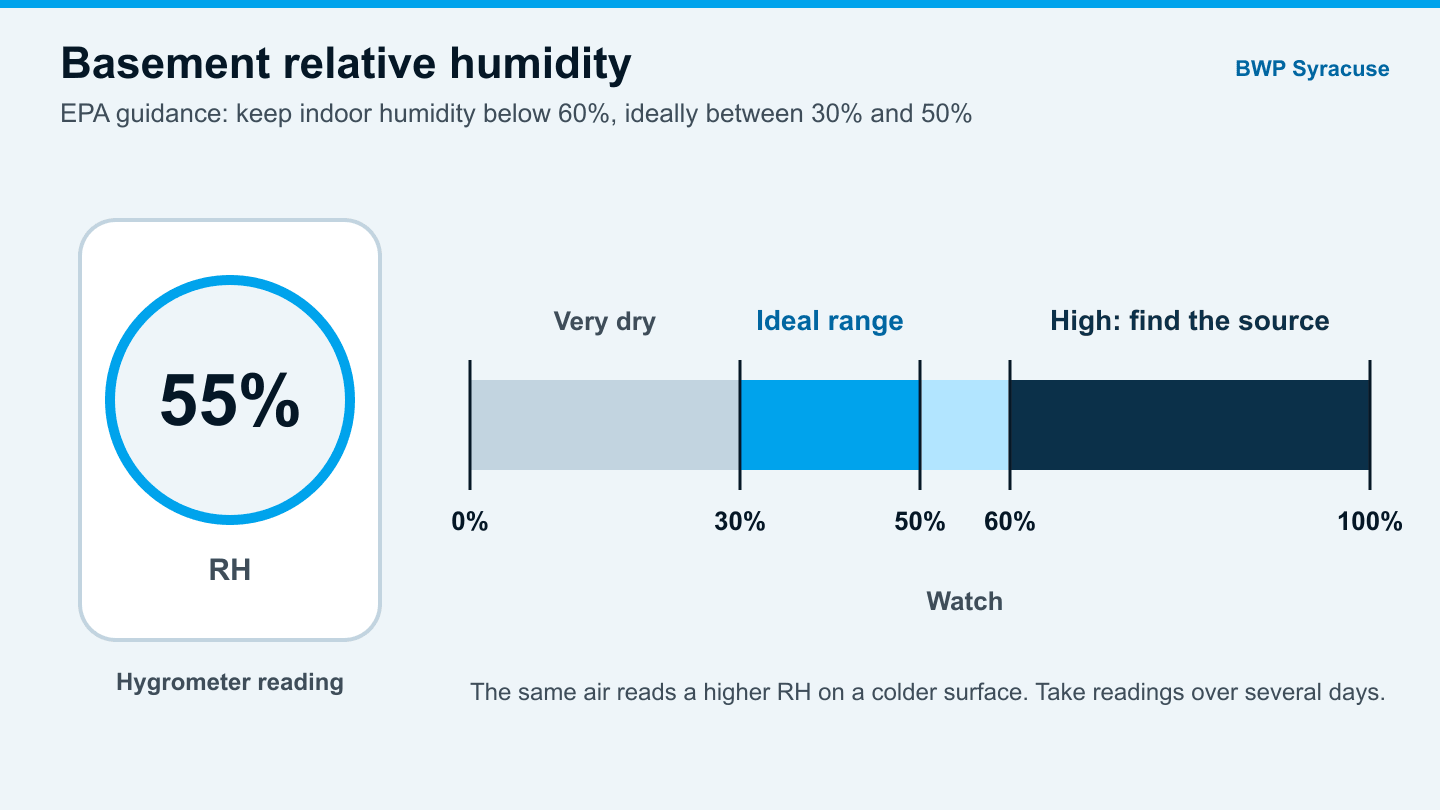
Read the humidity. A $12 hygrometer tells you what is coming, as long as it is placed away from the dehumidifier and read over several days, which the guide to ideal basement humidity explains. Under 50% is where you want to be. Staying above 60% makes mold growth more likely, and 60% is the same upper limit the EPA’s brief guide to mold, moisture and your home (opens in a new tab) draws.
Walk the perimeter with a flashlight. Look at the cove joint, look for efflorescence on the basement walls, look for new cracks. Photograph anything you find, dated, so next year you have a comparison. The nine early signs are the list to check it against.
Buy this one thing
A Wi-Fi water sensor on the basement floor, about $20. It texts you when the floor gets wet. Every catastrophic basement flood we have responded to was made worse by nobody knowing for hours or days. Twenty dollars buys you that phone call.
When to bring us in
Call in the fall, not during the thaw, if you see any of these:
- Efflorescence that returns after you clean it off
- A cove-joint stain that darkens after rain or snowmelt
- Any crack that has visibly widened since last year, which usually means injection while it is still small
- Floors above a crawl space that flex when you walk on them
- Humidity above 60% with a dehumidifier already running
- A wall that looks like it is bowing inward at all, which needs a structural evaluation first, as the bowing basement wall guide explains
November diagnosis is calm, cheap and scheduled. March diagnosis is none of those things. Book the free inspection while the ground is still soft, and if you want to see what the work looks like on a real house first, the project write-ups have the before and after numbers. Budgeting is easier in the autumn too, and the 2026 cost article gives you the ranges without having to ask anybody.