Should crawl space vents be open or closed? It depends on how the crawl space was designed, how wet it is and what equipment sits inside it. A crawl space built or converted to be sealed and conditioned should keep its vents closed all year, while a traditionally vented crawl space is often closed or covered for the coldest months and managed carefully the rest of the time.
There is no single rule that fits every house, and anyone offering one without asking about your crawl space is guessing. What matters is what winter air does under a floor, why shutting vents on a wet crawl space backfires and what equipment is down there.
What Crawl Space Vents Were Supposed to Do
Foundation vents are the small screened openings in the walls of a crawl space, usually just above the ground outside. The idea behind them was simple: let outside air move through the space so moisture rising from the soil would be carried away before it could soak the wood.
That logic works only when the outside air is drier than the crawl space air. The Department of Energy’s Building America program summarizes the problem with vented crawl spaces (opens in a new tab) plainly: the air from outside is often more moist than the air in the crawl space, which can lead to structural, mold and pest problems. DOE also notes that this research fed into changes in the International Residential Code that allow unvented, conditioned crawl spaces.
So there are now two legitimate designs:
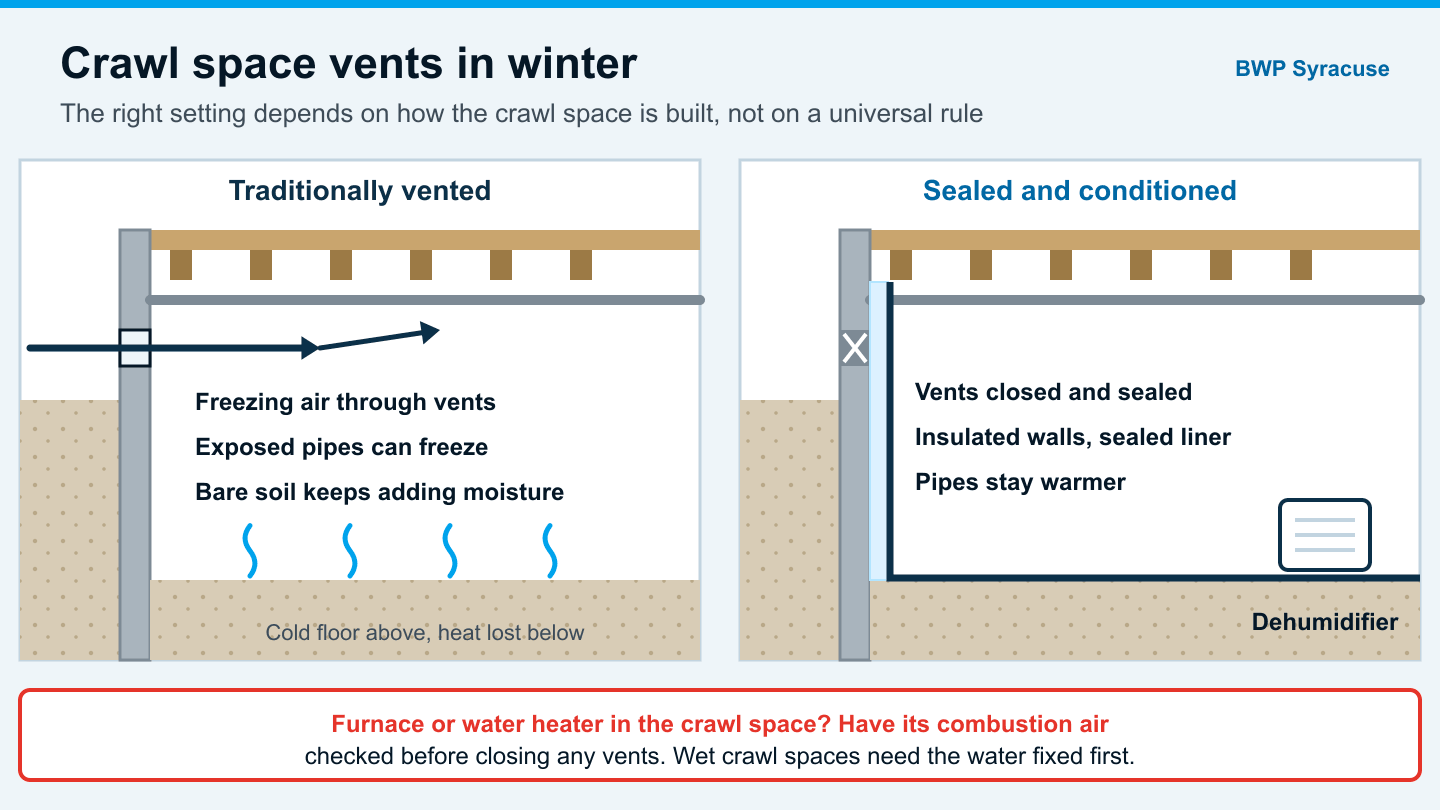
- A traditionally vented crawl space. Open to outside air through vents, usually with insulation between the floor joists above and, ideally, a plastic ground cover on the soil.
- A sealed, conditioned crawl space (often called unvented or encapsulated). Vents are closed and sealed, the soil is covered with a continuous vapor barrier, the walls are insulated and air sealed, and the space has a way to remove moisture.
The right setting for your vents follows from which of those two you actually have.
What Winter Air Does in a Vented Crawl Space
In a Syracuse winter, open vents pull frigid air under the house. That causes three problems.
Frozen pipes. Supply lines running through a vented crawl space sit in air that can drop far below freezing on a windy January night. Pipes near the vents, the rim joist (the band of framing that sits on top of the foundation wall) and the access door are the most exposed. A pipe that freezes and splits often goes unnoticed until the thaw, when water runs into the crawl space or the floor above.
Cold floors. Cold air moving across the underside of the floor makes the rooms above feel colder at foot level. Floor insulation helps, but gaps, sagging batts and wet insulation reduce what it can do.
Heat loss. Ducts, a furnace or a water heater in a vented crawl space lose heat to that cold air. Any air leaks through the floor also let warm house air escape downward and cold air move up.
That is why closing or covering vents for the coldest months has long been common practice in cold climates, even for crawl spaces designed to be vented.
What Summer Air Does in a Vented Crawl Space
The summer problem runs the other way. Warm, humid air comes in through the vents and meets surfaces that are cooler than the air: cold water pipes, air conditioning ducts, the subfloor above an air-conditioned room and framing near the soil.
When air touches a surface below its dew point (the temperature at which water vapor turns to liquid), water condenses on that surface. This is how a vented crawl space can get wetter in July than in January. Dripping ducts, damp insulation and beads of water on pipes are the usual signs.
That summer pattern is a big reason building science has moved toward sealed, conditioned crawl spaces.
Why Closing Vents on a Wet, Unsealed Crawl Space Doesn’t Fix It
This is the mistake to avoid. Closing vents changes where the air comes from. It does nothing about where the water comes from.
A crawl space with bare soil, puddles after rain or a dripping pipe is producing moisture every day. Bare ground keeps evaporating water into the air. Closing the vents on that space traps the moisture inside, and humidity can climb higher than it was with the vents open. Wood, insulation and stored items stay damp longer, and conditions for mold improve rather than worsen.
Building Science Corporation’s article on crawl spaces, Crawlspaces: Either In or Out (opens in a new tab), makes the point that a crawl space connected to the house needs a means of removing moisture, just like any room in the house, either through conditioned air or a dehumidifier. DOE’s Building America guidance on insulating crawl space floors (opens in a new tab) adds that whether or not the crawl space is part of the conditioned space, it must always have a ground cover that prevents evaporation of ground moisture.
In practice, a sealed crawl space that works has four parts working together:
- Liquid water is handled first, through gutters, grading, plumbing repairs or a drain and sump.
- The soil is covered with a continuous vapor barrier, sealed at seams, walls and piers.
- The walls and rim joists are insulated and air sealed, and the vents are closed.
- Moisture has a way out, usually a dehumidifier or a small supply of conditioned air.
Skip the first two and closed vents become a lid on a wet box. If your crawl space holds water, standing water in a crawl space covers how to trace the source before any sealing happens.
Combustion Appliances: Check Before You Seal Anything
Some crawl spaces hold a furnace, boiler or water heater that burns gas, propane or oil. Many of these appliances draw the air they need for burning, called combustion air, from the space around them. Manufacturer installation instructions specify how that air must be supplied, and in some installations the vents are part of that supply.
Closing or sealing vents around an appliance that depends on them can starve it of air. That can cause poor burning and backdrafting, where exhaust gases, including carbon monoxide, spill into the crawl space instead of going up the flue and outside. In a crawl space connected to the house, that air can reach the rooms above.
If any fuel-burning equipment sits in your crawl space:
- Don’t close or block vents until a qualified heating contractor has confirmed how that appliance gets its combustion air.
- Expect equipment changes if the space is being sealed. Sealed-combustion appliances, which draw outside air through their own pipe, are designed for this situation.
- Keep working carbon monoxide alarms on each level of the house, as the alarm manufacturer directs.
Should Crawl Space Vents Be Open or Closed This Winter? A Decision Guide
Goal: decide what to do with your vents before sustained freezing weather, without trapping moisture or creating a combustion hazard.
Do the first steps from outside or from the access opening with a flashlight. Don’t crawl in if you see standing water near wiring, smell sewage, feel the air is unsafe or see sagging or broken framing.
- Identify what you have. Look through the access opening. Is the soil bare, covered with loose plastic or covered by a sealed liner running up the walls? Are the walls insulated? Is there a dehumidifier? A sealed liner, insulated walls and a dehumidifier mean the space was designed to run closed.
- Check for fuel-burning equipment. Look for a furnace, boiler or water heater with a flue pipe. If you find one, stop here for vent changes and talk to a heating contractor.
- Check for liquid water. Look for puddles, wet soil, water on top of plastic, dripping pipes or a water line on the walls.
- Check humidity signs. Note damp or sagging insulation, water beads on ducts or pipes, a musty smell or white mold-like growth on wood.
- Check pipes. Note supply lines near vents, the rim joist or the access door, and whether they are insulated.
How to read the result:
| What you found | What it usually means | Reasonable winter step |
|---|---|---|
| Sealed liner, insulated walls, dehumidifier, no fuel-burning equipment | Designed to run closed | Keep vents closed and sealed year-round |
| Vented design, dry soil under intact plastic, no fuel-burning equipment | Traditional vented crawl space in decent shape | Close or cover vents for the coldest months, insulate exposed pipes, reopen or reassess in spring |
| Bare soil, damp insulation or condensation, no standing water | Moisture problem in a vented space | Cover the soil first, then plan a sealed approach rather than simply shutting vents |
| Standing water or wet soil after rain | Liquid water entering | Find and fix the water source before changing vents |
| Furnace, boiler or water heater present | Possible combustion air dependency | No vent changes until a heating contractor checks combustion air |
When to call a professional: if there’s standing water, fuel-burning equipment, visible rot or growth on the framing, pipes that have frozen before, or you want to convert to a sealed crawl space. A conversion involves water management, insulation and moisture removal, and may involve your local building department.
How This Fits a Sealed, Conditioned Crawl Space
When a crawl space has been sealed and conditioned properly, the vents stay closed in this climate in summer and winter alike. That is how crawl space encapsulation is designed to work here: the liner, wall and rim joist sealing and a dehumidifier hold the crawl space close to indoor conditions, so there is no reason to let outside air in. Pipes stay warmer, floors feel warmer and summer condensation has no humid air to feed on.
Closed vents are the last step of a sealed crawl space, not the first. Damaged framing comes before any of it, which is where crawl space repair fits.
Common Mistakes With Crawl Space Vents
- Shutting vents on a wet crawl space and calling it fixed. The water source is still there, and the moisture now has fewer ways out.
- Opening vents wider in humid weather to dry the space. Humid summer air adds moisture to cool surfaces.
- Stuffing vents with insulation and forgetting about it. Loose batts get wet, fall out and block nothing well. Purpose-made covers or a planned sealing job work better.
- Ignoring the furnace or water heater. Combustion air is a safety issue, not a comfort setting.
Where to Go From Here
If your crawl space is dry and you only want to protect pipes this winter, covering the vents and insulating exposed pipes is a reasonable seasonal step for a vented design. If it’s damp, smells or holds water, the vents are a symptom of a bigger moisture question, and the full guide to crawl space moisture walks through the sources and the fixes. Suspected growth on joists is covered in mold in a crawl space.
If you want someone to look at the crawl space before the first freeze, a free inspection covers the water, the vents and any equipment down there.
A vent is only as good as the crawl space behind it, so decide what the space is meant to be before you decide whether the vents stay open.
Frequently Asked Questions
Should I close my crawl space vents in the winter?
In a cold climate, closing or covering the vents for the coldest months is common practice in a traditionally vented crawl space, mainly to protect pipes and keep floors warmer. Before you do it, confirm there is no fuel-burning furnace, boiler or water heater down there that depends on that air, and plan to reopen or manage the space when the weather turns.
Will closing crawl space vents cause mold?
Closing vents on a crawl space that has bare, wet soil or standing water can trap that moisture. Closing vents works as part of a design that also covers the ground, seals the walls and gives the space a way to remove moisture, such as a dehumidifier or a small supply of conditioned air. Vents alone are not what keeps a crawl space dry.
Should crawl space vents be open in summer?
In humid summer weather, outdoor air can carry more moisture than the crawl space air, and that moisture can condense on cool pipes, ducts and framing. That is why building science research has moved toward closed, conditioned crawl spaces in humid conditions. A vented crawl space that is staying dry and sound is not automatically a problem, though, so watch for condensation, damp insulation and musty air.
Are vent covers enough to protect pipes from freezing?
Covers help by cutting the flow of cold air, but they are not a guarantee. Pipes near the rim joist, near an access door or in a crawl space with gaps in the walls can still freeze. Insulating exposed pipes and sealing obvious air leaks reduces the risk further, and a plumber can advise on pipes that have frozen before.
Do I need permission to seal my crawl space vents?
Building codes address both vented and unvented crawl spaces, and the details depend on the code your town has adopted. Check with your local building department before converting a vented crawl space to a sealed one, especially if the work involves insulation, mechanical equipment or changes to combustion air.