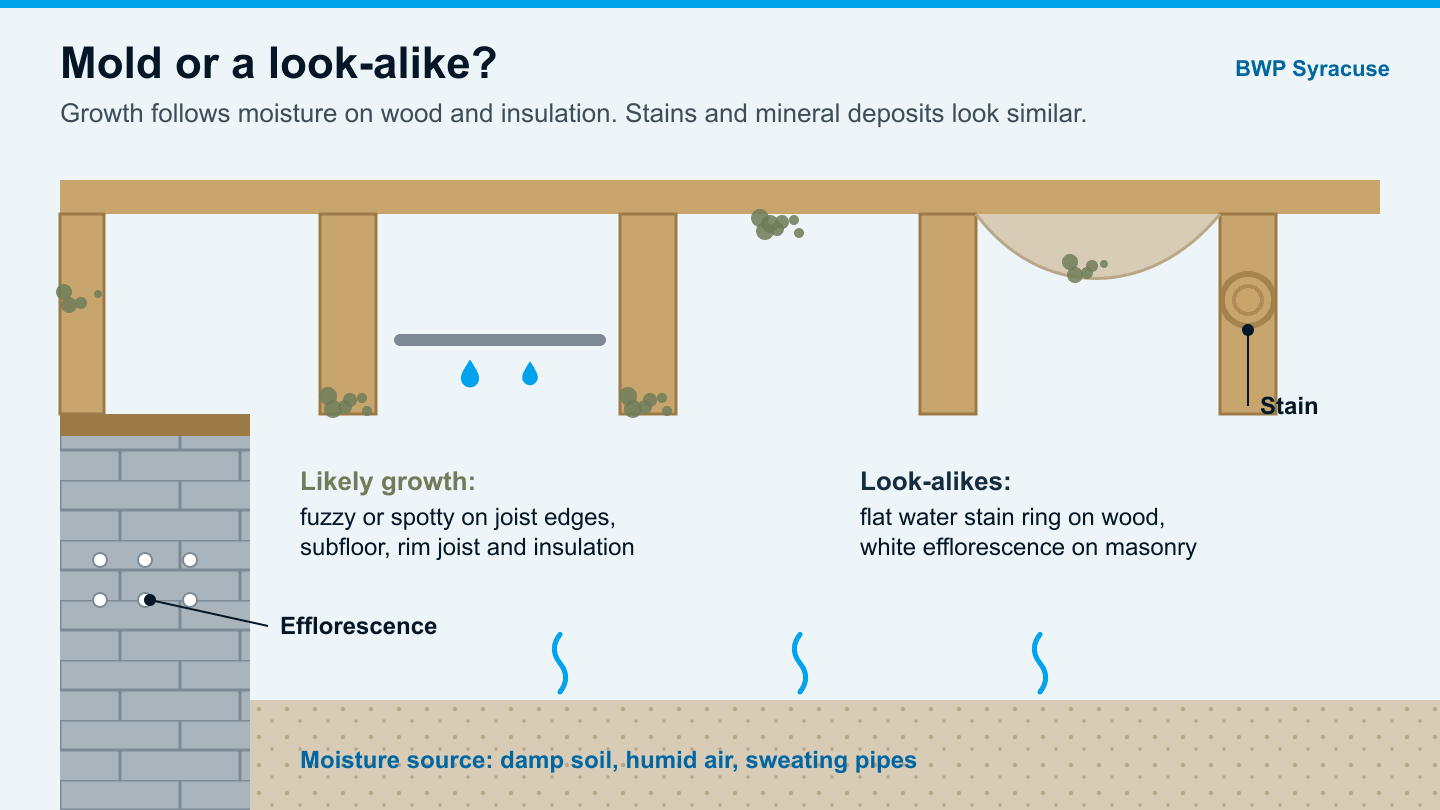
Mold in a crawl space grows wherever wood, insulation or debris stays damp long enough, most often on the floor joists, the underside of the subfloor and the rim joist near the foundation. The growth is a symptom: the moisture that feeds it has to be found and controlled first, or cleaning only buys time.
Not everything that looks like mold is mold. Water stains, efflorescence (white mineral deposits left by evaporating water) and even dust can look similar from the access opening, and the size of the affected area decides whether cleanup is a homeowner job or a professional one.
What Makes a Crawl Space a Good Place for Mold
Mold needs moisture, a food source and a suitable temperature. Wood framing, paper facing on insulation, cardboard and dust all count as food, and a crawl space is rarely too cold or too warm for long. Moisture is the one condition you can realistically control, which is why EPA’s brief guide to mold, moisture and your home (opens in a new tab) says the key to mold control is moisture control.
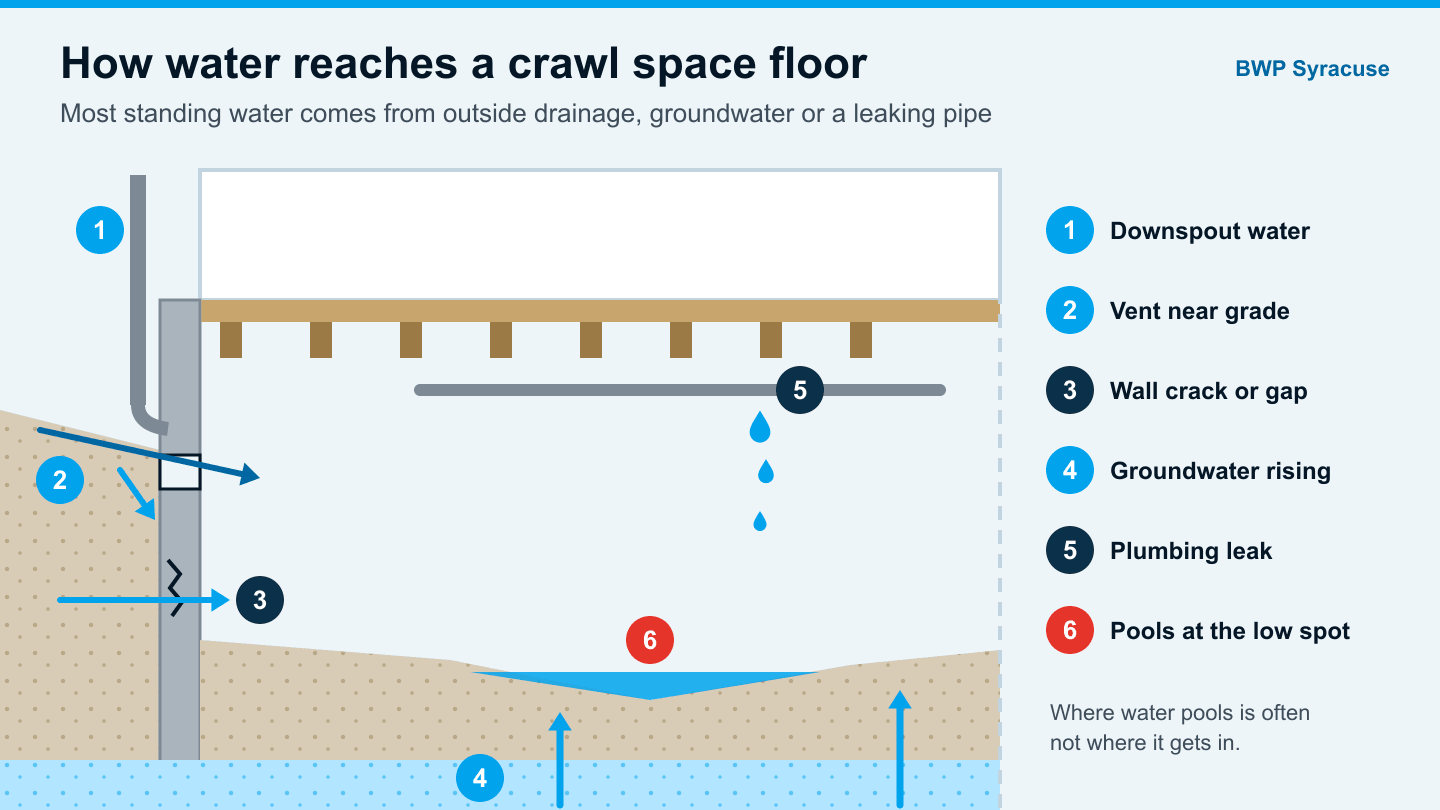
Crawl spaces get that moisture from several directions:
- Liquid water from poor outside drainage, groundwater or plumbing leaks. If water pools on the floor, start with standing water in a crawl space.
- Evaporation from bare soil, which keeps adding water vapor to the air under the house.
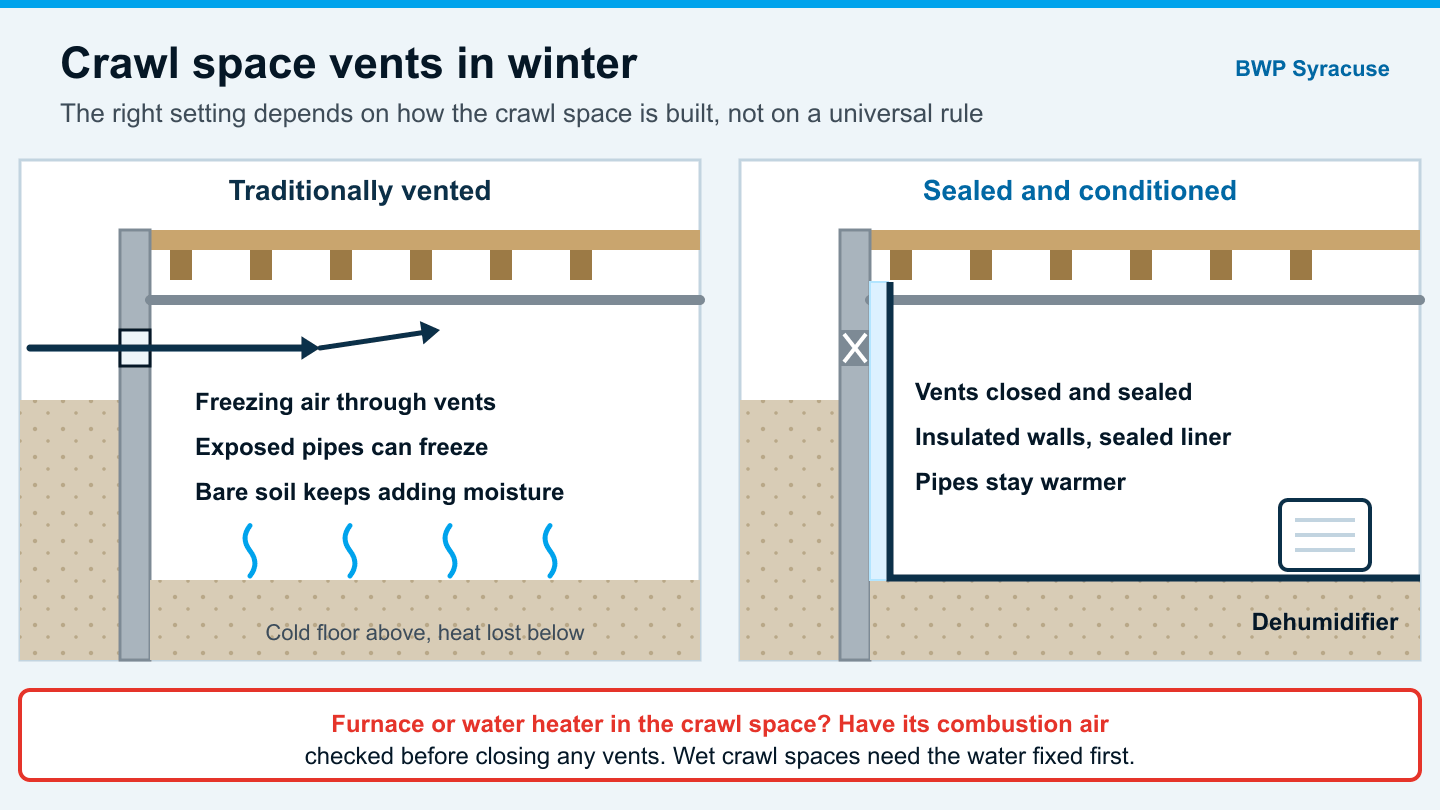
- Summer condensation when warm, humid outdoor air comes through vents and meets cool pipes, ducts and framing.
- Wet insulation that has absorbed water and holds it against the wood.
The full list of sources and how they interact is in the guide to crawl space moisture. For this article, the point is that growth in a crawl space almost always follows one of those patterns, and the location of the growth often tells you which one.
Where Mold in a Crawl Space Tends to Appear
Growth tends to start where moisture lingers longest:
- Floor joists and beams, especially the lower edges and the sides closest to damp soil or standing water.
- The underside of the subfloor, the wood sheathing that forms the floor above, particularly between joists over a bathroom, kitchen or laundry where plumbing runs.
- Rim joists and sill plates, the framing that sits on top of the foundation wall, where cold outdoor air and condensation meet wood.
- Insulation, particularly the paper facing on fiberglass batts and batts that have sagged or fallen onto damp soil.
- Around ducts and pipes that sweat in summer.
- Stored items and debris, including cardboard, old lumber and leftover construction scraps.
What growth usually looks like
Mold on crawl space wood is often fuzzy, cottony or spotty. It may be white, gray, green, black or other colors, and it often appears in patches or speckles rather than a smooth stain. A musty smell near the growth is common.
Appearance does not identify the species or tell you how it will affect anyone’s health. Don’t rely on color. “Black mold” is a common phrase, but color alone says nothing reliable about the type.
Look-Alikes That Aren’t Mold
Some of what people call crawl space mold is something else. These look-alikes still matter, because most of them point to moisture, but they call for different next steps.
| What you see | Usually is | How to tell | What it tells you |
|---|---|---|---|
| Fuzzy or cottony patches, spots that spread across the wood | Likely mold growth | Raised texture, often with a musty smell | Moisture has stayed high there for a while |
| Dark rings or brown tide lines on wood | Water staining | Flat, no texture, edges follow drips or splash | Water reached that spot, now or in the past |
| White crystals or powder on block, stone or concrete | Efflorescence | Found on masonry, not wood, crumbles to powder | Water moved through the wall and evaporated |
| Gray, even film over everything | Dust or dirt | Wipes off evenly, same on dry and damp areas | Not a moisture sign by itself |
| Soft, crumbly or cracked wood | Possible decay | A screwdriver sinks in with light pressure | Long-term wetting, may need structural repair |
Efflorescence on foundation walls is covered in more detail in efflorescence on basement walls, and the same mineral process happens on crawl space walls. If you can’t tell what you’re looking at, treat it as possible growth and don’t disturb it.
How to Take a Safe First Look
Goal: see how much suspected growth there is, where it is and what is feeding it, without spreading spores or putting yourself at risk.
Do not enter if there is standing water near wiring or equipment, you smell sewage, the air feels stale or smells of fuel or gas, the framing is sagging or broken, or you’re unsure. Close the opening and call a professional instead.
- Look from the access opening first. A strong flashlight shows most of what you need. Note where growth appears and roughly how far it spreads.
- Estimate the area. Picture the patches side by side. Is it less than a 3 foot by 3 foot square, or more?
- Look for the moisture source. Check for standing water, wet soil, dripping pipes, sweating ducts, sagging wet insulation and open vents.
- Check the wood, gently. If you can do it safely, press a screwdriver into a stained joist edge. Firm wood that resists is a good sign. Soft wood is not.
- Photograph and date everything. Wide shots for extent, close shots for texture.
- Don’t scrape, brush or pull insulation to get a better look. That releases spores and can spread growth.
How to read the result: a small patch near an obvious, fixable source (one dripping fitting, one spot of sweating duct) is a different job from growth spread across many joists over bare, damp soil. The first may be a homeowner task once the source is fixed. The second is a crawl space moisture problem with growth as one symptom.
Why Moisture Control Comes Before Cleanup
Cleaning growth without fixing the moisture means it returns. EPA guidance is direct on this: if there is mold growth in your home, you must clean up the mold and fix the water problem.
In a crawl space, the order usually runs like this:
- Stop liquid water. Outside drainage, plumbing repairs, or an interior drain and sump for groundwater.
- Remove the growth and damaged materials. Wet or moldy insulation usually comes out. EPA’s mold cleanup guidance (opens in a new tab) notes that absorbent or porous materials may have to be thrown away if they become moldy.
- Dry the wood. Framing needs to dry before anything is sealed over it.
- Repair damaged framing where wood has decayed, through crawl space repair.
- Control humidity long term, with a ground cover, air sealing and dehumidification, or full crawl space encapsulation.
Don’t cover it with a liner
Laying a vapor barrier or sealing the crawl space over active growth and wet wood hides the problem. EPA’s cleanup guidance says not to paint or caulk moldy surfaces, and the same logic applies to covering growth with plastic or spraying a coating over it. A properly done encapsulation follows cleanup and drying. It doesn’t replace them.
Cleanup Basics if the Area Is Small
EPA’s guidance says that if the moldy area is less than about 10 square feet, in most cases you can handle the job yourself following its guidelines. For larger areas, or a lot of water damage, it points to its more detailed remediation guidance. Ten square feet is roughly a 3 foot by 3 foot patch.
For a small area that you can reach safely:
- Wear protection. EPA lists gloves, goggles and an N-95 respirator, and says to avoid breathing in mold or mold spores.
- Fix the moisture source first, or the area will regrow.
- Clean hard surfaces with detergent and water and dry them completely.
- Bag and remove porous materials such as moldy insulation and cardboard rather than trying to clean them.
- Don’t disturb more than you need to. Keep the work small and contained.
Crawl spaces make even small jobs harder: tight space, poor lighting, limited air and awkward reach. If you can’t work comfortably and safely, that alone is a reason to hire it out.
Mistakes That Make Crawl Space Mold Worse
- Spraying or fogging and calling it done. A spray applied over growth leaves the moisture source in place, and the growth is still on the wood. Removal and moisture control are what the guidance calls for.
- Pulling down moldy insulation without protection. Fiberglass batts that have been wet for a long time can shed a lot of debris. Bag them where they are, with a respirator on.
- Running fans to dry out a wet crawl space while water keeps arriving. Air movement helps after the source is fixed. Before that, it moves damp air around.
- Opening vents wider in summer to air it out. Humid outdoor air can add moisture to cool framing, which is explained in whether crawl space vents should be open or closed.
- Assuming the stain is old. A stain from years ago and an active leak look much the same. Check again after a heavy rain and in late summer before deciding the problem is past.
The Seasonal Pattern Under Syracuse Homes
Crawl space growth in this area often follows the calendar. In late summer, humid air reaching cool framing and pipes through open vents keeps wood damp for weeks, and a common field pattern is growth concentrated over plumbing runs and on the shadier side of the house. In late winter and spring, snowmelt and rising groundwater can wet the soil and the lowest framing. Crawl spaces that see both patterns rarely dry out fully in between.
That is also why an inspection in October can look different from one in August. Growth and stains stay visible, but the moisture that caused them may be gone for the season. Photos from different times of year help separate a summer condensation problem from a spring water problem.
When Professional Investigation or Remediation Makes Sense
Bring in professionals when:
- The growth covers more than about 10 square feet, or spreads across many joists.
- Ducts or HVAC equipment in the crawl space are involved. EPA advises not to run the HVAC system if you know or suspect that it is contaminated with mold.
- Anyone in the house has health concerns, such as asthma, allergies or a weakened immune system. EPA says to consult a health professional before starting cleanup if you have health concerns.
- The water came from sewage or other contaminated water. EPA says to call in a professional with experience cleaning buildings damaged by contaminated water.
- You suspect hidden growth, for example a moldy smell with no visible source.
- The wood is soft or the floor above sags, which adds a structural question.
EPA also advises choosing a contractor with experience cleaning up mold. Remediation and moisture control are related but separate jobs, so ask how the water source will be dealt with before or alongside cleanup.
How This Differs From a Musty Basement
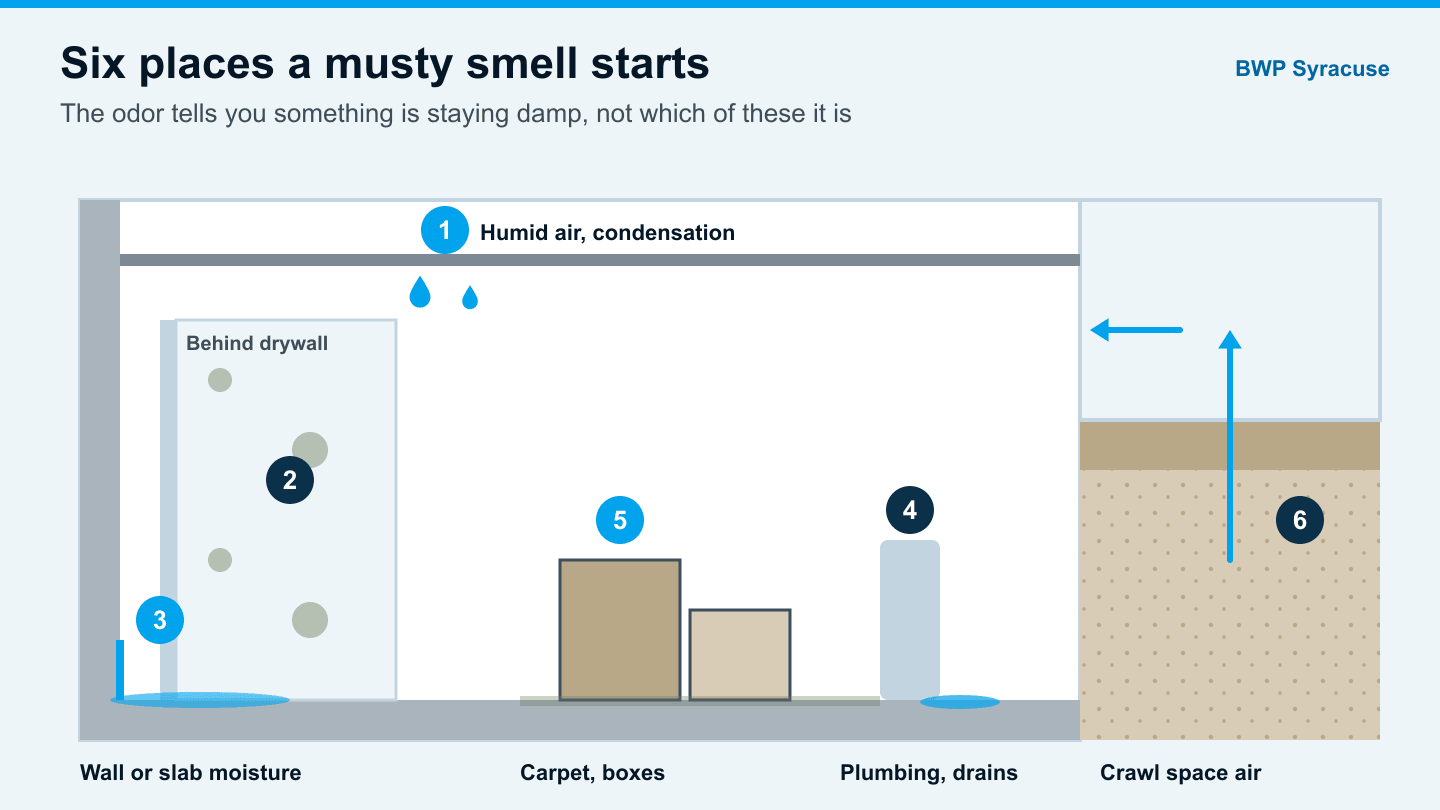
A crawl space and a basement share some causes, but the crawl space usually has bare soil, vents to outside air and wood framing close to the ground, which changes both the sources and the fixes. If the smell is in a full basement rather than above a crawl space, the musty basement smell guide covers that separately.
If you’ve found growth and aren’t sure where the water is coming from, a free inspection can trace the moisture source before anyone starts cleaning.
In a crawl space, the growth shows you where the water has been, so follow it back to the source before deciding how to clean it.
Frequently Asked Questions
Do I need to test mold in my crawl space?
Usually not when growth is visible. EPA guidance says that in most cases, if visible mold growth is present, sampling is unnecessary, and that no EPA or other federal limits have been set for mold or mold spores. Testing can still help in specific cases, such as suspected hidden growth or a dispute that needs documentation, and that work belongs with an experienced professional.
Is white mold on crawl space joists dangerous?
Color does not tell you which mold it is or how it may affect a particular person. Treat any growth as something to remove and keep people with asthma, allergies or weakened immune systems away from the work. EPA advises anyone with health concerns to consult a health professional before starting cleanup.
Can I just put a vapor barrier over the mold?
No. Covering growth or sealing a crawl space around it does not remove it, and if the moisture source is still active, the growth can continue under or behind the new material. EPA guidance says not to paint or caulk moldy surfaces. Fix the water, remove the growth and let the wood dry before any liner or encapsulation goes in.
Will a dehumidifier kill crawl space mold?
A dehumidifier lowers humidity, which helps stop new growth and helps materials dry, but it does not remove growth that is already there. It also cannot keep up with liquid water from a leak or groundwater. Think of it as part of moisture control after the source is fixed and the growth is cleaned.
Does mold in the crawl space affect the air upstairs?
It can. Air moves upward through a house, and air from a crawl space can reach the rooms above through gaps in the floor, around pipes and through ducts. That is one reason crawl space moisture problems often show up as a smell in ground-floor rooms. How much air moves, and what it carries, varies from house to house.