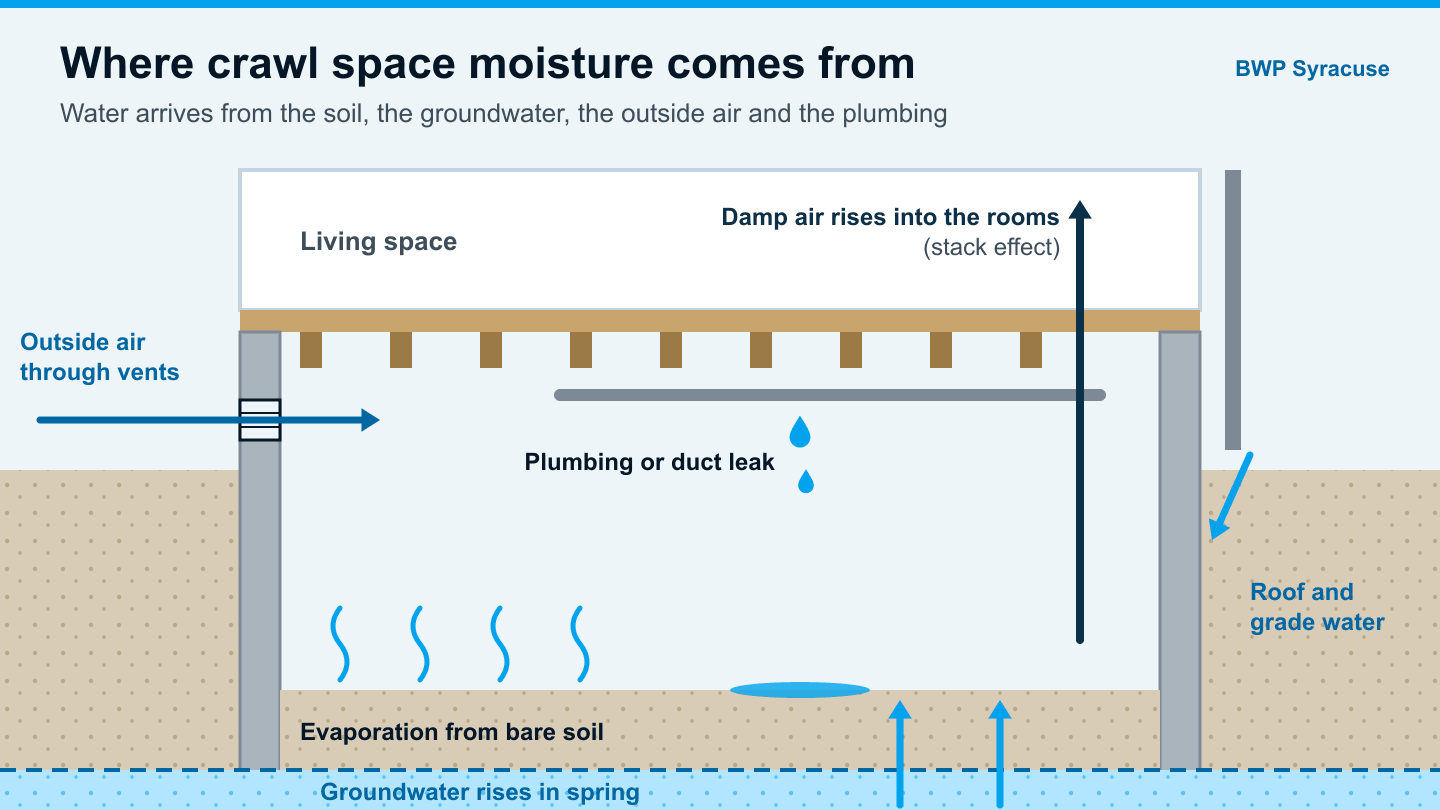
Crawl space moisture usually comes from the soil under the house, groundwater, outside air drawn in through vents and leaking pipes or ducts. Left alone, it soaks into wood framing and insulation, makes ducts sweat and sends damp, musty air into the rooms above, so the fix starts with finding which source is doing the most work.
Most crawl spaces have more than one source at a time. A crawl space can have dry soil and still drip with condensation every August, or stay dry all summer and fill with water each March. Sorting out which pattern you have is what keeps you from paying for a fix aimed at the wrong source.
Why Crawl Spaces Hold Moisture
A crawl space is a shallow space between the ground and the first floor, usually two to four feet high, enclosed by foundation walls. In many older Syracuse homes the floor is bare soil, sometimes with a thin sheet of plastic that has torn or shifted over the years.
That arrangement puts wood framing a short distance above damp earth in a space with little air movement and almost no sunlight. Water arrives from below, from the sides and from the air, and leaves slowly. Anything in the space that can absorb water, such as joists, subfloor, insulation, cardboard and dust, does.
Where Crawl Space Moisture Comes From
Evaporation from bare soil
Soil holds water even when it looks dry, and it releases that water as vapor into the air above it. Over a whole crawl space floor, this adds moisture to the air every day of the year. DOE’s Building America guidance on crawl space floors (opens in a new tab) says that whether or not a crawl space is part of the conditioned house, it must always have a ground cover that prevents evaporation of ground moisture into the crawl space.
Groundwater and a high water table
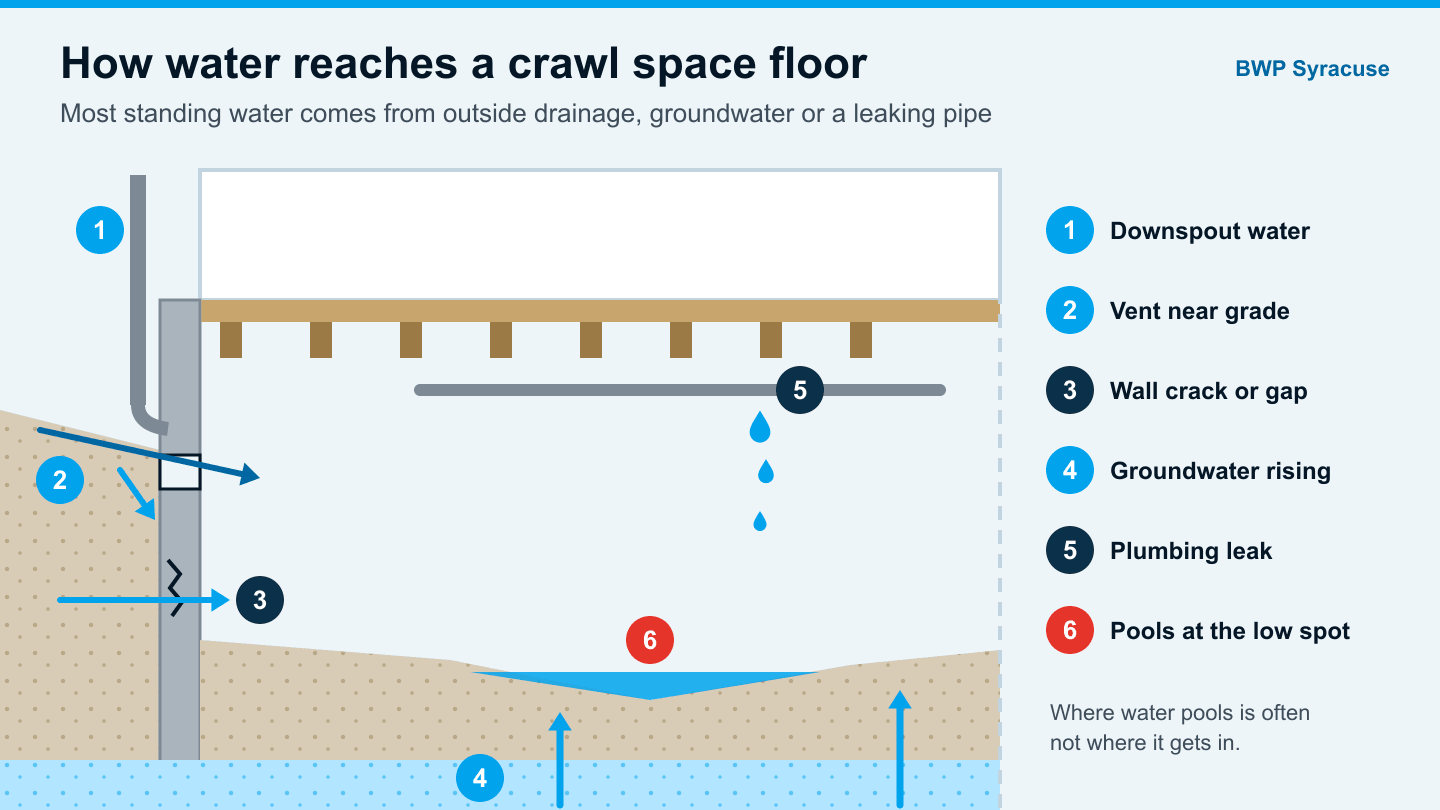
The water table is the level below which the ground is saturated. When heavy rain or snowmelt raises it toward the crawl space floor, water can seep up through the soil and pool, often in the lowest corner, with no obvious entry point. In Syracuse this is most common from late winter into spring, when a deep snowpack melts over partly frozen ground. The ways to tell groundwater from other sources, and what to do about pooled water, are covered in standing water in a crawl space.
Surface drainage
Gutters that overflow, downspouts that empty beside the foundation and soil that slopes toward the house all send rain and meltwater to the crawl space walls. That water soaks through block or stone, runs in along pipes or pours through vents and access doors set close to the ground. Surface drainage is usually the cheapest source to fix, and the first to check.
Summer condensation
Warm, humid summer air holds a lot of water vapor. When that air reaches a surface cooler than its dew point, the temperature at which vapor turns to liquid, water forms on the surface. In a crawl space, the cool surfaces are cold water pipes, air conditioning ducts, the subfloor under air-conditioned rooms and framing near the soil.
This is why some crawl spaces are wetter in July than in March. The water isn’t coming through the walls. It’s coming out of the air.
Venting conditions
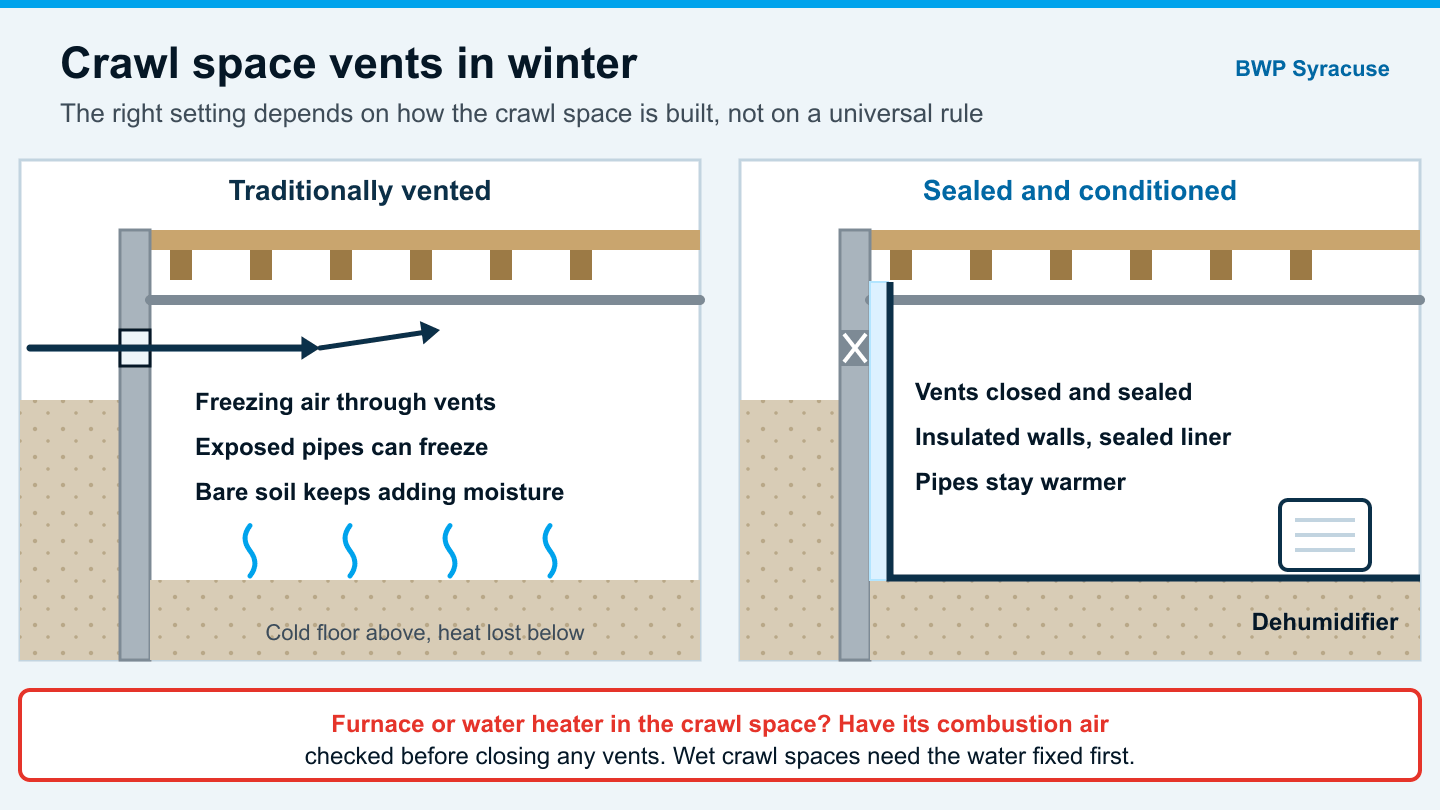
Traditional foundation vents were meant to let outside air dry the crawl space. DOE’s Building America program notes that the air from outside is often more moist (opens in a new tab) than the air in the crawl space, which can lead to structural, mold and pest problems. In winter, the same vents pull frigid air under the floor, which affects pipes and comfort. The right vent setting depends on how the crawl space is built, and whether crawl space vents should be open or closed works through that decision, including the combustion air caution for furnaces and water heaters.
Plumbing and duct leaks
Supply lines, drain lines, water heaters and air conditioning condensate lines can all leak into a crawl space. Ducts that leak cool air in summer chill the framing around them and make condensation worse. Leaking supply ducts in winter can push warm, moist house air into a cold crawl space, where it condenses on the rim joist and sill. Plumbing water ignores the weather, so moisture that shows up on dry weeks points here first.
What Moisture Does to a Crawl Space and the House Above
Wood framing and subfloor
Wood absorbs moisture from damp air and from direct contact with water. Wood that stays wet for long periods can grow mold and, over time, decay. Decay softens joist ends, sill plates and the subfloor, which can show up upstairs as bouncy or sagging floors. Where framing has already softened, crawl space repair has to happen before anything is sealed over it.
Insulation
Fiberglass batts between floor joists are common in vented crawl spaces. When they absorb water they sag, pull away from the subfloor and lose much of their insulating value, since wet insulation conducts heat far more readily than dry. Batts that fall onto damp soil hold water against whatever they touch.
Ducts and equipment
Ducts running through a damp crawl space can sweat in summer, dripping onto insulation and soil below. Rust on duct hangers, furnace cabinets and fasteners is a common sign. If ducts leak, they can also draw crawl space air into the system and distribute it through the house.
Indoor air and the stack effect
Warm air rises inside a house, the same way smoke rises up a chimney. As warm air escapes through the upper floors and attic, replacement air is pulled in low in the house. This is called the stack effect. In a home over a crawl space, some of that replacement air comes up from the crawl space, through gaps around pipes, wires, ducts and the floor.
That’s why a crawl space problem is often noticed first as a smell or a clammy feel in ground-floor rooms. How much air moves this way varies a lot from house to house, depending on how airtight the floor is and how the house is heated and ventilated. The basement version of this problem, and how it differs, is covered in the guide to basement humidity levels.
Damp, Wet, Condensation or Growth? How to Read What You See
Different kinds of moisture call for different next steps. This table is a first sort, not a diagnosis.
| What you see | What it looks like | Likely cause | Next step |
|---|---|---|---|
| Damp surfaces | Dark, damp soil, damp foundation walls, wood that feels cool and slightly damp, no puddles | Evaporation from bare soil, humid air, wicking through masonry | Cover the soil, check humidity over a week, look for drainage problems outside |
| Standing water | Puddles or pools on soil or on top of plastic, water lines on walls | Surface drainage, groundwater, plumbing leak | Observe safely, match timing to weather, fix drainage or plumbing before sealing anything |
| Condensation | Beads of water or drips on pipes, ducts and the underside of the subfloor, mostly in summer | Humid outdoor air meeting cool surfaces, often through vents | Insulate cold pipes and ducts, reconsider venting, control humidity |
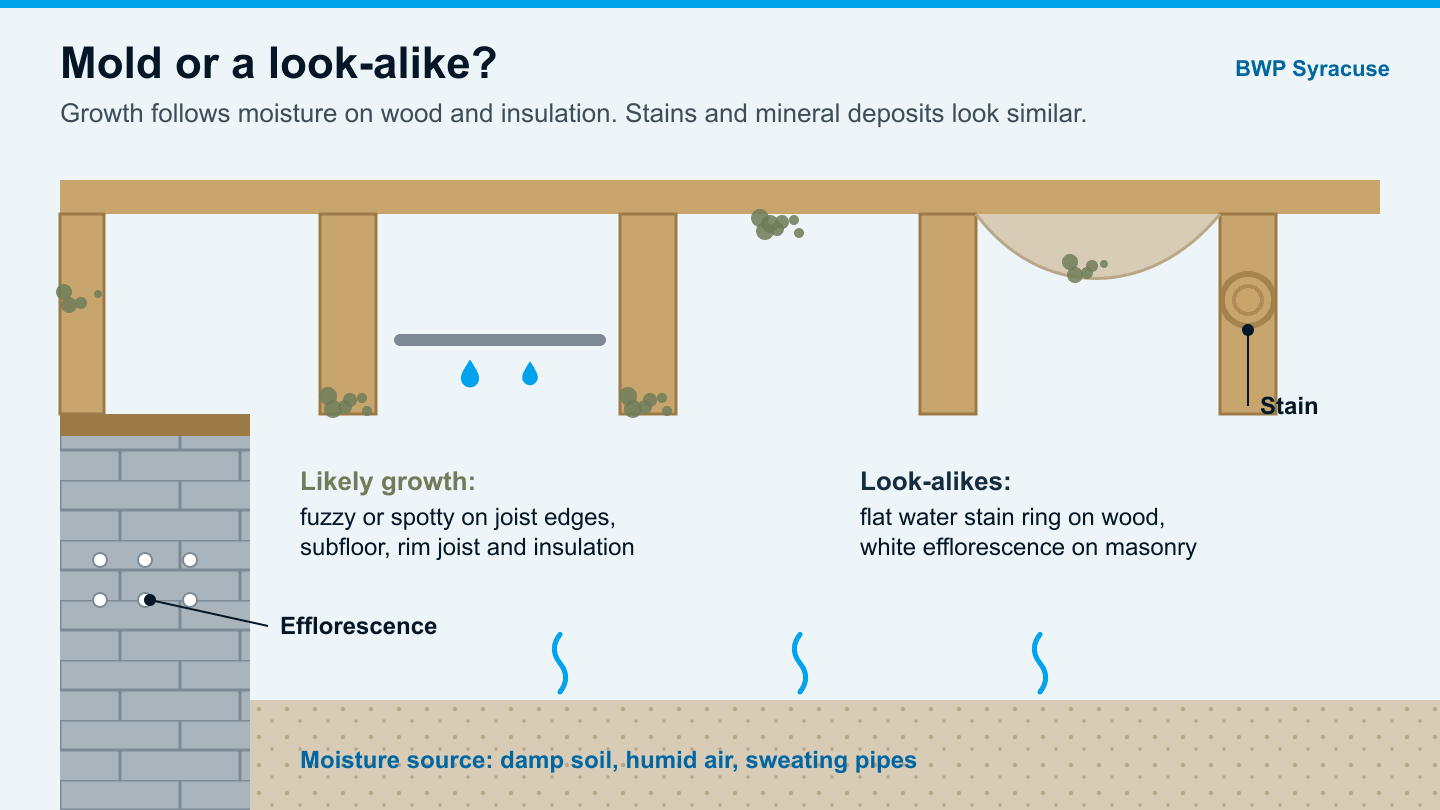
| Suspected microbial growth | Fuzzy, cottony or spotty patches on joists, subfloor or insulation, often with a musty smell | Moisture that has stayed high for weeks or longer | Don’t disturb it, find the moisture source, judge the size and decide on cleanup |
Visible growth has its own considerations: what is and isn’t mold, EPA’s cleanup guidance and when professionals are needed. Those are covered in mold in a crawl space.
A One-Week Crawl Space Moisture Check
Goal: find out which moisture source is driving the problem before you spend money on a fix.
What you need: a flashlight, a phone camera and an inexpensive digital hygrometer with a remote sensor, or two hygrometers.
Safety first: do this from the access opening. Don’t enter if there is standing water near wiring or equipment, a sewage smell, stale or fuel-smelling air, or sagging or broken framing.
- Place a hygrometer sensor just inside the access opening, on a dry surface off the soil, and leave the other unit upstairs. Close the access door.
- Record both readings morning and evening for a week, along with the outdoor weather, especially rain and humid days.
- Do a flashlight survey on day one. Note the soil (bare, partly covered, fully covered), any water, the condition of insulation, rust on ducts and staining or growth on wood.
- Look at pipes and ducts on a humid afternoon. Beads of water mean condensation.
- Walk the outside. Check gutters, downspout outlets, soil slope and how close the vents and access door sit to the ground.
How to read the result:
- Crawl space readings that climb on humid days and track outdoor weather point to vented air and condensation.
- Readings that stay high whatever the weather, with bare soil, point to ground evaporation.
- Water that appears after storms points to surface drainage. Water that lingers through spring points to groundwater. Water on dry days points to plumbing.
- Growth or soft wood means the moisture has been there for a long time, whatever the source.
When to call a professional: standing water, visible growth across a large area, soft or sagging framing, fuel-burning equipment in the crawl space, or readings that stay high after the soil is covered and the outside drainage is fixed.
How Crawl Space Moisture Is Fixed
The approaches below solve different parts of the problem. Most crawl spaces need more than one, in roughly this order.
Drainage improvements and a sump
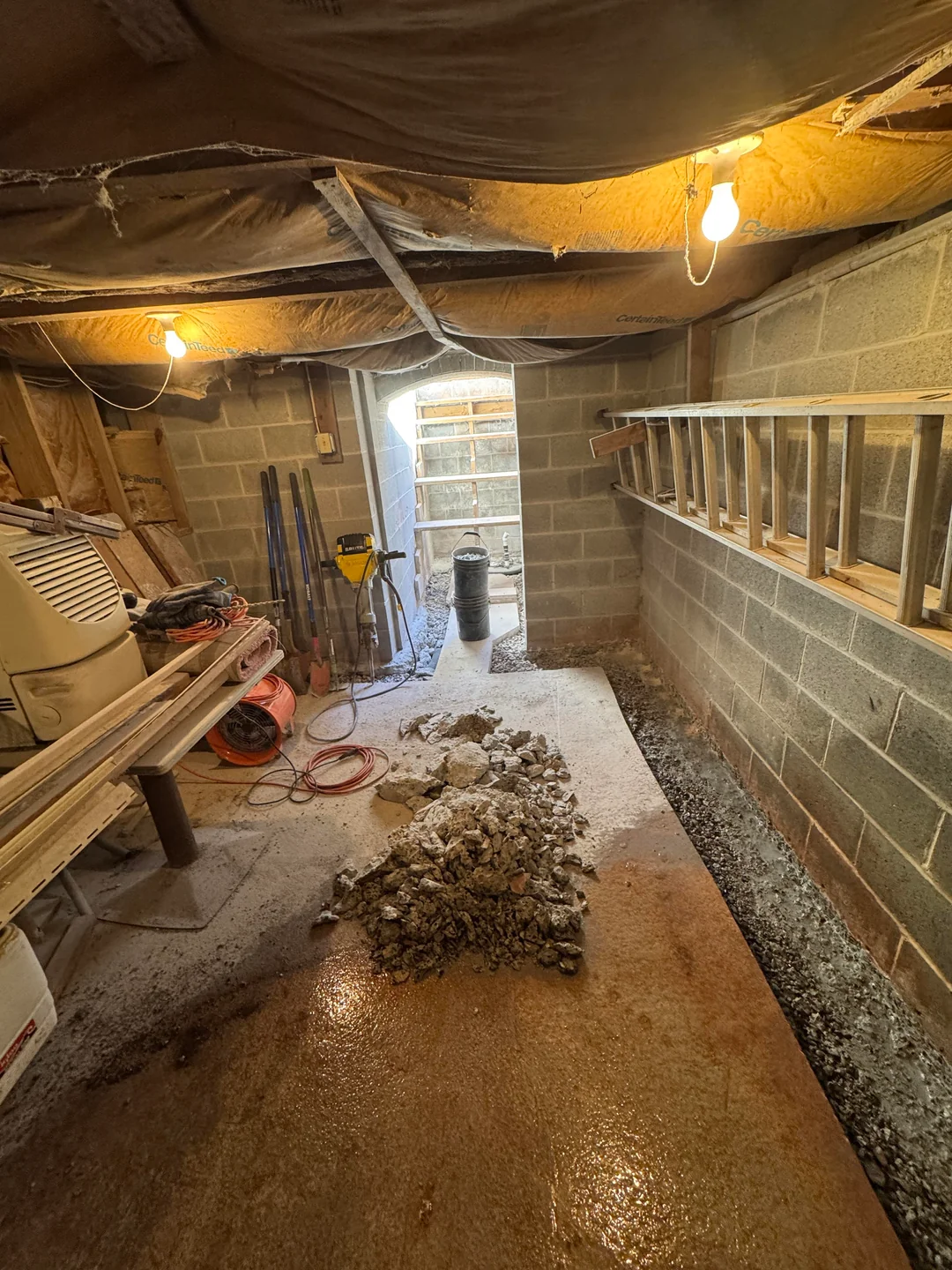
Liquid water comes first. Gutters, downspout extensions and regrading handle surface water. Groundwater or persistent wall seepage usually needs an interior perimeter drain: perforated pipe in a trench along the inside of the foundation, sloped to a sump basin, with a sump pump that sends the water away from the house. That is water management, a separate job from controlling humidity.
Vapor barriers and ground covers
A vapor barrier is a sheet of plastic that slows water vapor moving through it. Laid over the soil, it cuts evaporation from the ground. The difference between a loose sheet and a working ground cover is in the details: overlapped and sealed seams, edges sealed to the walls and around piers, and material tough enough to survive someone crawling over it.
Humidity management and dehumidification
A dehumidifier removes water vapor from the air. In a crawl space with covered soil and handled liquid water, a dehumidifier can hold humidity steady through humid months. In a vented crawl space or one with bare soil, it’s fighting outdoor air or the ground and may never keep up. Insulating cold water pipes and ducts also reduces condensation.
Sealing and encapsulation
Sealing closes the crawl space off from outside air: vents closed, walls and rim joists insulated and air sealed, a continuous liner over the soil and up the walls, and a way to remove moisture. Building Science Corporation’s article on crawl spaces, Crawlspaces: Either In or Out (opens in a new tab), makes the point that a crawl space connected to the house needs a means of removing moisture, just like any room in the house. A full version of this, with the liner, sealing and dehumidifier together, is crawl space encapsulation. Codes address both vented and unvented crawl spaces, so check with your local building department before converting one.
Repair of damaged framing
Moisture that has been there for years can leave joists, sill plates and subfloor soft. Damaged wood is repaired or reinforced before the space is sealed, so the liner isn’t hiding a structural problem.
Mistakes That Keep a Crawl Space Wet
- Laying plastic over standing water. The water stays, now out of sight.
- Closing vents on a crawl space with bare, wet soil. The moisture has fewer ways out and humidity can climb.
- Running a dehumidifier in a vented crawl space. It ends up drying outdoor air.
- Stuffing new insulation between wet joists. It soaks up water and holds it against the wood.
- Fixing the smell instead of the source. Air fresheners upstairs don’t change what’s happening below the floor.
- Treating every source as the same problem. Condensation, groundwater and a leaking pipe each have their own fix, and one doesn’t cover the others.
The Syracuse Pattern
Crawl spaces in this area often see two wet seasons. In late summer, humid air and cool surfaces produce condensation in vented crawl spaces. In late winter and spring, snowmelt over frozen or clay soils raises groundwater and sends surface water toward foundations. Winter adds its own risk: open vents and poorly insulated rim joists expose supply pipes to freezing.
A crawl space checked only once a year can look fine in October and be soaked in March. If you’re tracking moisture, check in August and again during the spring thaw. For homes with both a basement and a crawl space, the basement side of the house may need its own drainage approach, even when the crawl space is handled with a liner and dehumidifier.
If you’d like a second set of eyes on the crawl space, a free inspection covers the water, the air, the framing and any equipment down there.
Crawl space moisture rarely has a single cause, so match each source to its own fix and the space below the floor stops working against the rooms above it.
Frequently Asked Questions
What humidity level is too high for a crawl space?
There is no single official crawl space number, but EPA guidance for indoor spaces is to keep relative humidity below 60 percent, ideally 30 to 50 percent, and a crawl space connected to the house is a reasonable place to apply the same reference point. Readings that sit well above 60 percent for weeks, especially with damp wood or insulation, point to a moisture source worth finding.
Is some moisture in a crawl space normal?
Some moisture is normal, since the soil under a house is never completely dry. What is not normal is wet wood, dripping ducts, sagging wet insulation, standing water or a musty smell. Those signs mean moisture is arriving faster than it leaves, and the source decides the fix.
Will a dehumidifier alone fix crawl space moisture?
A dehumidifier controls water vapor in the air, so it works best in a crawl space that already has its liquid water handled and its soil covered. In a vented crawl space it is drying outdoor air, and in a crawl space with bare soil or standing water it can run constantly without keeping up.
Does crawl space moisture affect the rest of the house?
It can. Warm air rises through a house and pulls replacement air in low, and some of that air comes up from the crawl space through gaps around pipes, wires, ducts and the floor. Damp, musty crawl space air can reach the rooms above, which is why the first sign is often a smell or cold, clammy floors upstairs.
Should I put plastic down in my crawl space?
A ground cover over bare soil is one of the most useful steps in a damp crawl space, and DOE guidance says a crawl space should always have one. It works best when it is continuous, overlapped and sealed at the seams and walls, and laid only after any standing water problem has been solved.