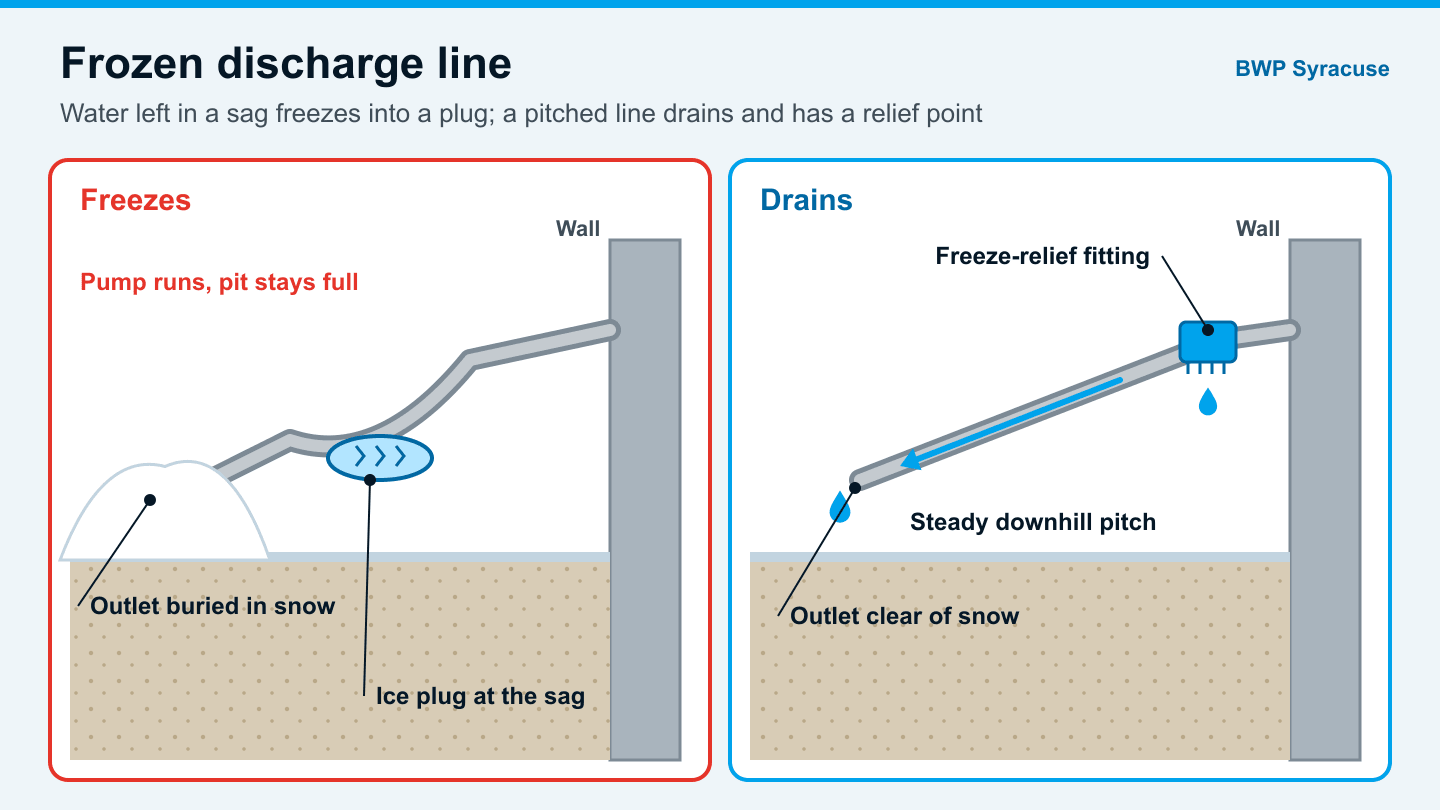
A frozen sump pump discharge line is a pipe that has iced shut somewhere between the house and the outlet, so the pump can’t push water out of the pit. The pump may keep running, the water level in the pit stays high, and if the ice holds, water can rise over the rim and onto the basement floor.
Most freeze-ups start in the same few places: a sag in the pipe that holds water, a flat run that drains slowly, or an outlet buried under snow. Below: how to spot it, check it safely, thaw it without creating a new hazard and set the line up for winter. For the full picture of how the system fits together, start with how a sump pump works.
Why a Sump Pump Discharge Line Freezes
The pump sits in the sump basin indoors, where the water is above freezing. The discharge line is the pipe that carries water from the pump up, through the wall or rim joist, and out to the yard. The outdoor part of that pipe is exposed to the same cold as everything else outside.
A line that empties completely after each cycle rarely freezes, since there is nothing left inside to turn to ice. Trouble starts when water stays in the pipe between cycles. Each small amount that lingers can freeze a little more, and over several cold days that thin layer builds into a plug.
Low spots and sags
A pipe that dips, even slightly, holds a puddle in the low point. Flexible hose and corrugated pipe are the usual offenders, because they settle into the lawn and follow every bump. The low spot becomes the first place ice forms.
Flat runs
A pipe laid level drains slowly, and the last bit of each discharge trickles out over minutes instead of seconds. In hard cold that slow trickle can freeze before it leaves.
Outlets buried in snow or ice
Plowed or shoveled snow, drifts and roof avalanches can cover the end of the pipe. Water leaving the pipe then has nowhere to go, backs up and freezes at the mouth. In Syracuse, where lake-effect snow can pile up quickly and stay for weeks, a buried outlet is one of the most common causes.
Discharging onto frozen ground
When the outlet empties onto ground that is already frozen, the water cannot soak in. It spreads, refreezes and builds a mound of ice that slowly creeps back toward the pipe until it seals the end.
Signs Your Sump Pump Discharge Line Is Frozen
These signs usually show up after several days of hard cold, or right after a thaw when the pump suddenly has work to do again.
- The pump runs but the pit doesn’t drop. You hear the motor, yet the water level in the basin stays where it was or keeps climbing.
- Short, rapid cycling. The pump starts, pushes a little water into a partly blocked line, stops, and starts again soon after because the water has nowhere to go.
- Ice at the outlet. A cap of ice over the pipe end, an icicle, or a frozen mound where the water usually spreads out.
- No water coming out outside. The pump is running, but nothing leaves the pipe.
- A hot, tripping pump. A pump pushing against a blockage can overheat, shut itself off on its thermal protection, then restart once it cools.
- Water on the basement floor. If the pit overflows, the first water usually appears around the basin, then spreads along the floor.
Some of these overlap with other problems. A pump that runs nonstop in a thaw may simply be keeping up with heavy groundwater, which is covered in why a sump pump runs constantly. A pump that is silent while the pit fills is a different problem, covered in what to check when a sump pump won’t turn on.
How to Check a Frozen Discharge Line Safely
Goal: find out whether ice is the reason the pit is not draining, without putting yourself near water and electricity at the same time.
- Check the basement floor before you go down. If there is water on the floor near the pit, outlets or cords, do not walk into it and do not touch the pump, the plug or the outlet. If the panel can only be reached by walking through water, have an electrician or the utility cut the power.
- Start outside. Walk the line from the wall to the outlet. Look for an iced-over pipe end, snow or a plow pile on top of it, a frozen mound around it, and any section that sags.
- Listen and look from a dry spot inside. From dry floor, note whether the pump is running, whether the water level is falling, and how long each cycle lasts. Don’t reach into the pit.
- Feel the pipe where it is safe to do so. On the dry, indoor part of the discharge pipe above the pit, a line that is full and not moving often feels cold and solid when you tap it. Never handle the pump or its cord while standing in water or with wet hands.
- Check for a freeze-relief fitting. If the house has one near the wall, see whether water is spilling from it. Spilling water there means the fitting is doing its job and the blockage is farther out.
How to read the result: ice at the outlet or a buried pipe end, plus a pump that runs without lowering the pit, points strongly to a frozen line. A pump that is silent, with no ice outside, points to a power or switch problem instead. When to call a professional: the pit is close to overflowing, the floor is wet near electrical equipment, the pump has been running hot or tripping, or you cannot find where the line is blocked.
How to Thaw a Frozen Sump Pump Discharge Line
The aim is to open the line without damaging the pipe or creating a fire or shock risk.
- Clear the outlet first. Shovel snow and chip loose ice away from the pipe end by hand. Often the blockage is only at the mouth, and clearing it is enough.
- Use warm water. Pouring warm, not boiling, water over the outside of an iced section, or into an accessible end, can soften the plug. Very hot water on cold plastic pipe can stress it.
- Use a heat source rated for that use. Heat cable or heat tape made for pipes, installed according to its instructions, is designed for this job. DOE Building America guidance on winter weather (opens in a new tab) notes that plug-in heat tape should only be plugged into a GFCI receptacle.
- Never use a torch or open flame. Plastic discharge pipe melts, and flame near the house or siding is a fire risk.
- Don’t improvise electrical heat. No space heaters set in snow, no extension cords run across wet ground, and no homemade heating setups.
- Don’t pour antifreeze or salt into the line or the pit. Those chemicals end up in the soil or storm system and are not made for this.
If the pit is close to the rim while you work, a professional can set up temporary pumping or reroute the discharge. A pump that has run against a frozen line for a long time should be checked before you rely on it again. The motor may have overheated, and a damaged pump can fail on the next storm.
How to Keep the Discharge Line From Freezing This Winter
Prevention is mostly about getting water out of the outdoor pipe after every cycle and giving it a place to go when the outlet is blocked.
Pitch the line so it drains
The outdoor run should slope steadily downhill from the house to the outlet, with no dips. A rigid pipe holds its pitch better than a hose lying on the lawn. If you can see a sag, that is the place to fix first.
Add a freeze-relief fitting
A freeze-relief fitting, sometimes sold as an ice-guard fitting, is a short section with a grated or slotted air gap placed where the line leaves the house. In normal operation water flows past the opening into the pipe. If the pipe beyond it freezes or gets blocked, water spills out of the opening, outside the house, instead of backing up into the pit. Several companies make versions of this fitting. Follow the manufacturer’s instructions for placement, and make sure the spill point does not dump water against the foundation or onto a walkway.
Consider a larger pipe
A larger-diameter outdoor pipe takes longer to freeze shut, because more ice has to build before it closes. A pro can tell you whether that change suits your pump.
Keep the outlet clear of snow
Mark the outlet with a tall stake so it is easy to find after a storm. Tell whoever plows or shovels where it is, and keep piles away from it.
Discharge away from the foundation
Building America guidance for sump pumps (opens in a new tab) says the discharge pipe should direct water out and away from the building. Water dumped right beside the wall can soak back toward the foundation, and in winter it freezes into a slick patch or an ice dam at the outlet.
Use a removable winter extension
A long flexible extension is handy in summer and a problem in winter. Many homeowners pull it in late fall and use a short rigid section that drains fully, or a removable extension they can lift off and knock clear after each cold snap.
Bury it below frost, or reroute it
The permanent fix for a line that freezes every year is often to bury it below the frost line, or to reroute it to a better outlet. The frost line in Syracuse is commonly cited at 42 to 48 inches, and local rules decide where discharge can go. That is professional work.
Mistakes That Make Freeze-Ups Worse
- Leaving corrugated hose on the ground all winter. Its ridges hold water and it follows every dip in the lawn.
- Unplugging the pump to stop the cycling. That stops the noise but leaves nothing to empty the pit. If water is rising, the problem gets worse fast.
- Sealing or capping the outlet to keep snow out. That blocks the water too.
- Assuming one thaw fixed it. If the cause was a sag or a buried outlet, the line will refreeze at the next cold spell.
When to Bring In a Professional
Call for help if the line freezes more than once a season, if it has to be buried or rerouted, if the pump has been overheating or tripping, or if water has reached the floor. A frozen line is a drainage-layout problem more than a pump problem, and the fix usually means changing where and how the pipe runs.
If you want the line, the pit and the outlet looked at together before the deep cold sets in, BWP Syracuse offers a free inspection.
A discharge line that drains completely after every cycle has very little in it to freeze.
Frequently Asked Questions
Can I pour antifreeze or salt into a frozen sump discharge line?
No. Automotive antifreeze is toxic and ends up in the yard or storm system, and rock salt can sit in the pipe and in the pit. Neither is designed for a sump system. Thaw the ice with warm water or a heat source rated for the job, then fix the slope or the outlet so it does not refreeze.
Will a frozen discharge line damage my sump pump?
It can. A pump pushing against a blocked line moves little or no water, so it may run hot, trip its thermal protection or wear out early. If the pump has been running against a frozen line for a long time, have it checked before you trust it again. How a sump pump works explains the parts that take the strain.
Should I disconnect the discharge extension for winter?
Often, yes. A long hose or flexible extension laid across the lawn is one of the most common places for ice to form. Many homeowners remove it in late fall and use a short, rigid section that drains completely, then reattach the longer run in spring. Make sure water still leaves well away from the foundation.
Is a freeze-relief fitting the same as a burst pipe?
No. A freeze-relief fitting is a deliberate opening, usually grated or slotted, placed where the line leaves the house. In normal operation water flows past it. If the line beyond it freezes, water escapes through the opening outside instead of backing up into the pit. Follow the manufacturer's instructions for where to place it.