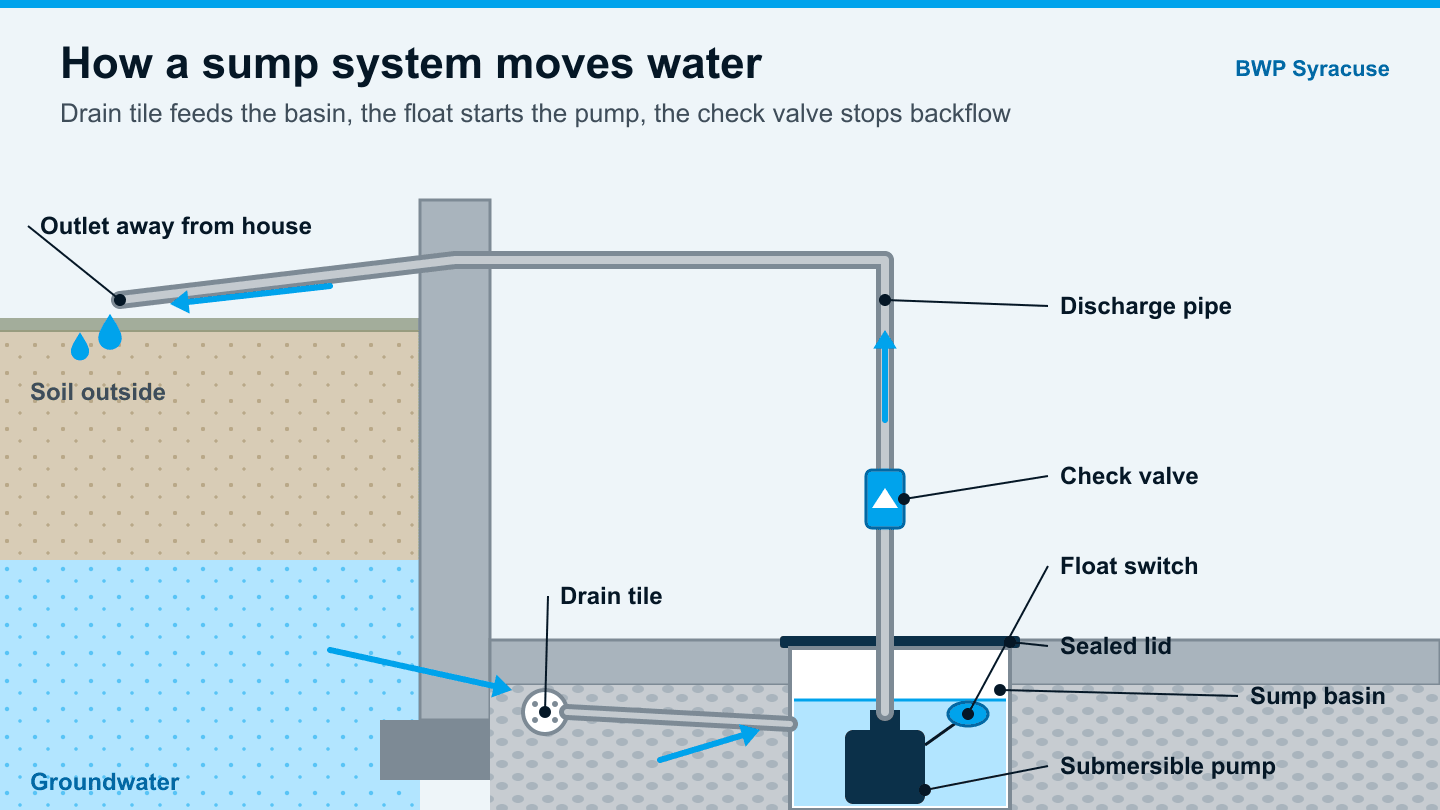
A sump pump works by collecting groundwater in a pit below the basement floor and pumping it out of the house before it rises onto the slab. A float switch or an electronic sensor turns the pump on when the water reaches a set height, the pump pushes the water up a discharge pipe and outside, and a check valve keeps that water from falling back into the pit.
That covers how a sump pump works on a normal day. The parts around the pump, where the water comes from and how the pump is sized decide whether the system keeps up on the worst day of spring. This guide walks through each component, the main pump types, how sizing really works and what normal operation looks like.
How Does a Sump Pump Work? Collection, Then Discharge
A sump system has two jobs. The first is collection, getting water from the soil around and under the basement into one place. The second is discharge, getting that water out of the house and far enough away that it doesn’t come straight back.
Collection usually starts with drain tile, a perforated pipe laid in gravel along the footing, either outside the foundation or inside the basement under the edge of the slab. Groundwater that would otherwise build up against the wall, creating hydrostatic pressure (the push of standing water against the foundation), enters the holes in the pipe instead and flows by gravity to the sump pit.
Exterior drain tile, often called a footing drain, is usually installed when the house is built or during an excavation, and in older homes it may be clogged, crushed or missing. Interior drain tile is cut in along the inside edge of the floor and is common on existing homes, since it doesn’t require digging up the yard. Both feed a pit in the same way. The trade-offs between the two approaches are covered in interior vs exterior drainage. In many older Syracuse houses the pit is the only part of the system anyone has seen, so it’s worth knowing whether pipes actually enter it, and from which walls.
Discharge starts at the pump. The pump lifts the water out of the pit, up through a pipe, through the wall or rim joist and out to an outlet in the yard or another approved location. Wikipedia’s overview of sump pumps (opens in a new tab) describes the goal plainly: move water to a place where it is no longer a problem, such as a storm drain, a dry well or downhill away from the house. Where you are allowed to send it is set by local rules, not by the pump.
A pump without collection only catches the water that happens to reach the pit. A system that collects well but discharges next to the foundation pumps the same water twice. Both halves have to work.
The Parts of a Sump Pump System
The sump pit or basin
The sump pit, also called the basin, is a liner set into the floor, usually at a low point. Building America’s guidance on sump pump installation (opens in a new tab) says the pump should sit in the lowest spot of the floor. Drain tile enters through openings in the side of the basin. The size of the pit matters: a small pit fills quickly and forces the pump to start more often.
The pump
The pump uses an electric motor to spin an impeller, a small wheel with vanes that flings water outward and up the discharge pipe. Most homes use submersible pumps that sit in the water at the bottom of the pit. The pump should rest on a firm, level base so it doesn’t pull in silt or tip against the float.
The switch: float or electronic sensor
The switch decides when the pump runs. A float rises with the water and closes a switch at the “on” level, then drops and opens it at the “off” level. Some pumps use an electronic sensor that detects water level with no moving float at all. The switch has to move freely, which is why the pump’s position in the pit and anything else hanging in the pit matter.
The check valve
A check valve is a one-way valve on the discharge pipe, usually just above the pit. It lets water flow out and stops the water standing in the pipe from falling back when the pump shuts off. The Building America guidance calls for one for exactly that reason. Without it, the pump re-pumps the same water every cycle.
The discharge pipe and outlet
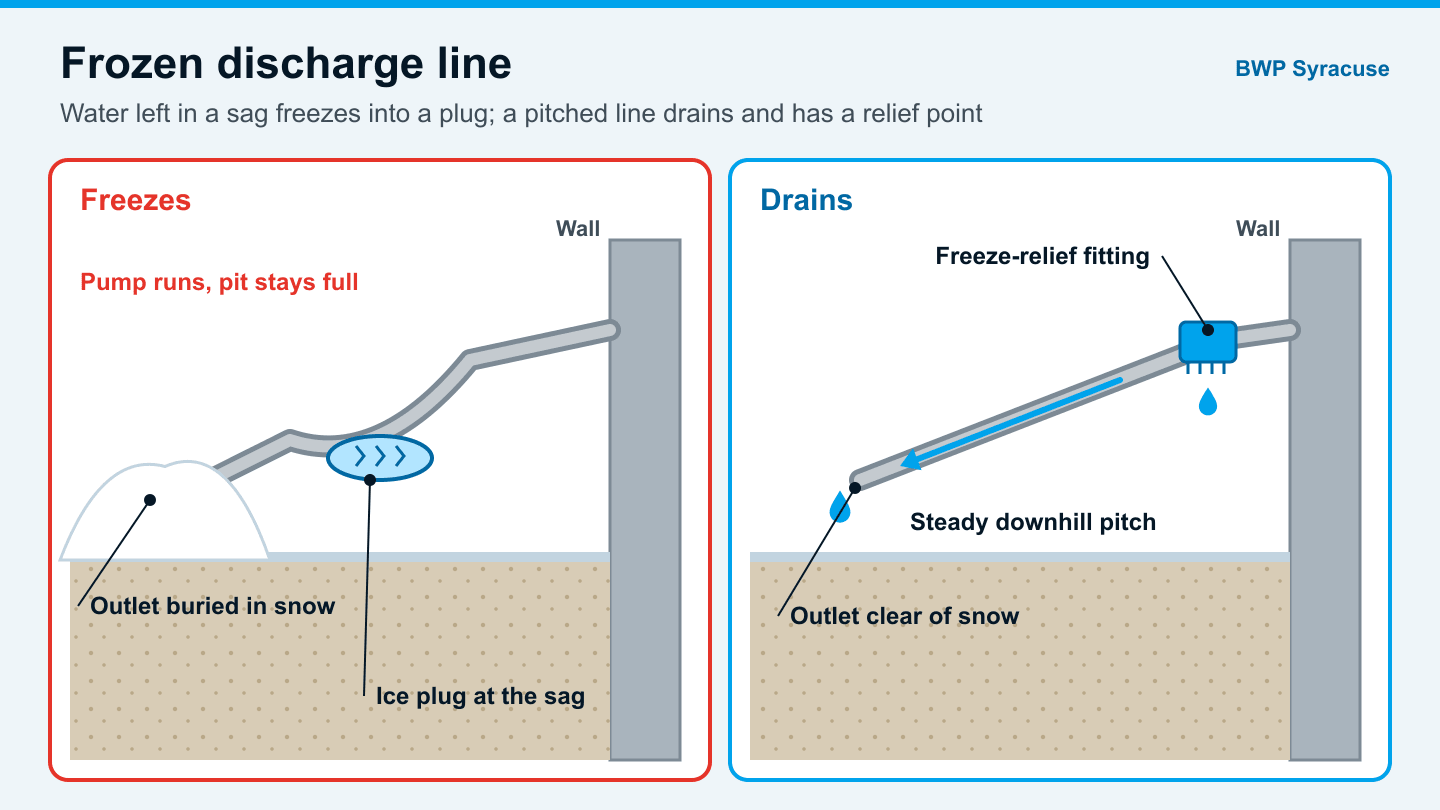
The discharge pipe carries water from the check valve up and out of the house. Outside, it should direct water away from the building, as the same guidance says. In cold climates this outdoor run is where problems start, since water left in a sag or a buried outlet can freeze.
The lid
The Building America guidance says the pit should have an airtight cover for indoor air quality reasons, so soil gases don’t enter the house. A sealed lid also keeps debris, toys and pets out of the pit, all of which can jam a float.
Alarms
A high-water alarm sounds when the water rises above the level where the pump should have started. It is the cheapest way to learn the pump has failed before the floor is wet. An alarm that runs on its own battery still works when the power is out or a GFCI has tripped.
Backup arrangements
A backup gives the system a second way to move water if the primary pump fails or loses power. Wikipedia’s article notes that a secondary, typically battery-powered pump can operate if the first fails. The main options:
- Battery backup pump. A second pump with its own float, on a battery that charges from household power. It runs for a limited time depending on the battery and how hard it works.
- Water-powered backup. Uses municipal water pressure to pull water out of the pit, with no electricity. Whether it suits a home depends on water pressure, the supply type and local plumbing rules, so it isn’t allowed or practical everywhere.
- Dual primary pumps. Two electric pumps in the same pit, set at staggered heights, so the second runs if the first fails or can’t keep up. It doesn’t help in a power outage unless paired with a battery or generator.
Power supply
The pump plugs into an outlet near the pit. Building America notes the outlet may need to be a GFCI (ground fault circuit interrupter) outlet, which cuts power if it detects current leaking. Many installers prefer a dedicated circuit so another appliance can’t trip the pump’s breaker. An electrician should decide what your home needs, and the pump should plug straight in rather than through an extension cord.
Components at a Glance
| Component | Its job | What commonly goes wrong |
|---|---|---|
| Drain tile | Collects groundwater and carries it to the pit | Silted up, crushed or missing on part of the perimeter |
| Sump pit (basin) | Holds water until the pump starts | Too small, full of debris, no sealed lid |
| Pump and impeller | Lifts water out of the pit | Undersized, worn, jammed by debris, motor burned out |
| Float switch or sensor | Starts and stops the pump | Stuck, tangled, blocked, failed internally |
| Check valve | Stops water falling back into the pit | Stuck open, installed backward, missing |
| Discharge pipe and outlet | Carries water out and away | Frozen, sagging, buried in snow, too close to the house |
| Alarm | Warns of high water | No battery, unplugged, never tested |
| Backup pump | Runs if the primary fails or loses power | Dead battery, float set wrong, never tested |
| Outlet and circuit | Powers the pump | Tripped GFCI or breaker, extension cord, unplugged |
Types of Sump Pumps
Submersible vs pedestal
A submersible pump sits in the water at the bottom of the pit. Its motor is sealed inside a waterproof housing. Because it’s below the water, it’s quieter, and the pit can be covered with a sealed lid. Most residential systems use this type.
A pedestal pump has the motor mounted on a column above the pit, with only the intake end in the water. The motor stays dry and is easy to reach, but it is louder and the open column makes a sealed lid harder. Pedestal pumps are often found in narrow pits that can’t fit a submersible.
Float types
- Tethered float. A float on a short cord that swings up as the water rises. It needs a wide pit so it can move without catching on the wall or the pipe.
- Vertical float. A float that slides up and down a rod attached to the pump. It needs less room, which suits narrower pits.
- Electronic switch. Detects the water level without a moving float. It has no arm to snag, though it still depends on the sensor staying clean.
The right type depends on the pit size and the pump. Manufacturer instructions specify how much clearance each switch needs.
How Sump Pump Sizing Works
Sizing is where a lot of pumps go wrong, and there is no honest rule of thumb that fits every house. Three things set the requirement.
Inflow rate. How much water reaches the pit during the wettest conditions. A house on a high water table with full perimeter drain tile can see far more water than a house with a small pit and dry soil. The best evidence is how often the existing pump runs during a spring thaw.
Total dynamic head. This is the total resistance the pump has to overcome. It combines the vertical lift (the height from the water in the pit to the highest point of the discharge pipe) with friction loss from the length of pipe, its diameter and every elbow, valve and fitting. A pump moves less water as head increases.
Configuration. The pit size, the switch type and the on and off levels affect how long each cycle runs and how often the pump starts.
To match a pump to those numbers, installers read the pump curve, a chart from the manufacturer that shows how many gallons per hour or minute the pump moves at each height. A pump that looks strong at zero lift may move far less at your actual head. Horsepower alone does not tell you that. A bigger pump is not always better either: in a small pit it can empty the basin in seconds and start and stop constantly.
What Normal Operation Looks Like
A healthy pump is mostly quiet. In dry weather it may not run for days or weeks. After heavy rain or during snowmelt, it starts more often, each cycle lowers the water clearly and the pump shuts off on its own. As the ground dries, the gaps between cycles get longer again.
In Syracuse, that usually means a busy pump in late winter and spring, when the March thaw and spring rain push groundwater up, and a quiet one by late summer. It’s worth listening for the pump during the first big thaw each year, since that tells you whether the system is keeping up.
A simple fall check helps too. From dry floor, with dry hands, make sure the pump is plugged in, the float moves freely, the lid is in place and the outlet outside is clear. Many pump manufacturers describe a test that involves slowly adding a bucket of water to the pit and watching the pump start and stop, so check your manual.
Common Sump Pump Problems
A frozen discharge line
In a cold snap, water left in a sagging or flat outdoor pipe, or an outlet buried in snow, can freeze and block the line. The pump runs, but the pit doesn’t drop. October is the time to fix the pitch and the outlet. See what to do about a frozen discharge line.
A pump that runs constantly
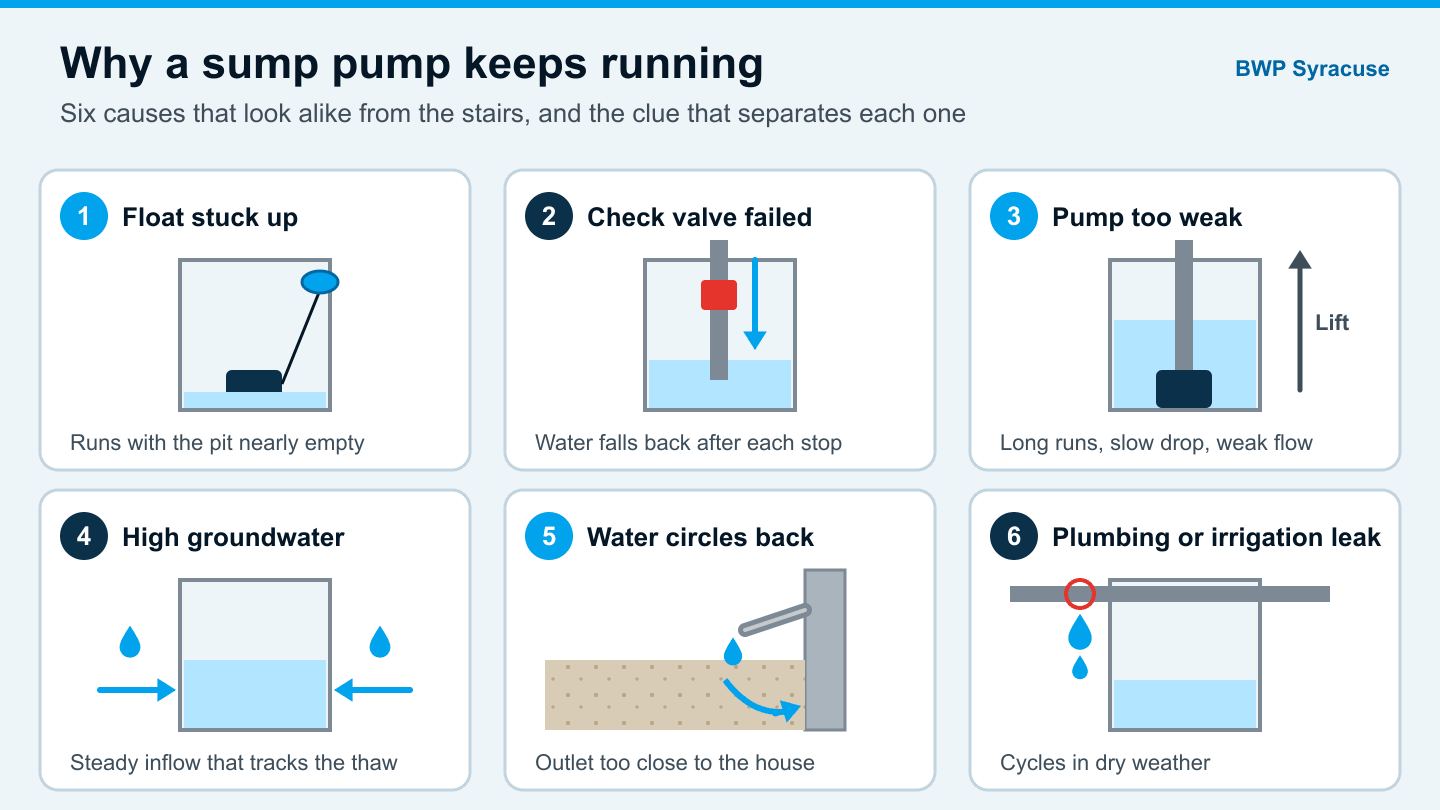
Constant running can be normal during a heavy thaw, or it can mean a stuck float, a failed check valve, an undersized pump or water circling back from the outlet. Timing the cycles tells you which. Why a sump pump runs constantly lays out six causes and how to tell them apart.
A pump that won’t turn on
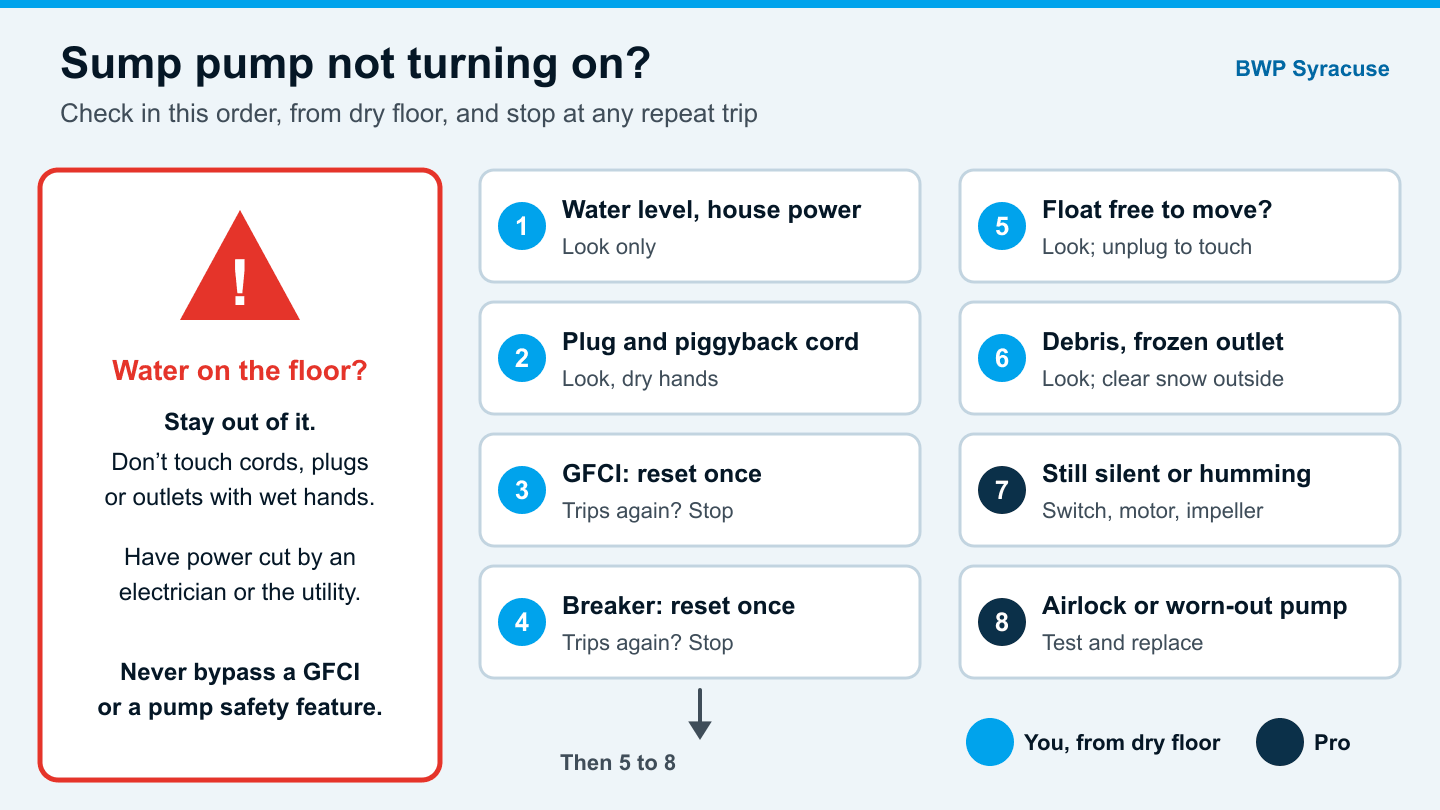
A pump that stays silent while the pit fills usually has a power problem, such as a tripped GFCI or breaker, or a stuck float. The order of checks matters because of the water and electricity involved. What to check when a sump pump won’t turn on walks through it safely.
What a Sump Pump Can and Can’t Do
A sump pump manages water that reaches the pit. It does not stop water entering through a wall crack higher up, and it does nothing for humidity or condensation. It also can’t collect water from parts of the foundation that have no drain tile feeding the pit. If water is appearing at the base of the wall with a pump already in place, water coming in where the wall meets the floor explains how to read that pattern.
No pump is a guarantee. Pumps fail, power goes out and switches stick. The systems that hold up best pair a properly sized primary pump with a sealed lid, a check valve, a clear and pitched discharge line, a high-water alarm and a backup. When a drainage system around the perimeter feeds the pit, the layout of the drain tile matters as much as the pump. BWP Syracuse installs interior drainage systems with sump pumps and can look at an existing setup during a free inspection.
The pump gets the attention, but the drain tile, the check valve and the outlet decide whether the water actually leaves.
Frequently Asked Questions
Where does the water in a sump pit come from?
Usually from groundwater. Perforated drain tile around the footing or under the slab collects water from the soil and carries it to the pit. Some pits also take water from a floor drain or from seepage through the slab. A pit with no drain pipes entering it collects only what reaches it directly, which is far less.
How often should a sump pump run?
There is no correct number, since it depends on how much water reaches the pit. A pump that is quiet in dry weather and busy after rain or snowmelt is behaving normally. Running nonstop, restarting within seconds or cycling hard in a dry spell are the patterns worth investigating, as covered in why a sump pump runs constantly.
Do I need a battery backup sump pump?
It depends on how much water your pit handles and how much risk a power outage carries for you. Storms that fill the pit also cause outages, and a primary pump on household power stops when the power does. A battery backup with its own float and alarm covers that gap for a limited time. It is a backup, not a guarantee.
Should the sump pit have a lid?
Yes. DOE Building America guidance says the pit should have an airtight cover for indoor air quality reasons, to keep soil gases out of the house. A sealed lid also keeps debris, pets and children out of the pit. It needs openings for the discharge pipe and cord that are sealed around them.
How long does a sump pump last?
Life depends heavily on how hard the pump works, the water it handles and the model. A pump in a pit that runs through every spring thaw will wear faster than one that runs a few times a year. Check the manufacturer's literature for your model and plan to test the pump each fall.