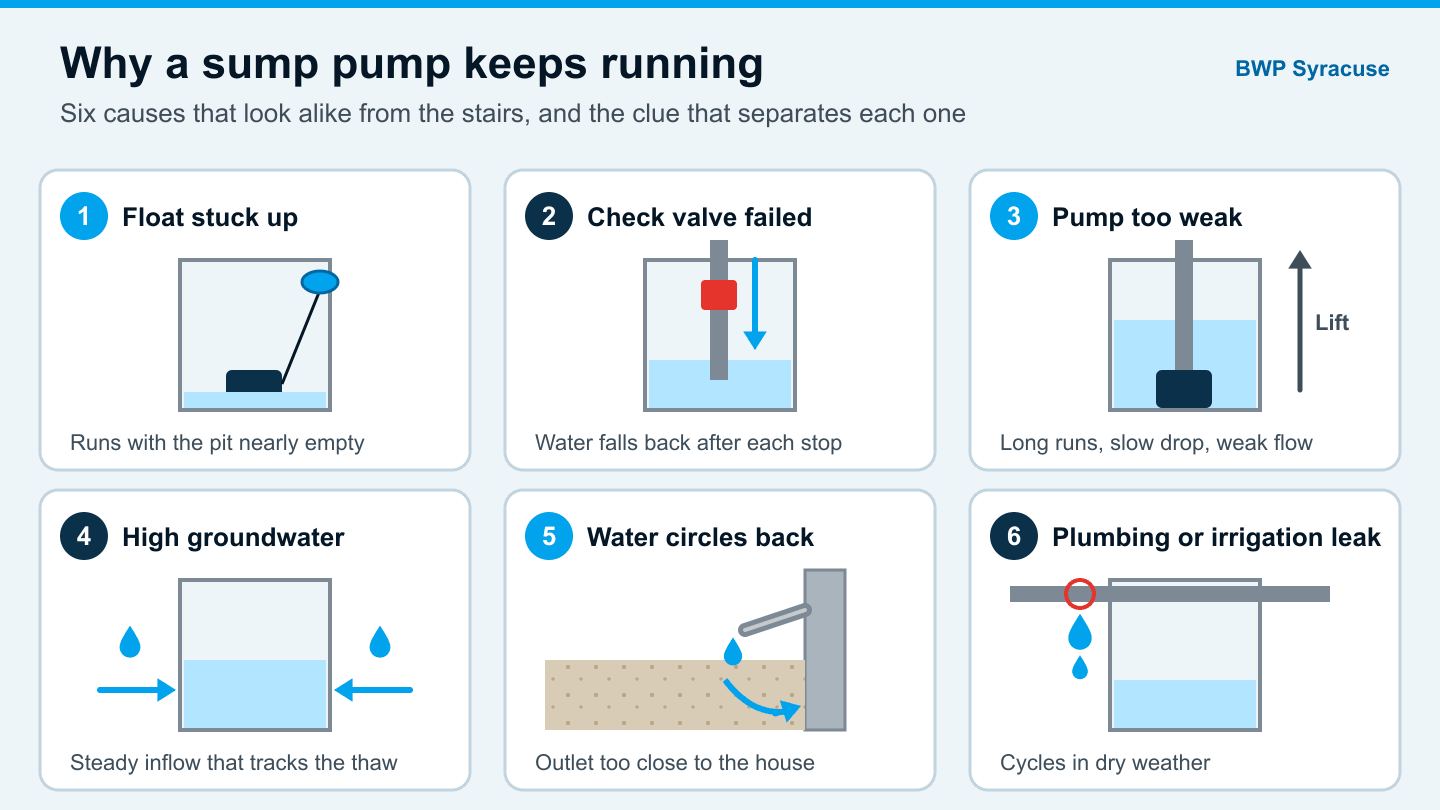
A sump pump running constantly is doing one of two things: keeping up with water that really is coming into the pit, or stuck in a loop where it can’t finish its job. The first is often normal after rain or snowmelt. The second, a stuck switch, a failed check valve or water circling back to the pit, wears out the motor and needs a fix.
The way to tell them apart is to watch the pit and time the cycles, which takes a few minutes and never requires reaching into the water. This guide covers what normal cycling looks like, six causes of constant running that don’t overlap, and a safe way to narrow them down. If you are new to the parts involved, how a sump pump works explains the float, check valve and discharge line first.
Normal Cycling vs a Sump Pump Running Constantly
A sump pump is supposed to run in bursts. The pit fills, the float switch rises and starts the pump, the pump lowers the water, the float drops and the pump stops. How often that happens depends on how fast water reaches the pit.
Normal looks like this: the pump runs for a short stretch, the water level drops clearly, the pump shuts off, and the pit stays low for a while before the next cycle. During a long rain or a spring thaw, those quiet gaps get shorter, sometimes only a few minutes. As the ground dries out, the gaps get longer again.
Abnormal looks like one of these:
- The pump runs without stopping, even though the water level has dropped near the bottom.
- The pump runs, stops, and restarts within seconds, before the pit could have refilled.
- The pump runs often during a dry week with no thaw going on.
- The pump runs nonstop and the water level never drops.
Penn State Extension’s groundwater guidance (opens in a new tab) notes that groundwater levels tend to be highest in March and April, driven by snowmelt and spring rain. In Syracuse, a pump that is busy through late winter and spring and quiet by late summer is following that seasonal pattern.
How to Time the Cycles Safely
Goal: find out whether the pump is responding to real inflow or repeating itself without a reason. You need a watch or phone timer, a flashlight and dry floor to stand on.
- Check the floor first. If there is water on the floor near the pit, outlets or cords, don’t go near the pump. Have power shut off by someone who can reach the panel safely, such as an electrician or the utility.
- Lift the lid only if it is designed to come off, and only from dry floor. Look, don’t touch. Never reach into the pit while the pump is plugged in.
- Time one full cycle. Note when the pump starts, when it stops, and how far the water drops.
- Time the gap. Note how long the pit stays quiet before the next start, and watch where the water is coming from: the drain pipe openings in the pit wall, the bottom, or back down the discharge pipe.
- Repeat a few hours later, and again after a dry day, so you have a trend rather than one reading.
- Walk outside to the outlet. See where the water goes after it leaves the pipe.
How to read the result: a pump that lowers the water and stops, with gaps that track the weather, is probably keeping up with inflow. A pump that never stops, restarts within seconds, or cycles hard in dry weather points to one of the causes below. When to call a professional: the pump keeps shutting off on its thermal protection or smells of hot insulation, the breaker or GFCI keeps tripping, water is rising over the pit, or you can’t see the float clearly.
Six Reasons a Sump Pump Keeps Running
1. The float switch is stuck or has failed
The float switch is the part that tells the pump when to start and stop. A tethered float on a cord can catch on the pit wall, the discharge pipe or the pump’s own power cord and stay in the “on” position. A vertical float can stick on its rod. Debris, a pump that has shifted in the pit, or a float that has filled with water can all hold it up. A switch can also fail internally and keep the pump running even when the float is low.
The sign: the pump keeps running with the pit nearly empty, often with a sucking or gurgling sound as it pulls air. Repositioning a pump or freeing a float means reaching into the pit, which should only be done with the pump unplugged from a dry position, or by a professional.
2. The check valve has failed or is missing
A check valve is a one-way valve on the discharge pipe that stops water from falling back into the pit after the pump shuts off. Building America guidance on sump pump installation (opens in a new tab) calls for one for exactly that reason. Without it, or with a valve stuck open, the water standing in the vertical pipe drains back into the pit every cycle. The pump then pumps the same water over and over.
The sign: right after the pump stops, you hear water rushing back down the pipe and see the pit level jump up. Cycles are short and frequent even when little new water is arriving. Replacing a check valve is a plumbing repair on a pipe that may hold water, so most homeowners leave it to a pro.
3. The pump is undersized or too weak for the lift
Every pump moves less water the higher it has to push it. That height, plus resistance from the pipe and fittings, is called total dynamic head. A pump that was fine for a short, straight run may barely move water through a taller lift or a long line with many elbows. An aging pump with a worn impeller has the same problem.
The sign: the pump runs for long stretches during wet weather, the water drops slowly, and the outlet flow looks weak. The pit may barely keep up. Sizing a replacement means checking the manufacturer’s pump curve against your actual lift and pipe run, which is a job for an installer.
4. Groundwater is high, even without rain
Some houses sit on a high water table, near a spring, in a low part of the lot, or on dense clay that drains slowly. During a thaw the ground can feed the drain tile, the perforated pipe that collects water around the footing, for days with no rain at all.
The sign: water arrives steadily through the drain openings in the pit wall, the pump empties the pit and stops properly, and the cycling follows the season. That is a pump doing its job. The practical question is whether it can keep doing it, which is where a backup pump, an alarm and a look at the outside drainage come in.
5. Discharged water is flowing back to the foundation
If the outlet drops water right beside the house, onto ground that slopes back toward the wall, or into a short extension that has come loose, the water can soak straight back down to the drain tile. The pump ends up moving the same water in a circle.
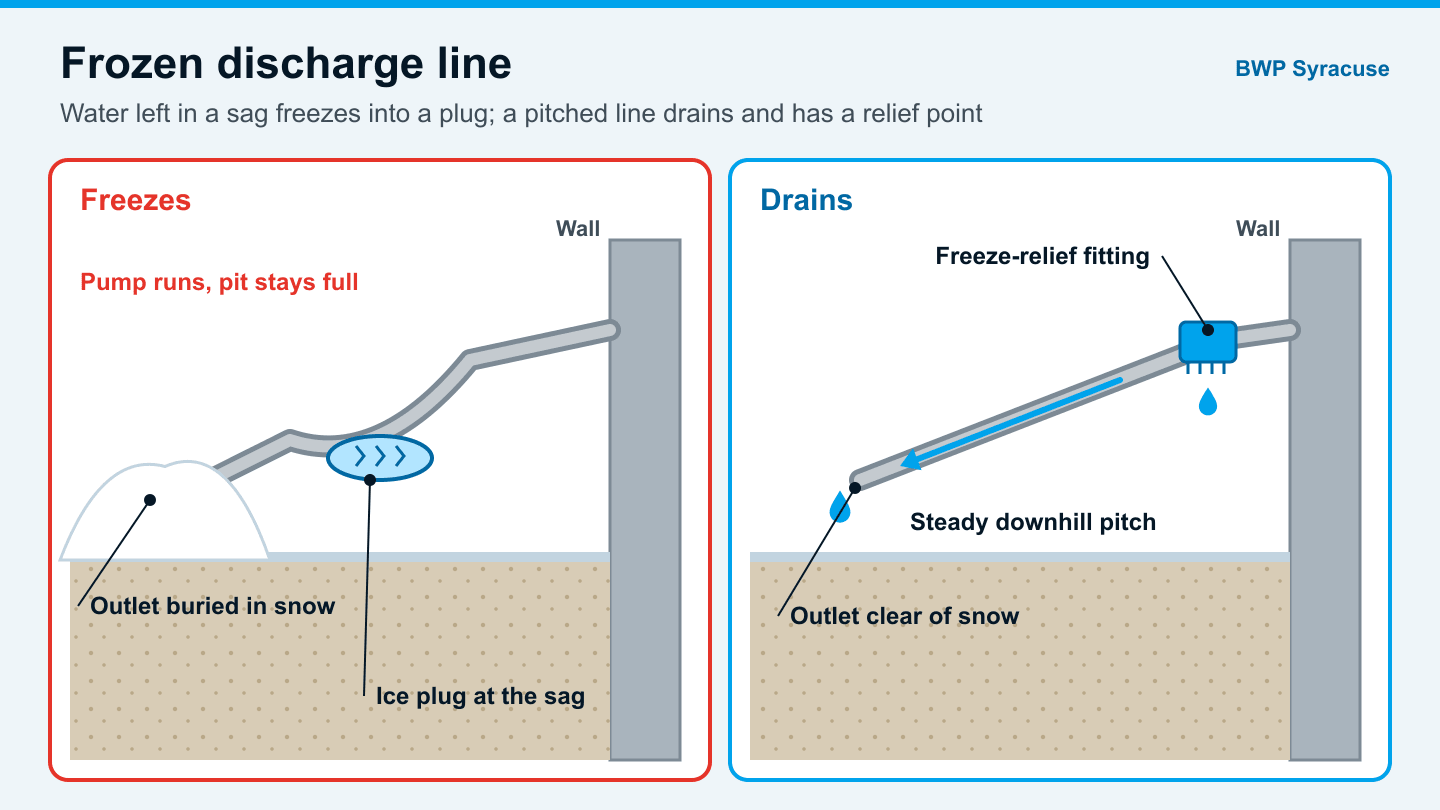
The sign: pooling or soggy ground near the outlet, an outlet within a few feet of the wall, and cycling that eases off when you temporarily extend the line farther out. In winter, an outlet that ices over causes a different problem, covered in what to do about a frozen discharge line.
6. A plumbing or irrigation leak is feeding the pit
A leaking water supply line under the slab, a broken irrigation line, a dripping outdoor spigot, or a fixture drain that someone tied into the sump can all send water to the pit every day. These sources don’t follow the weather.
The sign: steady cycling during a dry spell, with no thaw. Turn off all water use and watch the water meter. If it still moves, there is a leak somewhere on the supply side. Shut off the irrigation system and see whether the cycling slows. If the water in the pit looks soapy or smells like a drain, a fixture may be connected to it, which is a question for a plumber.
Diagnostic Table: Symptom, Likely Cause, Next Step
| What you see | Likely cause | Safe next step |
|---|---|---|
| Pump runs nonstop with pit nearly empty | Stuck or failed float switch | Unplug from a dry spot with dry hands, then have the float checked or freed |
| Water rushes back into pit after each stop | Failed or missing check valve | Note the backflow, then have the valve replaced |
| Long run times, slow drop, weak outlet flow | Pump undersized or worn for the lift | Note run times, then have the pump and pump curve checked against the lift |
| Steady inflow from drain openings, cycles track the thaw | High groundwater | Log cycles, check backup and alarm, review outside drainage |
| Soggy ground at a nearby outlet, cycling eases when extended | Water recirculating to the foundation | Move the outlet farther from the house so water runs away |
| Frequent cycling in dry weather, meter moving | Supply, irrigation or fixture leak | Do a water meter test, shut off irrigation, call a plumber |
| Pump runs but no water leaves the outlet in freezing weather | Frozen or blocked discharge line | Check the outlet from outside first |
Short Cycling Is a Separate Pattern
Short cycling means the pump turns on and off in very quick bursts, often every few seconds. It is not the same as running constantly, though it wears the motor the same way. The usual causes are a failed check valve (cause 2), a float set with too little travel, or a pump too large for a small pit, which empties it almost instantly and restarts as soon as a little water returns. The fix is usually an adjustment or a better-matched pump, not a bigger one.
Mistakes That Make It Worse
- Unplugging a pump that is keeping up with real inflow. That turns a noisy problem into a flooded one.
- Taping or wedging the float. Disabling a switch or safety feature to stop the noise can lead to a burned-out motor or a flooded basement.
- Reaching into the pit with the pump plugged in. Unplug from a dry position first, or leave it to a pro.
- Buying a much bigger pump without measuring. A bigger pump in a small pit can create short cycling instead of fixing anything.
- Ignoring a pump that has worked hard all spring. Heavy duty seasons are when backups and alarms earn their place.
When the Pit Is the Wrong Place to Look
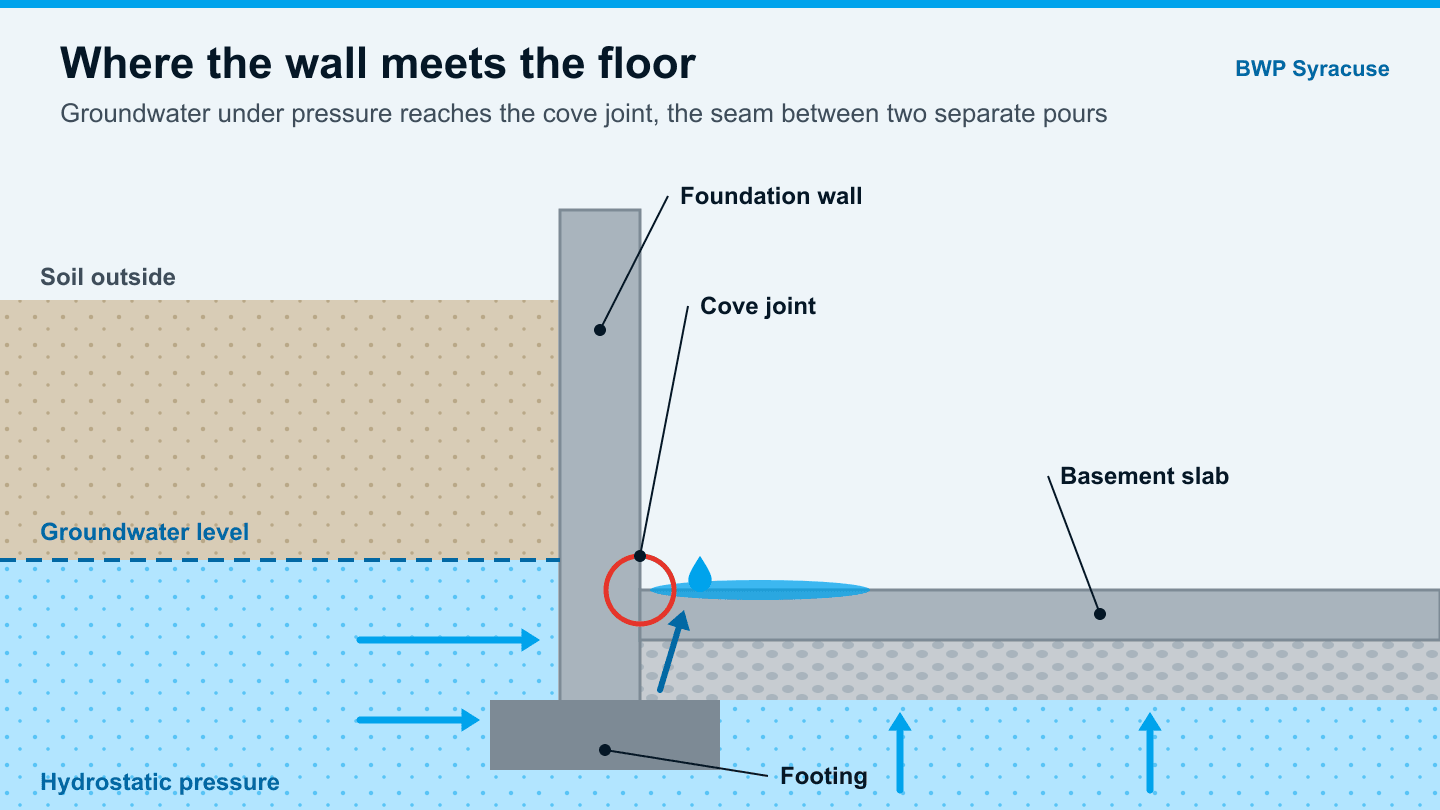
If the pump runs hard every thaw and water still shows up at the wall-floor joint, the pump may not be the weak link. Water coming in where the wall meets the floor explains how groundwater at the footing can bypass a system that doesn’t collect along the whole perimeter.
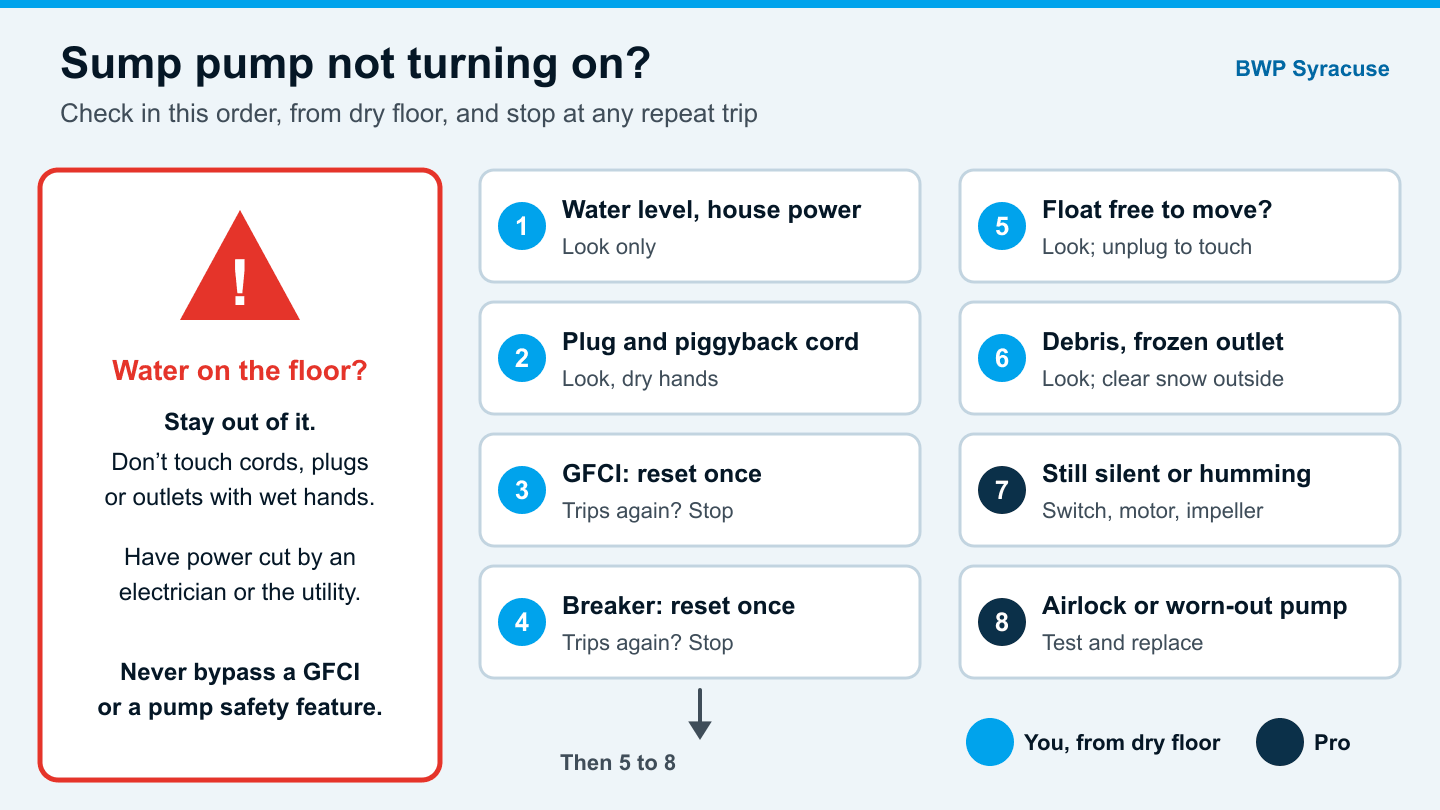
A pump that is silent while the pit fills is the opposite problem. What to check when a sump pump won’t turn on covers power, the float and the motor in a safe order.
If the cycling doesn’t match any of these patterns, BWP Syracuse can inspect the pit, the valve and the outlet and tell you whether the pump is struggling or simply busy.
A pump that runs often and shuts off cleanly is working; one that never stops is asking for help.
Frequently Asked Questions
Is it normal for a sump pump to run every few minutes?
It can be, during and after heavy rain or a fast snowmelt, when groundwater is high. What matters is whether the pit empties fully each time, whether the pump shuts off cleanly, and whether the cycling slows down as the weather dries out. Frequent cycling in a dry spell with no plumbing explanation is not normal.
Can I unplug my sump pump if it keeps running?
Only if you are certain no water is coming in, and only from a dry spot with dry hands. Unplugging a pump that is keeping up with groundwater leaves the pit with nowhere to go but the floor. If the pump is running because of a stuck switch with an empty pit, unplugging it briefly to protect the motor is reasonable while you arrange a repair.
How long does a sump pump last if it runs all the time?
There is no reliable single number. Manufacturers generally design residential pumps for intermittent duty, and a pump that runs far more than it was sized for will usually wear out sooner. Ask the installer or check the manufacturer's literature for your model, and plan for a replacement or a backup if your pit stays busy every spring.
Why does my sump pump run when it hasn't rained?
Snowmelt and seasonal groundwater can keep a pit filling for days or weeks without rain, especially in early spring. If the cycling continues through a long dry stretch, look for a plumbing or irrigation leak, water recirculating from the outlet, or a check valve letting water fall back. The diagnostic table in this guide lists a safe next step for each.