A sump pump not turning on is most often a power problem, such as a tripped GFCI outlet, a tripped breaker or an unplugged cord. The next most likely causes are a float switch that is stuck or blocked, followed by a failed switch, a burned-out motor or a pump that has reached the end of its life.
Because the pump sits in water and runs on household current, the order you check things matters. The safe sequence starts with the checks you can make by looking, from dry floor, and leaves anything inside the pit or the electrical system to the right professional. For background on the parts, see how a sump pump works.
How You Usually Find Out the Pump Isn’t Starting
Most homeowners don’t notice a silent pump on a dry day, since a pump with nothing to do is supposed to be quiet. The problem shows up when water arrives and nothing happens. Common clues:
- A high-water alarm sounds. Many systems have a separate alarm that goes off when the water rises above the normal starting point.
- The pit is full to near the rim during or after rain or a thaw, with no motor sound.
- The backup pump is running. If a battery backup kicks on, the primary pump has either failed to start or can’t keep up.
- Water appears around the pit or along the floor after a storm when the basement normally stays dry.
Any of these during wet weather means the troubleshooting is urgent, and safety comes first.
Before You Touch Anything: Electricity and Water
A pump that won’t start is often discovered when water is already rising. That is the moment people get hurt.
- If water is on the floor around the pit, outlet or cords, stay out of it. Don’t step into the water to unplug anything or reset anything.
- Don’t touch the pump, its cord, the plug or the outlet with wet hands or while standing on a wet floor.
- If the basement is flooded, have the power cut by an electrician or the utility. CDC’s guidance on electrical hazards (opens in a new tab) says never to turn power on or off yourself while standing in water, and to call an electrician if you would have to wade in to reach the main switch.
- Never bypass a safety device. Don’t plug the pump into a different circuit with an improvised cord, defeat a GFCI, or rewire the switch to force the pump on.
If the floor is dry and you can reach the pit area without stepping in water, the checks below are safe to do in order.
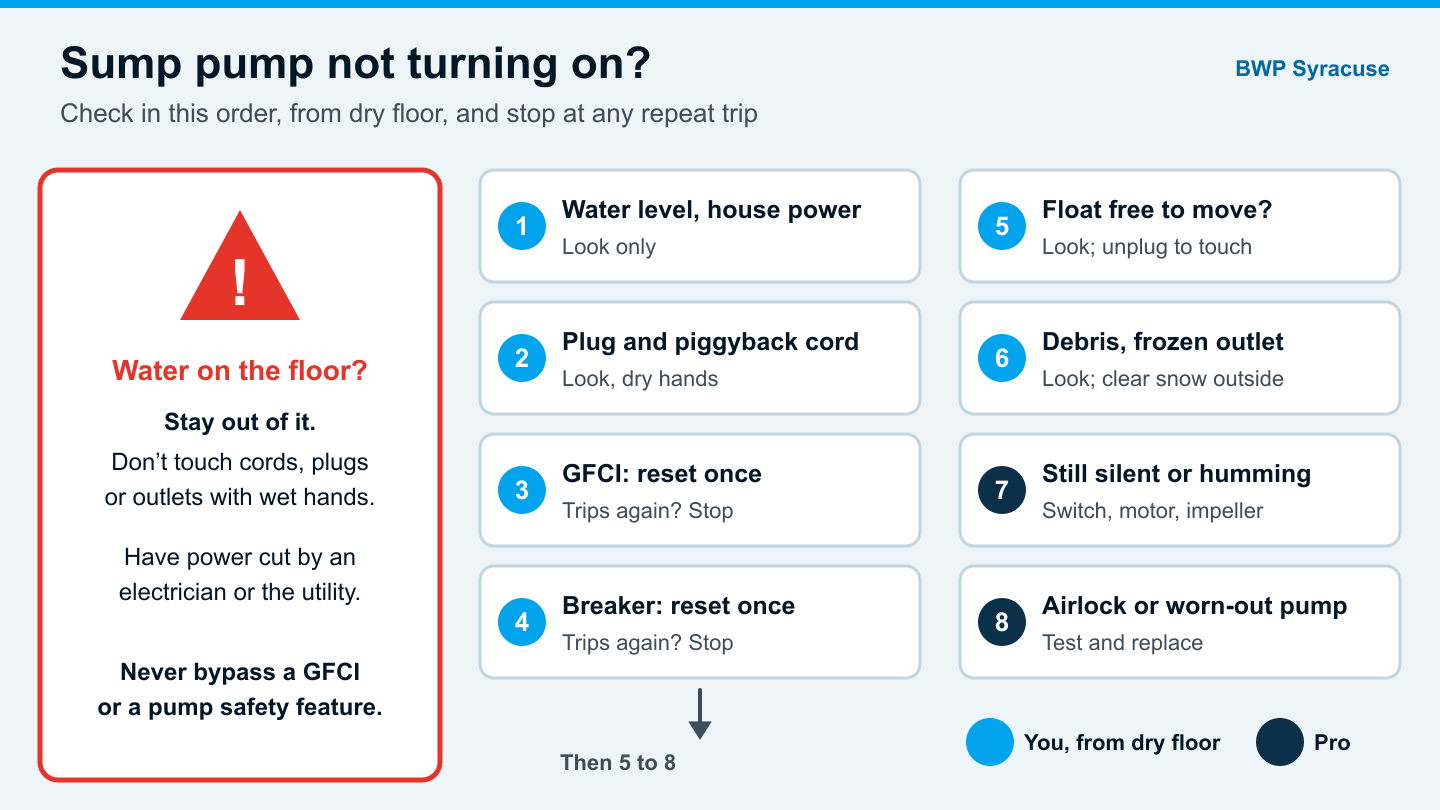
Safe Troubleshooting Order for a Sump Pump Not Turning On
Goal: find the reason the pump isn’t starting while staying on dry floor and leaving the electrical and mechanical work to a pro.
1. Look at the water level and the house power (visual)
Check whether the pit is actually full enough to start the pump. If the water is below the point where the float lifts, the pump is right to be off. If the water is high, keep going.
Then confirm the house has power. Storms that fill the pit also knock out power lines, and a pump on household current stops with everything else. If the lights are out, the pump isn’t broken, and the question becomes whether you have a backup that runs without grid power.
2. Check the plug and the cord (visual)
From dry floor, look to see whether the pump is plugged in. Pumps get knocked loose during cleaning or storage. Look for a cord that is cut, crushed or pulled partly out.
Many pumps use a piggyback plug, where the float switch has its own plug and the pump plugs into the back of it. If the pump is plugged straight into the wall without going through the switch plug, or the two are separated, the float can’t turn the pump on. Check how yours is meant to be connected in the manufacturer’s instructions.
3. Check the GFCI outlet (homeowner, dry hands only)
Building America guidance on sump pump installation (opens in a new tab) notes that the outlet may need to be a GFCI (ground fault circuit interrupter) outlet, a type that cuts power when it senses current leaking where it shouldn’t. That protects people, but it also means a trip can silently stop the pump. The GFCI protecting the pump is not always the outlet the pump is plugged into; it can be another GFCI upstream on the same circuit.
If the pump is on a GFCI outlet, look for a tripped indicator or a reset button that has popped out. With dry hands and dry feet, press reset once. If it trips again, stop. A GFCI that keeps tripping is telling you there is a fault, often in the pump or cord, and that needs an electrician or a pump technician.
4. Check the breaker (homeowner, from a dry spot)
At the panel, look for a breaker in the tripped position. Reset it once if you are standing on a dry floor. If it trips again right away, leave it off and call an electrician.
5. Watch whether the float can move (visual)
With the pit lid off, if it is designed to come off, look at the float. A tethered float on a cord can get pinned against the pit wall or caught on the discharge pipe. A vertical float can stick on its rod from mineral buildup or debris. A pump that has shifted in the pit can trap the float too.
Don’t reach into the pit while the pump is plugged in. If the float needs freeing or the pump needs repositioning, unplug it first from a dry position, or have a professional do it.
6. Look for debris (visual)
Gravel, silt, a fallen object or a bag left in the pit can block the float or the pump intake. Note what you see. Clearing the pit is a job for an unplugged pump and, ideally, a professional.
7. Check the discharge line outside (visual)
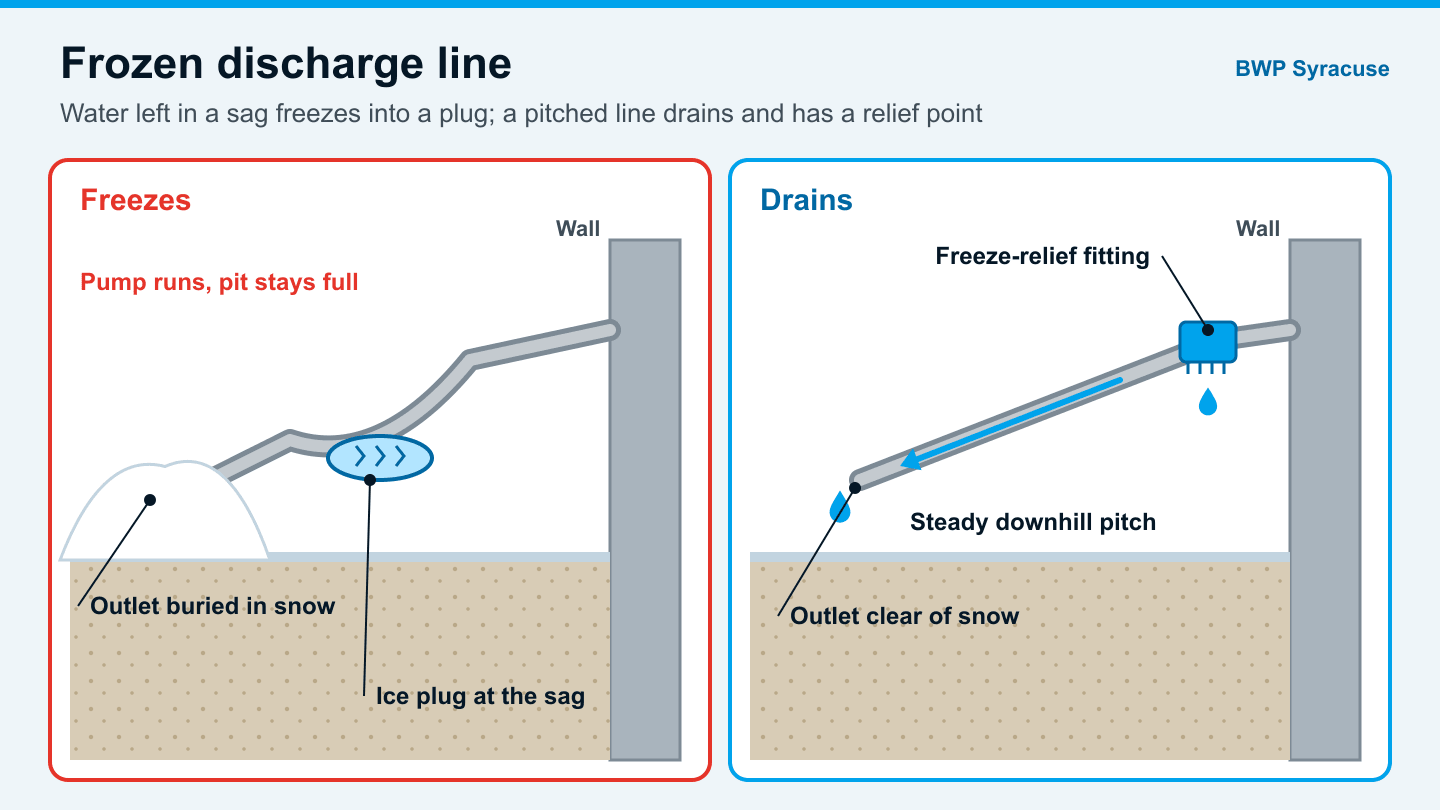
If the weather is freezing, go outside and look at the pipe outlet. A frozen line usually makes a pump run without draining the pit rather than stay silent, but a pump that overheated against a blocked line can shut itself off on its thermal protection. If the outlet is iced over, start with what to do about a frozen discharge line.
How to read the result: if steps 2 to 4 restored power and the pump started, watch it through a full cycle and plan to find out why it lost power. If power is confirmed and the float is free but the pump still won’t start, the cause is inside the pump or switch. When to call a professional: any repeat trip, any pump that hums without moving water, any sign of a burning smell, and any time water is close to the rim of the pit.
What a Professional Checks Next
Once power and the float are ruled out, the remaining causes need tools, an unplugged pump and often a pump lifted out of the pit.
A failed float switch
The float may move freely and still not close the switch inside. A technician can test the switch separately from the motor. On many pumps the switch can be replaced on its own.
A burned-out motor
Motors wear out, and they fail faster if they have run against a blockage, run dry or run constantly through wet seasons. A motor that has failed may hum, smell hot or do nothing at all.
A jammed impeller
The impeller is the spinning part that moves the water. A stone or debris can lock it, and the motor will hum or trip its protection instead of turning.
An airlock
Air trapped in the pump housing can stop a pump from moving water even though the motor runs. This shows up after a pump is replaced or the pit runs dry. Many installations use a small weep hole drilled in the discharge pipe, below the check valve, to let air out, but the right fix depends on the pump and should follow the manufacturer’s instructions.
End of life
Pumps don’t last forever. An old pump that has been through several hard springs may simply be done. Replacing it is a chance to check that the new pump suits your actual lift and pipe run, and to add a backup.
After It Starts Again
Getting the pump running is half the job. Watch it through at least one full cycle from dry floor: it should start when the water rises, lower the pit clearly and shut off on its own. Then work out why it stopped. A GFCI that tripped once during a storm, a plug knocked loose or a float pinned by a shifted pump each have a different fix, and a pump that quit once without a clear reason is likely to do it again. A high-water alarm on its own power source gives you warning next time.
Which Checks Are Yours and Which Are Not
| Check | Who | How |
|---|---|---|
| Water level in the pit | Homeowner | Look from dry floor |
| Plug, cord and piggyback connection | Homeowner | Look, don’t handle wet cords |
| GFCI reset | Homeowner, once, dry hands | Stop if it trips again |
| Breaker reset | Homeowner, once, dry floor | Stop if it trips again |
| Float movement and debris | Look only, unplug before touching | Pro if it needs freeing |
| Frozen discharge outlet | Homeowner, from outside | Clear snow, no flame |
| Switch test, motor, impeller, airlock | Professional | Pump unplugged and often removed |
| Flooded floor near power | Electrician or utility | Power cut before anyone enters |
While You Wait for a Repair
If the pump is down and water is coming in, a few steps limit the damage without adding risk:
- Move stored items away from the pit and off the floor, if the floor is dry.
- Use a backup if you have one. A battery backup pump should take over on its own. Check that its alarm and battery indicator look normal.
- Don’t run a temporary pump off an improvised cord in a wet basement. A professional can set up temporary pumping safely.
- Reduce water reaching the house. Make sure downspouts are connected and discharging away from the foundation.
Not Turning On vs Never Turning Off
A pump that stays silent while the pit fills and a pump that runs without stopping are different failures, though a stuck float can cause either one depending on where it sticks. If your pump starts but won’t shut off, why a sump pump runs constantly covers that side.
If you would rather have the pump, switch and power supply looked at together, BWP Syracuse offers a free inspection and 24/7 emergency response at (315) 940-2872.
A pump that won’t start is a warning to check the power from dry ground before anything else.
Frequently Asked Questions
Why does my sump pump hum but not pump water?
A hum usually means the motor is getting power but cannot turn or move water. Common causes are a jammed impeller, debris blocking the intake, an airlock, or a motor that is failing. Unplug the pump from a dry spot before anyone looks at the intake, and leave the impeller and motor to a professional.
Can I plug my sump pump into an extension cord?
Follow the pump manufacturer's instructions, and most say to plug directly into a properly grounded outlet. Extension cords can drop voltage, come apart at the joint and lie on a damp floor. If the cord does not reach, have an electrician add an outlet near the pit rather than relying on a cord.
Should my sump pump be on a GFCI outlet?
DOE Building America guidance notes that the outlet may need to be a GFCI (ground fault circuit interrupter) outlet. A GFCI protects people from shock, but it can also trip and silently cut power to the pump. That is why a high-water alarm on a separate power source, or a battery backup, is worth having. An electrician can tell you what applies to your home.
How do I know if my sump pump motor is burned out?
If the pump has confirmed power, the float moves freely and the pump still does nothing or only hums, the motor or internal switch has probably failed. A burning smell, a tripped breaker that trips again right away, or a pump that is very old all point the same way. Testing the motor and replacing the pump are jobs for a professional.