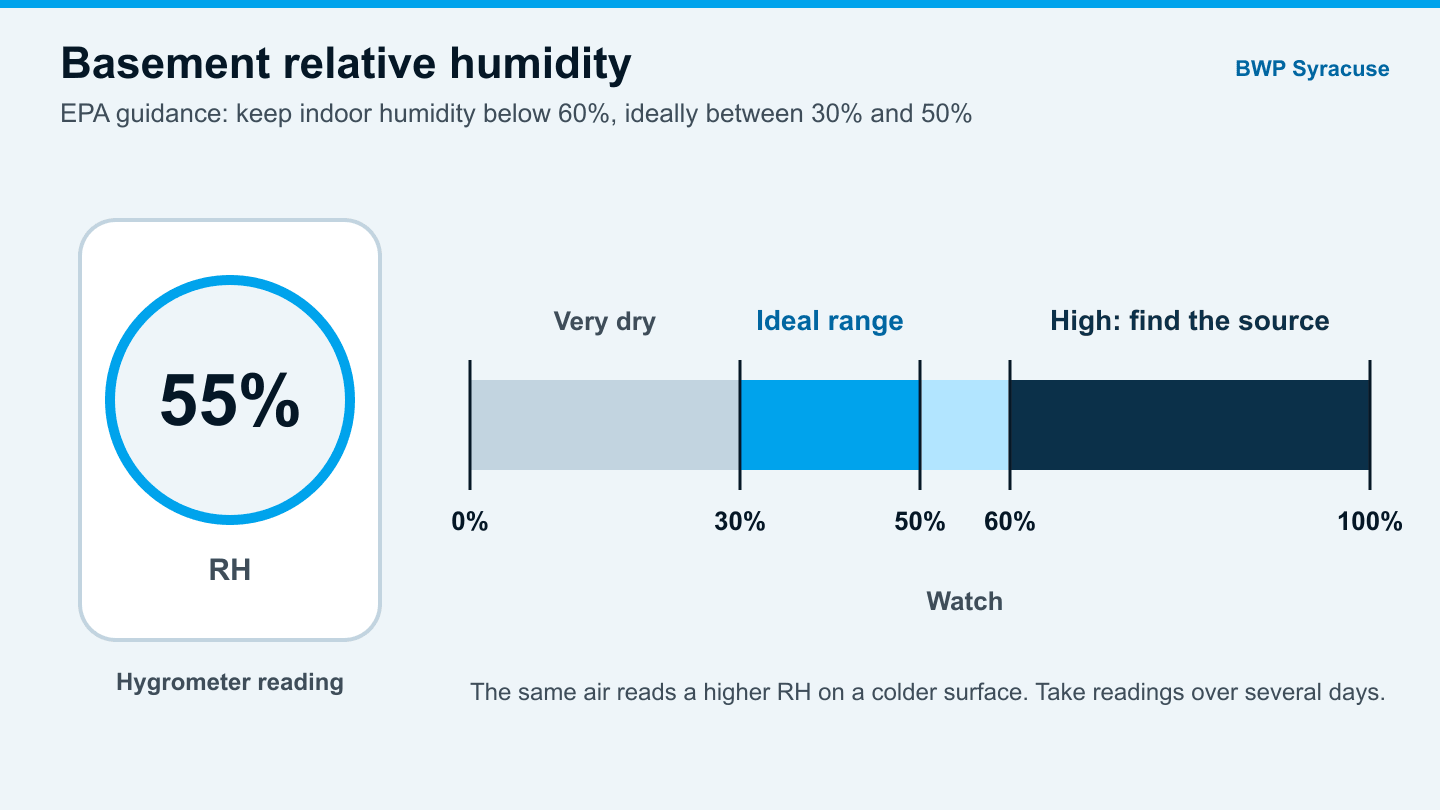
The ideal basement humidity level is below 60 percent relative humidity, and ideally between 30 and 50 percent, which matches EPA guidance for indoor spaces. A basement that holds readings above 60 percent for days at a time has more moisture than recommended, and a basement that cannot be brought below that level with a working dehumidifier often has a moisture source the dehumidifier is not reaching.
The number is only half of the answer. Relative humidity changes with temperature, time of day and where the reading is taken, so a single glance at a hygrometer can mislead. This guide explains what the reading means, how to measure it properly and what to do with each range.
What Relative Humidity Measures
Relative humidity (RH) compares the amount of water vapor in the air with the maximum amount that air could hold at its current temperature, expressed as a percentage. At 100 percent the air is saturated, and any extra vapor turns into liquid water.
The important word is “relative.” Warm air can hold much more water vapor than cool air. If the amount of vapor stays the same and the air cools down, the relative humidity rises, even though no water was added.
That is exactly what happens in a basement. Air that reads a comfortable 45 percent on the main floor can read 60 percent or more after it drifts down to a basement that is several degrees cooler.
Why basements read higher than upper floors
Three things push basement readings up:
- Cooler temperatures. The walls and floor sit against soil, so the air is usually cooler, which raises RH for the same amount of moisture.
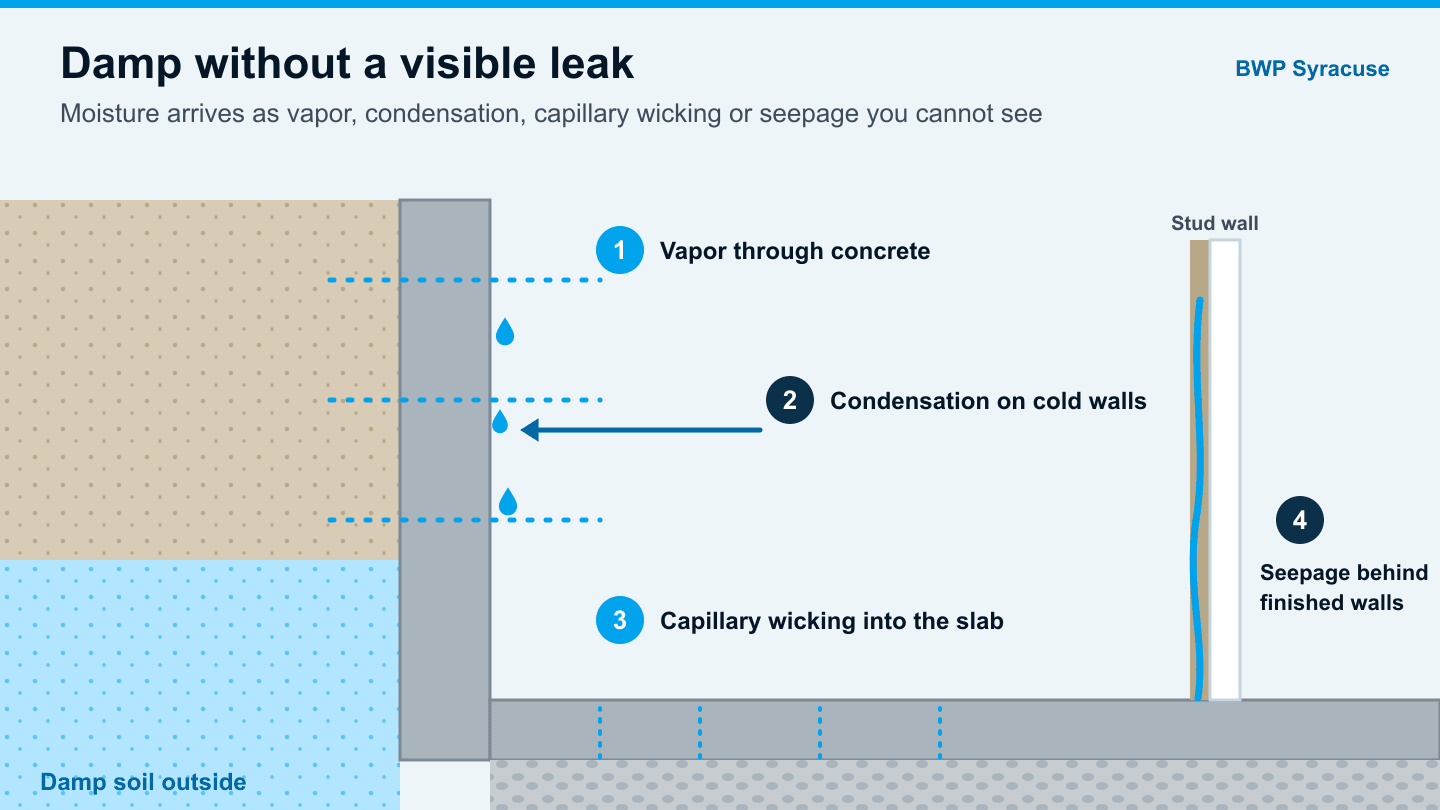
- Moisture from the foundation. Concrete and masonry let vapor through and can wick water from the soil, adding moisture directly to the basement.
- Less air movement. Basements often have fewer supply vents and less circulation, so moisture lingers.
Recommended Humidity Targets
The main published guidance agrees closely, with small differences worth knowing:
- EPA: the brief guide to mold, moisture and your home (opens in a new tab) says to keep indoor humidity below 60 percent, ideally between 30 and 50 percent relative humidity.
- CDC: the You Can Control Mold guide (opens in a new tab) says to keep humidity as low as you can, no higher than 50 percent, all day long.
- ENERGY STAR: the dehumidifier guidance (opens in a new tab) describes the optimum level for a building as generally between 30 and 50 percent.
For a basement, a practical working target is to hold readings between 30 and 50 percent most of the time, and to treat anything that stays above 60 percent as a reason to investigate.
What Each Humidity Range Usually Means
| RH range | What it usually means | What to do |
|---|---|---|
| Below 30% | Very dry air, most common in winter with the heat running | No moisture action needed. Turn off or raise the dehumidifier setting |
| 30% to 50% | Within the ideal range in EPA guidance | Keep monitoring, especially through summer |
| 50% to 60% | Below EPA’s upper limit but above the ideal range and above CDC’s 50% | Watch for condensation on cold pipes and walls, check readings after humid weather |
| 60% to 70% | Above EPA guidance for indoor humidity | Run a dehumidifier, close windows on humid days, look for moisture sources |
| Above 70% for days | Strong sign of a moisture source beyond ordinary humid air | Check for seepage, wicking, plumbing leaks and damp materials, and consider an inspection |
These ranges describe the air in the middle of the room. A cold surface in the same basement can be much wetter than the room reading suggests.
Humidity, Condensation and Mold
Humidity matters because of what it does at surfaces. When air touches a surface colder than its dew point, water vapor condenses into liquid on that surface. Building Science Corporation’s guide to understanding basements (opens in a new tab) describes the main problem with below-grade walls as coming in summer, when warm moist air contacts cold basement surfaces that are below the dewpoint of the interior air.
Mold needs moisture. EPA states that the key to mold control is moisture control, and that mold spores will not grow if moisture is not present. Keeping indoor humidity in the recommended range reduces the conditions that support mold growth. It does not guarantee that mold cannot grow, since a cold wall, a wet carpet pad or a slow plumbing leak can stay damp enough for growth even when the room reads a reasonable number.
That is also why the target is a range rather than a single threshold. The lower the air moisture, the less likely cool surfaces are to reach condensation.
Wood, stored items and finishes
Wood, paper, cardboard, fabric and drywall absorb moisture from humid air. Stored boxes soften, books and photos can stain or grow mildew, wood swells and paint can lift. A basement used for storage or finished living space benefits from staying in the ideal range year-round rather than only avoiding the highest readings.
How to Measure Basement Humidity Properly
A small digital hygrometer is inexpensive and accurate enough for this job. How you use it matters more than which model you buy.
Where to place the hygrometer
- In the main open area of the basement, not in a closet or corner.
- Away from the dehumidifier. Air leaving a dehumidifier is drier than the rest of the room, so a hygrometer beside the unit reports a better number than the basement really has.
- Away from the dryer, water heater, exterior doors and windows, all of which create local swings.
- About chest height, off the floor and away from exterior walls.
If the basement has separate rooms, a second hygrometer in a closed-off room often shows a very different reading.
How many readings to take
One reading tells you very little. CDC notes that humidity levels change over the course of a day, so levels need checking more than once a day. A useful routine:
- Read the hygrometer morning and evening for at least one week.
- Write down the outdoor weather alongside each reading.
- Repeat the week in midsummer and again after a heavy rain or thaw.
- Compare with a reading from the main floor on the same day.
A basement that reads high only on humid summer days behaves differently from one that reads high after every storm.
Using dew point
Many digital hygrometers also show the dew point. If a wall, floor or pipe is at or below that temperature, condensation on it is expected. An infrared thermometer pointed at the wall gives a reasonable surface temperature to compare.
Summer vs Winter Basement Humidity
Basement humidity usually peaks in summer. Warm outdoor air carries a lot of moisture, and when it reaches cool basement walls and floors, the relative humidity rises and condensation can form. Opening basement windows on humid days makes this worse.
Winter readings are usually lower. Cold outdoor air holds little moisture, and heating dries indoor air further. ENERGY STAR notes that in colder climates, humidity during the heating season should be in the 30 to 40 percent range to prevent window condensation.
In practice, Syracuse basements often follow this pattern closely: readings climb from June through September, fall through the heating season and can jump again during the spring thaw if groundwater dampens the walls and slab. A basement that reads high in January, when upstairs air is dry, is a strong hint that moisture is coming from the foundation rather than from outdoor air.
Choosing and Running a Dehumidifier
Sizing at a high level
Dehumidifiers are rated by how many pints of water they can remove per day. ENERGY STAR’s sizing guidance matches capacity to both the size of the space and how damp it is, with larger capacities recommended for spaces that feel wet or show visible moisture. A unit that is too small runs constantly and never reaches its setpoint.
Capacity ratings changed when the Department of Energy updated its dehumidifier test procedure (opens in a new tab), moving the test condition to 65 °F, which DOE considered more representative of how dehumidifiers are used. DOE noted that units extract less water at that temperature, so capacity ratings under the newer test are lower than ratings for the same unit under the older one. Compare models using the same rating basis.
Setpoint
Setting the dehumidifier around 50 percent keeps the basement near the top of the ideal range without wasting energy. Check the result with your separate hygrometer and adjust from there, since the built-in sensor reads the air right at the machine.
Setting it very low, such as 30 percent, rarely helps in a basement. The unit runs far longer, and many units are less effective in cool basements. Check the manufacturer’s guidance for low-temperature operation.
Drain hoses and condensate
A dehumidifier bucket fills quickly in a damp basement, and an overflowing bucket shuts the unit off. Continuous drainage avoids that:
- Gravity drain to a floor drain. The hose has to run downhill the whole way, without loops that trap water.
- Condensate pump. Units with a built-in pump, or a separate condensate pump, can lift water to a laundry sink or another drain point.
- Check the discharge point. Make sure the water leaves the basement through a proper drain rather than running back into the space.
ENERGY STAR also advises placing the unit away from walls and furniture so air can circulate freely.
When the Dehumidifier Runs Constantly
A dehumidifier that runs all day, fills its bucket every few hours or never reaches its setpoint is telling you something. The usual reasons are:
- The unit is undersized for the space or the dampness.
- Outside air is getting in through open windows, gaps at the rim joist or a basement door.
- Damp materials such as carpet pad and cardboard keep releasing moisture.
- Water is entering through the walls, the cove joint, cracks or the slab.
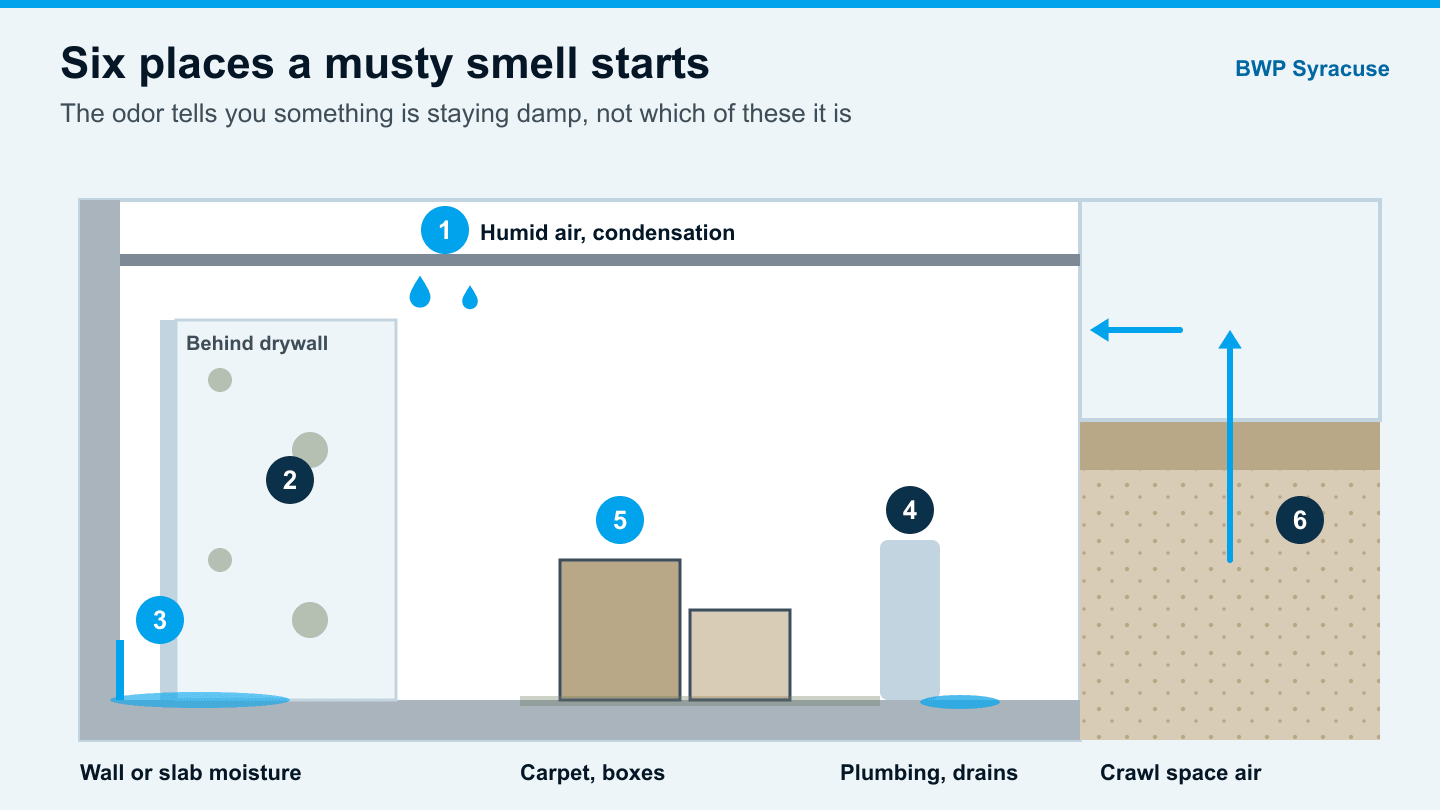
The last reason is the one a dehumidifier cannot solve. The ways moisture reaches a basement without an obvious leak are covered in why a basement is damp with no visible leak. If the humidity comes with an odor, the six causes of a musty basement smell covers where that smell usually starts.
When High Humidity Is a Symptom of Water Entry
High readings are sometimes just humid weather. They point toward water entry when they come with any of these:
- Readings that climb after rain or during the thaw rather than on humid days.
- A dark band of dampness along the base of the walls.
- White mineral deposits that come back after cleaning.
- Damp carpet edges, swollen baseboards or peeling floor paint.
- A basement that reads high in winter when the rest of the house is dry.
In those cases, the humidity is a result of moisture moving through the foundation, and the long-term fix is at the foundation. For houses with a dirt or damp crawl space feeding moisture into the house, crawl space encapsulation is one approach, and it works best once any liquid water source has been dealt with. Where crawl space moisture comes from covers the sources under the house in more detail.
What Does Not Work
- Choosing a setpoint without finding the moisture source. A lower number on the dial does not change why the basement reaches high humidity, and an active water source can outrun any setting.
- Trusting the dehumidifier’s own display. It measures the drier air right at the unit.
- Opening windows to air out a humid basement in summer. Humid outdoor air adds moisture to cool basement surfaces.
- Judging from a single reading. One number taken on one afternoon cannot show a pattern.
- Treating a musty smell with fragrance while humidity stays high. The smell comes back as long as surfaces stay damp.
When to Call a Professional
A moisture inspection is worth it when a properly sized dehumidifier cannot hold readings below 60 percent, when readings rise after rain or snowmelt, or when the basement shows signs of water entering at the walls or floor. The broader list of symptoms that travel with high humidity is in the nine early signs a basement gives.
If your readings stay high and you cannot tell whether the moisture is humid air or water coming through the foundation, a free moisture inspection can find the source before you invest in more dehumidification.
The Number Needs a Reason
Keeping basement humidity below 60 percent, and ideally in the 30 to 50 percent range, is sound guidance. But a humidity number is useful only when you know why the basement is reaching it. Measure over time, compare with the weather and check the walls and floor, and the reading turns from a worry into a diagnosis.
Frequently Asked Questions
What should I set my basement dehumidifier to?
Set the dehumidifier around 50 percent, then adjust it using readings from a separate hygrometer. EPA recommends keeping indoor humidity below 60 percent and ideally between 30 and 50 percent, and CDC advises no higher than 50 percent. The built-in humidity display on a dehumidifier measures air right at the machine, which can differ from the rest of the basement.
Is 60% humidity too high for a basement?
Sixty percent is the upper limit in EPA guidance, not a comfortable target. A basement that sits at 60 percent or above for days at a time is carrying more moisture than recommended, and cool surfaces in that basement can reach condensation even when the room reading looks acceptable. Aim to hold readings in the 30 to 50 percent range.
What should basement humidity be in winter?
Winter readings are usually lower, and in colder climates ENERGY STAR suggests 30 to 40 percent during the heating season to prevent window condensation. A Syracuse basement that stays well above that range in January, when heated indoor air is dry, is more likely gaining moisture from the foundation than from outdoor air.
Why is my basement still humid with a dehumidifier running?
The usual reasons are an undersized unit, a unit set too high, air leaking in from outside, or an active moisture source such as seepage through the walls or slab. A dehumidifier that runs constantly without lowering the reading is a sign that moisture is arriving faster than the machine can remove it.
What size dehumidifier does a basement need?
Size it to the space and how damp it is, not only the square footage on the box. ENERGY STAR publishes sizing guidance that scales capacity with both area and conditions, and a very damp or wet basement needs noticeably more capacity than a slightly damp one of the same size. An undersized unit runs constantly without reaching its setpoint.
Where should I put a hygrometer in the basement?
Place it away from the dehumidifier, at about chest height, and away from exterior doors and windows. A reading taken right beside the machine shows the driest air in the room. Checking a second spot near the wettest wall gives a fuller picture of how the basement is really doing.