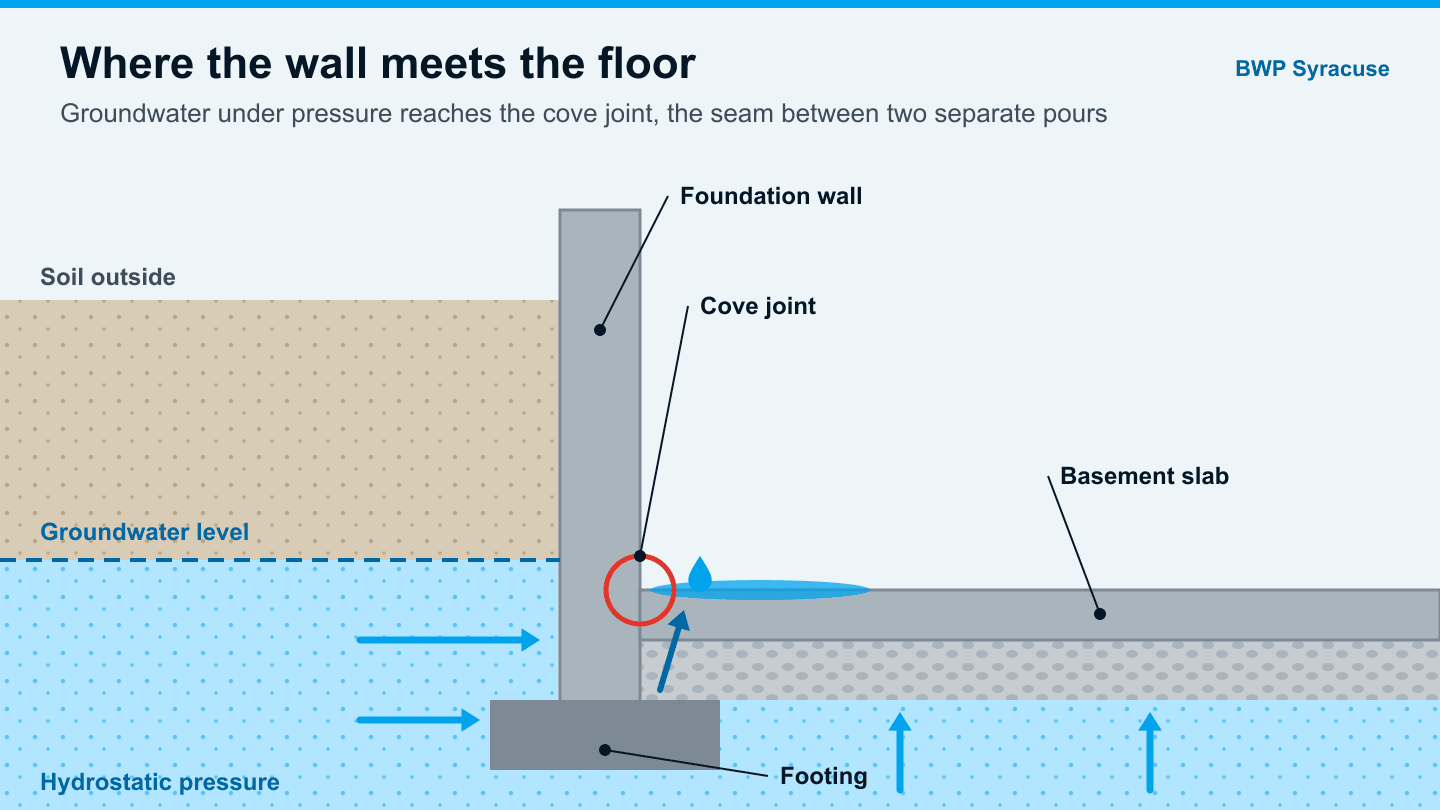
Water coming in where the wall meets the floor usually enters at the cove joint, the seam between the foundation wall and the basement slab, and it often points to groundwater reaching the base of the foundation. The location alone does not prove that, though, since wall seepage, a crack, plumbing and even condensation can all end up at the same seam.
The seam is where you see the water. The source is decided by when it appears, how it spreads and what the rest of the basement is doing at the same time. This article walks through what the cove joint is, why water favors it, how to separate the common look-alikes and when the pattern calls for a drainage evaluation instead of a patch.
What the Cove Joint Is
Most poured basements are built in stages. The footing goes in first, then the foundation walls are formed and poured on top of it, and the concrete floor slab is poured last, inside the walls. Each pour cures separately, so the edge of the slab sits against the wall without being bonded to it as one continuous piece of concrete.
The line where the slab meets the wall is called the cove joint. Builders also call it a cold joint, since new concrete was placed against concrete that had already hardened. In block and older stone basements the details differ, but the same idea holds: the floor and the wall are separate elements that meet at a seam.
That seam is not a defect. It is a normal part of how basements are built. It is also the lowest continuous opening around the room, and it sits right where water collecting around the footing has the shortest route inside.
Why Water Coming In Where the Wall Meets the Floor Starts at the Seam
Soil around a foundation holds water after rain and snowmelt. When the soil near the footing becomes saturated, that water presses against the wall and the underside of the slab. This is hydrostatic pressure: the pressure a body of water exerts because of its weight, which rises as the water gets deeper.
Concrete resists that pressure well across solid areas. The seam between two pours offers far less resistance, so water under pressure finds it first. NDSU Extension’s guidance on controlling basement water seepage (opens in a new tab) puts it plainly: when the water table is above the basement floor, water can get in where the walls and floor meet and through cracks in the floor. The same guidance notes that water coming through cracks in the wall is more often the result of water soaking into the ground from above.
That distinction is useful. Water rising at the floor line tends to point toward groundwater around and below the foundation. Water entering higher on the wall tends to point toward surface water finding its way down through the soil next to the house.
The seasonal pattern
Groundwater does not sit at the same level all year. Penn State Extension’s groundwater guidance (opens in a new tab) notes that groundwater levels tend to be highest during March and April in response to winter snowmelt and spring rainfall, and lowest in late September or October.
That cycle explains a pattern many homeowners describe: a basement that is dry in August, damp at the seam in November, and actively wet along the floor line in March. The joint is not changing much through the year. The water level outside it is.
Pattern Guide: What the Water Is Telling You
Where and when the water appears narrows the list of causes. Use this table to decide what to check next, and treat each row as a clue rather than a diagnosis.
| Pattern | More consistent with | What to check next |
|---|---|---|
| Continuous wet line along most of the perimeter | Groundwater under the slab or around the footing | Timing against rain and snowmelt, sump pump activity, whether the line appears on every wall |
| One narrow wet spot at the seam | A crack or penetration above that spot, or a single low point outside | The wall directly above for a crack, a pipe or tie-rod hole, and the downspout or grade on that side |
| Wall wet above the joint, water running down | Wall seepage or a wall crack, not the joint itself | Where the wet area starts on the wall, and whether it follows a crack or a mortar line |
| Water appears during snowmelt, not every storm | Seasonally high groundwater | Dates of the thaw, how long the water lasts, whether it returns each spring |
| Water appears right after plumbing use | A supply, drain or appliance leak | The nearest fixture, washer hoses, water heater, and a water meter check |
| Damp band with no liquid water | Capillary wicking or condensation | Humidity readings, season, and whether cold pipes are sweating at the same time |
| Puddle near a floor drain rather than a wall | Drain backup or water flowing across the slab | The drain itself, and whether water is coming up out of it |
The Look-Alikes: Water at the Seam That Did Not Start There
Several problems deliver water to the same spot. Ruling them out keeps the diagnosis honest and prevents a drainage repair for a problem that needed something else.
Crack leakage that runs down to the floor
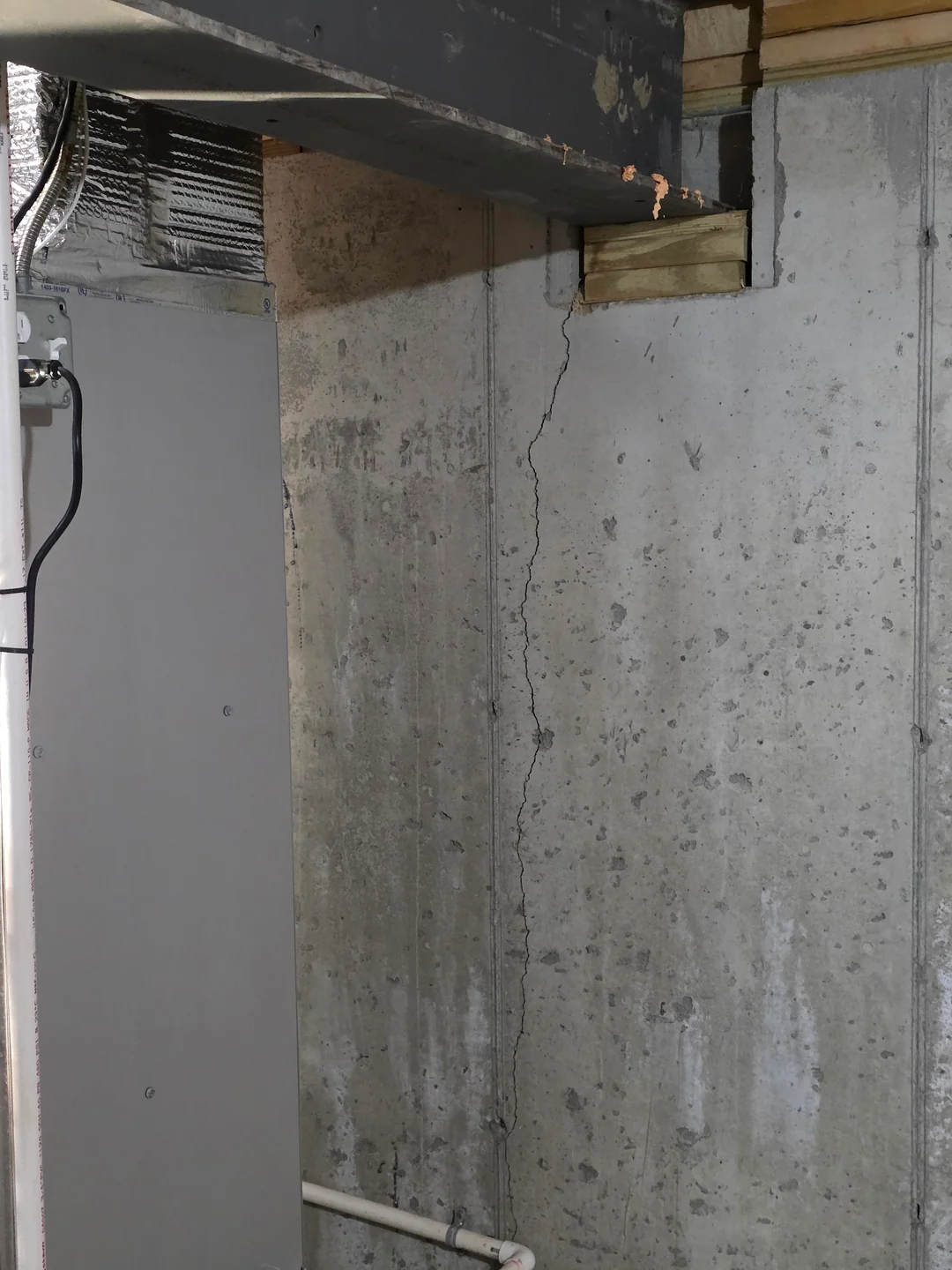
A vertical or diagonal crack can leak a few feet above the floor, with the water running down the wall and pooling at the seam. By the time you notice it, the puddle is at the joint and the crack has dried. Look at the wall surface directly above the wet spot. A dark streak, mineral staining or efflorescence following a line upward points to the crack as the entry point.
Wall seepage through porous masonry
Block and stone foundations can let water through the wall itself, especially along mortar joints. The water travels down inside or across the face of the wall and appears at the base. The clue is a wall that feels damp, darkens or shows white mineral deposits, called efflorescence, above the floor line during wet weather.
Plumbing
Supply lines, drain lines, water heaters, washing machine hoses and floor drains can all put water at the base of a wall. Plumbing water does not care about the weather. If the seam gets wet on a dry week, after laundry or near a fixture, check the plumbing before assuming groundwater.
Condensation
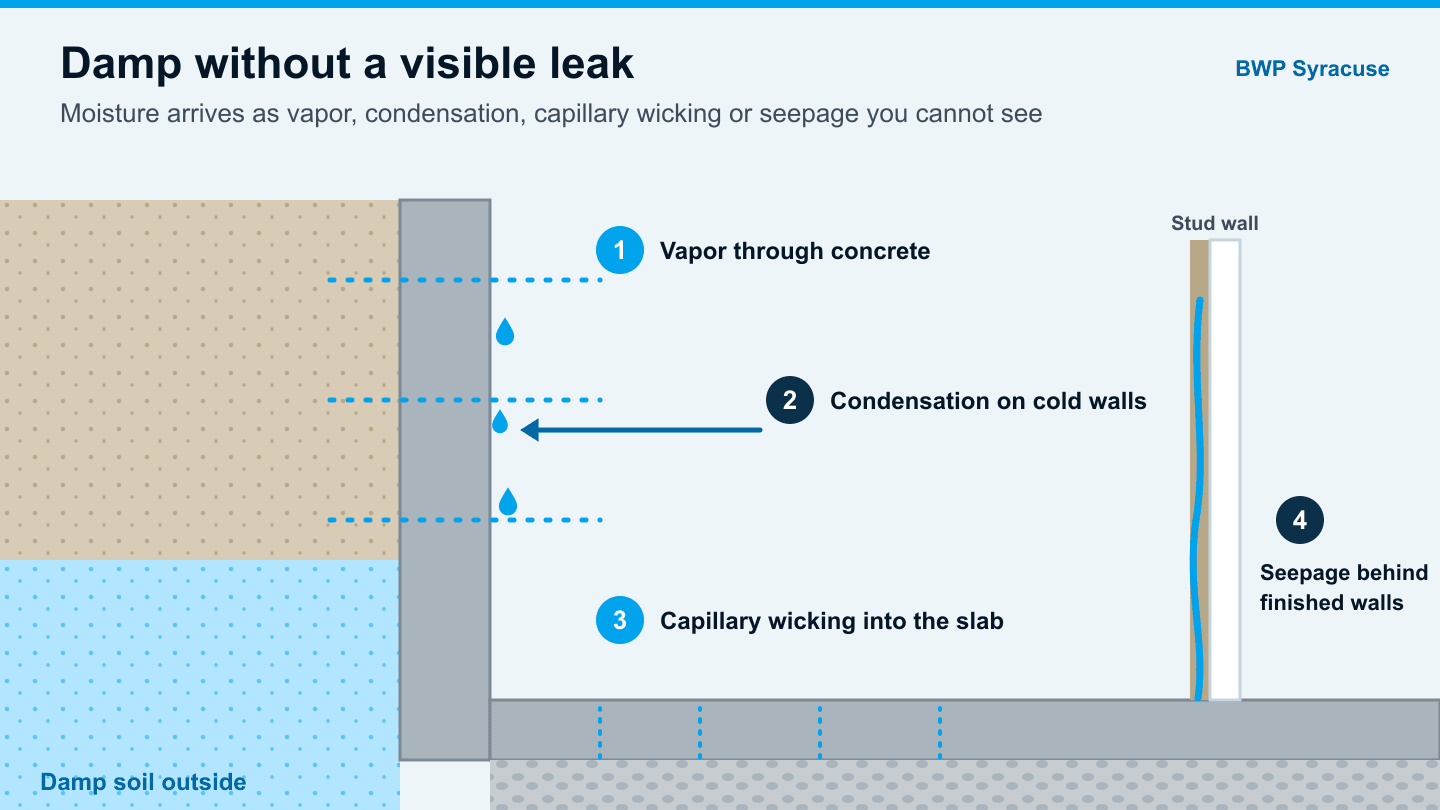
In summer, warm humid air meets cool basement walls and floors. University of Minnesota Extension’s guide to moisture in basements (opens in a new tab) notes that many homeowners see this moisture and believe the wall is leaking when the water is actually condensation. Condensation tends to show up across cool surfaces at once, on humid days, with no connection to rain.
Capillary wicking
Concrete is porous. Water in the soil can be drawn up through small pores in the footing and slab. The same University of Minnesota guidance describes this capillary effect as the source of the ring of dampness seen at the base of many basement walls, and notes it is very common at cold joints. A damp band without puddles, present for weeks at a time, fits this pattern better than an active leak does. The broader set of no-drip moisture sources is covered in why a basement feels damp with no visible leak.
Clues From Timing and From Where the Wall First Gets Wet
Two questions do most of the work in separating these causes.
When does the water appear? Water that follows heavy rain within hours, or appears during a thaw, points to water coming from the soil. Water that appears on dry days points to plumbing or condensation. Water that returns every spring on roughly the same schedule points to a seasonal water table rather than one downspout.
Where does the wall first get wet? Water that starts right at the floor line, with a dry wall above it, fits groundwater at the joint. Water that starts higher on the wall and runs down fits a crack or wall seepage. Water that starts at one corner or under one window fits a local source outside, such as a downspout discharging too close or a window well collecting water.
In practice, a wet line that appears at the same time along two or three walls, with dry walls above it, is one of the clearest signs that the water is coming from below rather than from a single entry point.
What to Document During an Active Event
The most useful evidence exists only while the basement is wet. A few minutes of documentation during an event is worth more than a detailed description a week later.
- Photograph the water while it is there. Take wide shots showing which walls are affected, and close shots of the seam, with the date and time recorded.
- Mark the edges. A pencil mark at the edge of the wet area shows whether it grows, shrinks or starts from the same point next time.
- Check the wall above. Run a dry paper towel up the wall from the wet seam. If the towel stays dry above the joint, the water is likely coming from the floor line rather than running down from a crack.
- Write down the weather. Note rainfall or thaw conditions over the previous 48 hours. A simple log across two or three events usually shows a pattern.
- Look outside on the same side. Check where downspouts discharge, whether the ground slopes toward the wall and whether snow is piled against the foundation.
- Watch the sump pump. A pump that runs constantly during the event tells you groundwater is high. A pump that never runs, in a basement with a sump pit, is worth checking too, and how a sump pump works explains what normal cycling looks like. If the water rises through the middle of the slab instead of at the edge, that is a different pattern, covered in water coming up through the basement floor.
- Rule out plumbing. If the timing does not match the weather, check nearby fixtures and do a water meter check with all water use turned off.
These observations are clues, not proof. A paper towel cannot detect water moving inside a block wall, and two events are not always enough to separate groundwater from a local surface-water problem. They do give an inspector far better information than a dry basement can.
Why Caulk Is Not a Reliable Answer to Groundwater at the Joint
The obvious move is to seal the seam. Caulk, hydraulic cement and interior coatings are cheap and easy to apply, and they do have a role. DOE’s Building America guidance on water management for existing basement floors (opens in a new tab) notes that sealing the seam between the slab and the foundation wall can reduce soil gas entry and moisture transfer.
The same guidance is clear about the limit: sealing alone will not prevent dampness where poor site grading, missing gutters, a high water table or similar conditions are causing serious water intrusion. NDSU Extension says the water generally cannot be stopped with products placed inside the basement, since the pressure is coming from outside. University of Minnesota Extension adds that a membrane or coating on the interior without drainage generally will not solve the problem in the long term.
When groundwater is the cause, a sealed seam leaves the water with nowhere to go except the next weakest point. That might be a floor crack, a different section of the joint or the base of a block wall. The seam may look dry for a while, and the water may appear somewhere else a season later.
The Syracuse Context
Syracuse gets a lot of snow, and that snow matters for this symptom. The National Weather Service office in Binghamton lists a 1991 to 2020 normal of 127.8 inches (opens in a new tab) (about 325 cm) of annual snowfall for Syracuse. Much of that water reaches the soil during thaws, when the ground may still be partly frozen and cannot absorb it quickly.
Syracuse homes commonly show the cove-joint pattern during late winter and early spring, often in older houses with block or stone foundations and in houses where downspouts discharge right beside the wall. Freeze-thaw cycles can also open small cracks in the slab near the perimeter, which gives rising water additional paths once the ground thaws.
None of that means every wet seam in Syracuse is groundwater. It does mean that timing against the thaw is a particularly useful clue here, and it is worth writing down every spring.
What You Can Safely Do Now
Some steps help regardless of the final diagnosis:
- Move stored items off the floor along the affected walls, especially cardboard and fabric.
- Dry the area quickly after each event using fans and a dehumidifier once the water has stopped.
- Check downspouts and grading on the wet side of the house. The spring thaw checklist walks through the outside items in order.
- Keep the documentation going for each event so the pattern builds over a season.
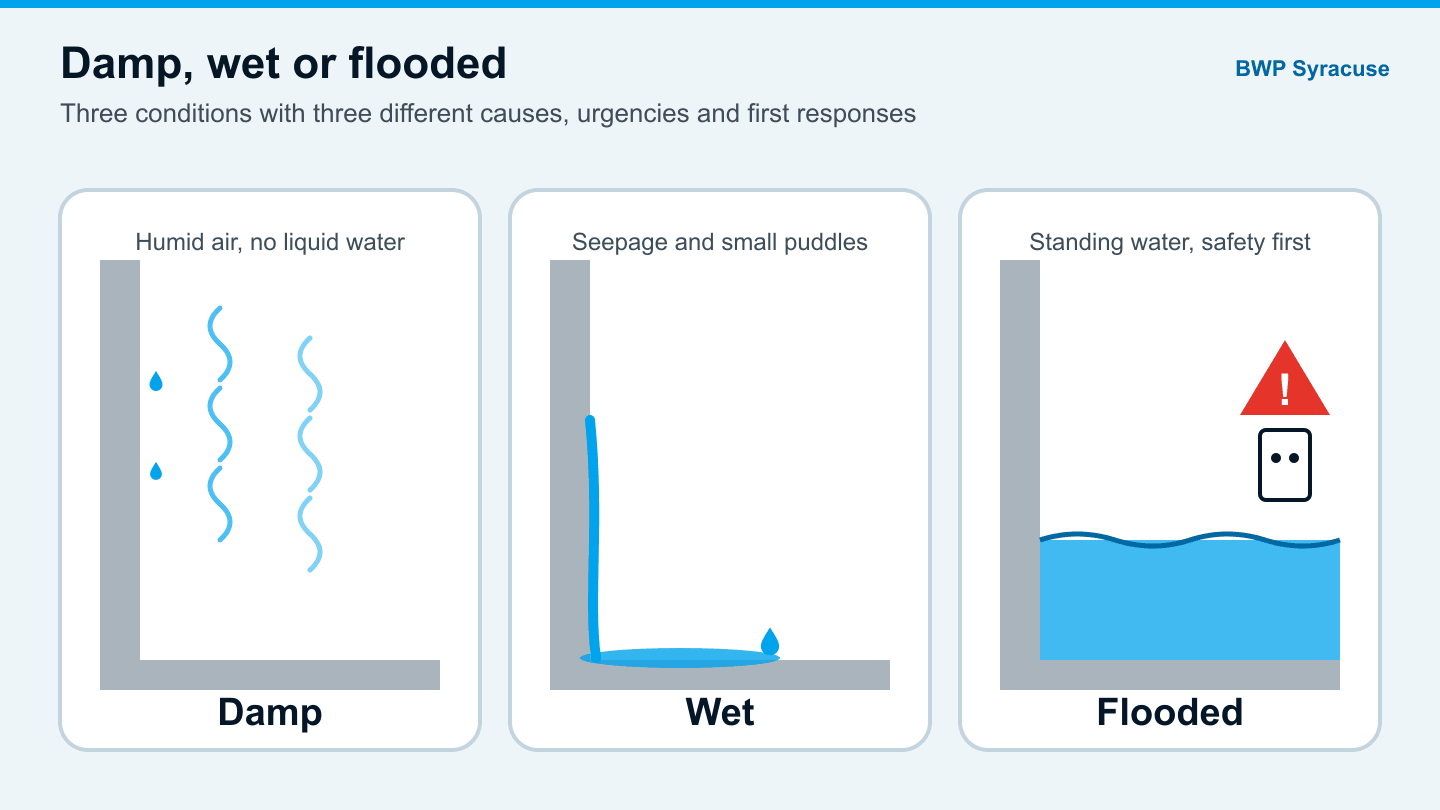
If the water covers a large part of the floor or reaches outlets, cords or appliances, the situation is no longer a diagnosis exercise. The difference between a damp, wet and flooded basement covers the safety steps that come first.
When a Drainage Evaluation Makes Sense
A professional evaluation is worth it once the pattern points to groundwater: a wet line along more than one wall, water that returns with each thaw or long rain, water rising at the seam with a dry wall above it, or a sump pump that runs hard every spring. At that point the question becomes whether the problem is a single entry point that can be sealed or pressure along the perimeter that needs to be relieved.
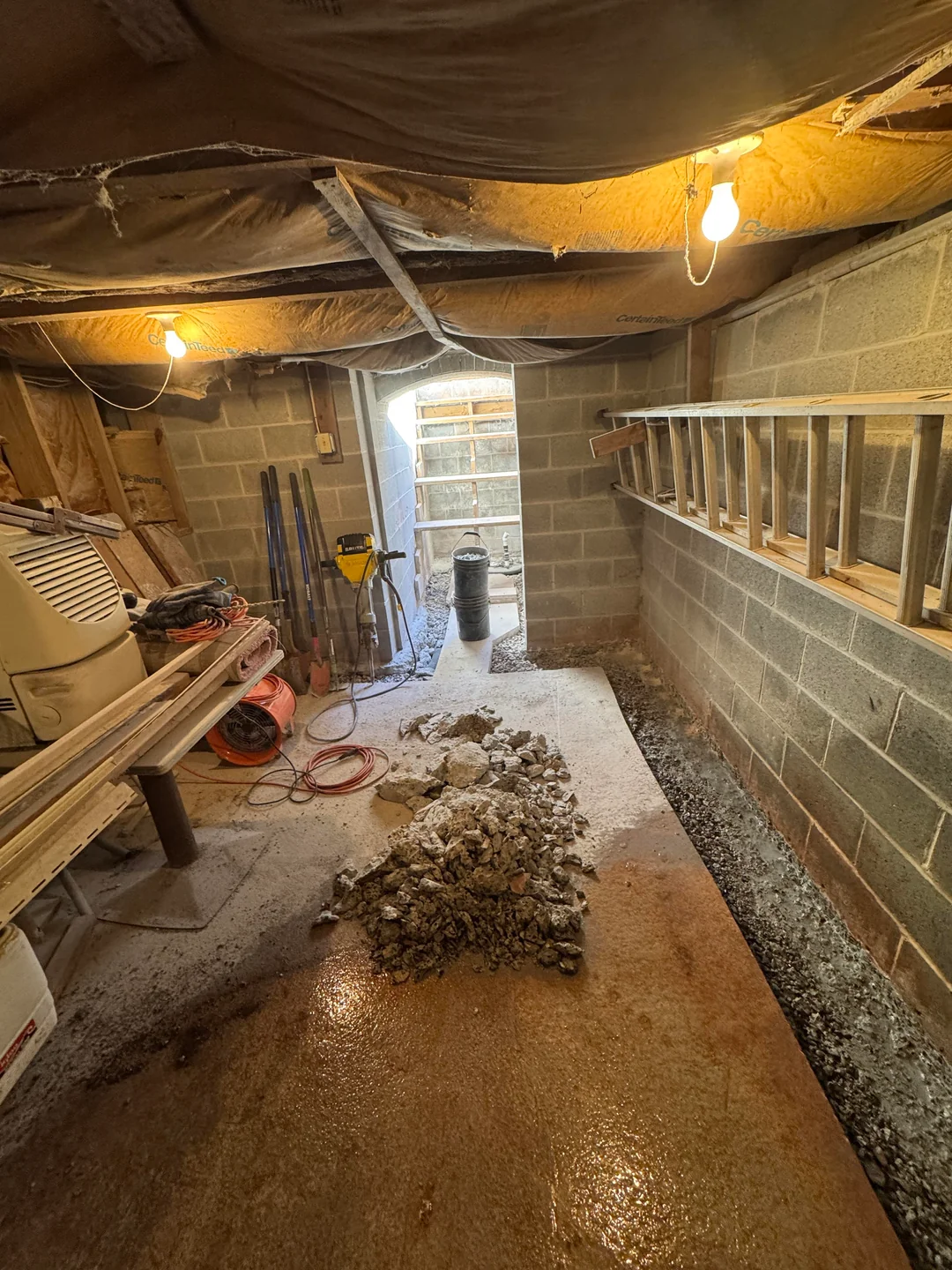
That decision has its own logic, and crack repair or full drainage explains how to tell a point problem from a pressure problem. Where the answer is groundwater at the joint, the usual approach is interior drainage and basement waterproofing that collects water at the footing and carries it to a sump before it reaches the seam. Water that turns out to be plumbing, a sewer backup or a structural issue belongs with a plumber or a structural engineer instead.
Still not sure whether the water is entering through a crack or coming up under the slab? A free moisture inspection can separate those two before you choose a repair. Bring your photos and your weather notes, since they make that diagnosis faster.
Where It Shows Up vs When It Shows Up
The cove joint is where water coming in at the base of a basement wall becomes visible, and it is a useful place to start looking. But where the water first becomes visible tells you less than when and how it appears. Timing against the weather, the wall above the seam and the number of walls affected are what separate groundwater from a crack, a pipe or summer condensation. For a wider view of what else a basement shows before water collects, compare notes with the nine early signs a basement gives.
Frequently Asked Questions
Is water at the wall-floor joint a structural problem?
Usually not by itself. Water at the cove joint is a water-entry problem, and it does not mean the foundation is failing. Treat it as structural only when it comes with other signs, such as a wall that has moved inward, a horizontal crack or a wall that is out of plumb. Those need a separate evaluation, covered in when a bowing basement wall needs attention.
Why does water only come in at the cove joint in spring?
Groundwater levels in the Northeast tend to peak in March and April, driven by snowmelt and spring rain. Penn State Extension describes that seasonal cycle. When the water table rises, water reaches the base of the foundation and uses the seam between wall and slab as a path, then the seam dries out again as groundwater drops.
Can I seal the cove joint with caulk or hydraulic cement?
Sealing the seam can reduce dampness and soil gas entry, but caulk or hydraulic cement is not a reliable fix for groundwater pushing up at the joint. NDSU Extension notes that water under outside pressure generally cannot be stopped with products applied inside the basement, and DOE Building America guidance says sealing alone will not prevent dampness where a high water table or poor drainage is the cause.
Will a dehumidifier stop water at the cove joint?
No. A dehumidifier removes water vapor from the air, so it helps with drying but does nothing to stop liquid water entering at the seam. A dehumidifier that fills constantly during wet weather is often a sign that water is still coming in.
How can I tell if the cove joint is wet from condensation?
Condensation tends to appear on humid summer days, forms on other cool surfaces at the same time, such as cold water pipes, and does not follow rain or snowmelt. Water that shows up hours after a storm or during a thaw, starting at the seam, points toward groundwater instead. University of Minnesota Extension notes that many homeowners mistake summer condensation for wall leakage.
What is the cove joint in a basement?
The cove joint is the seam where the basement wall meets the floor slab. The footing, wall and slab are usually poured at different times, so they never bond into one piece. That seam is the lowest opening in the basement, which is why groundwater pushed up by hydrostatic pressure so often appears there first.
Does water at the cove joint mean my sump pump failed?
Not always, many homes with cove joint seepage have no interior drain system at all. If you do have a sump pump, check that it switches on when the pit fills and that the discharge line is clear and not frozen. A working pump with water still crossing the floor points to water the system is not collecting.