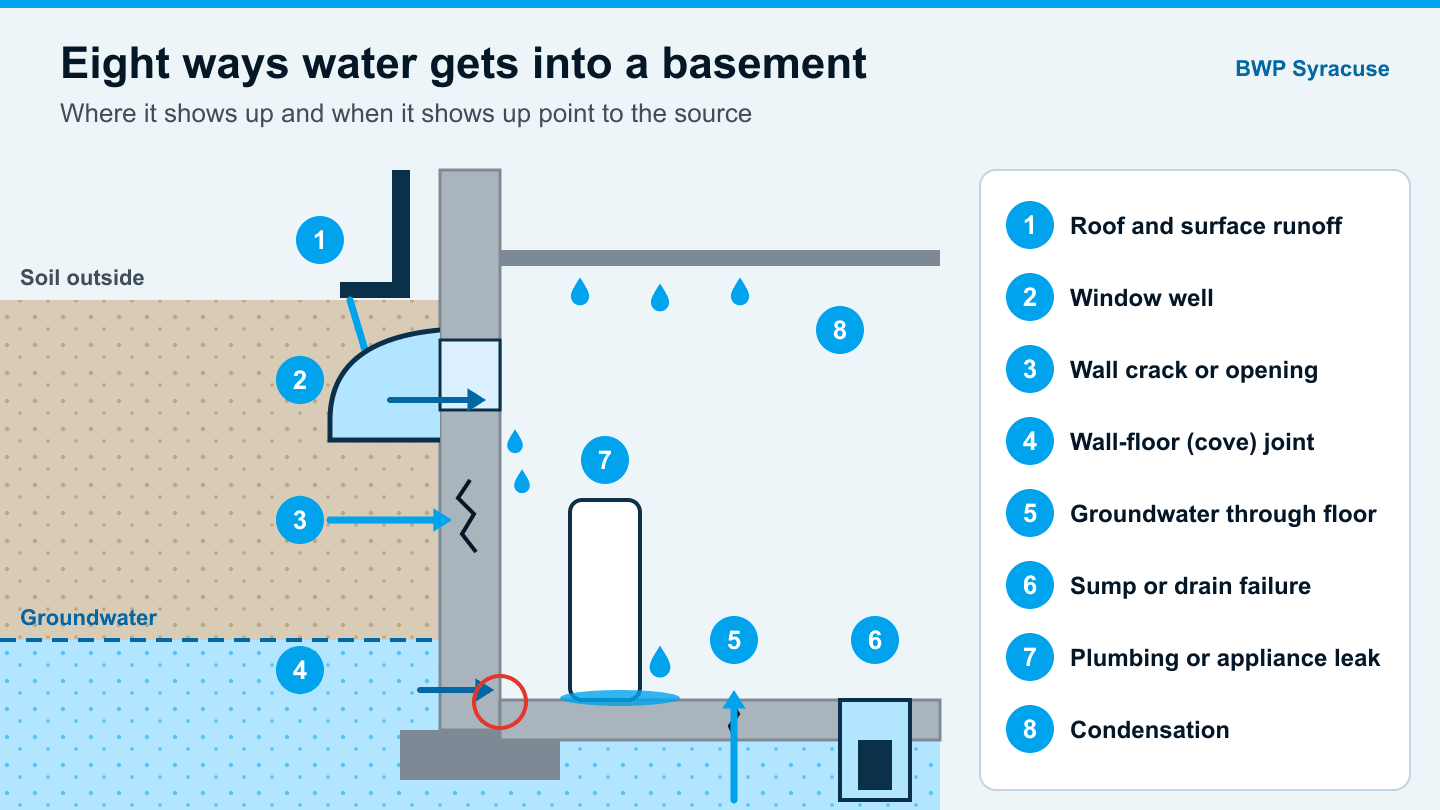
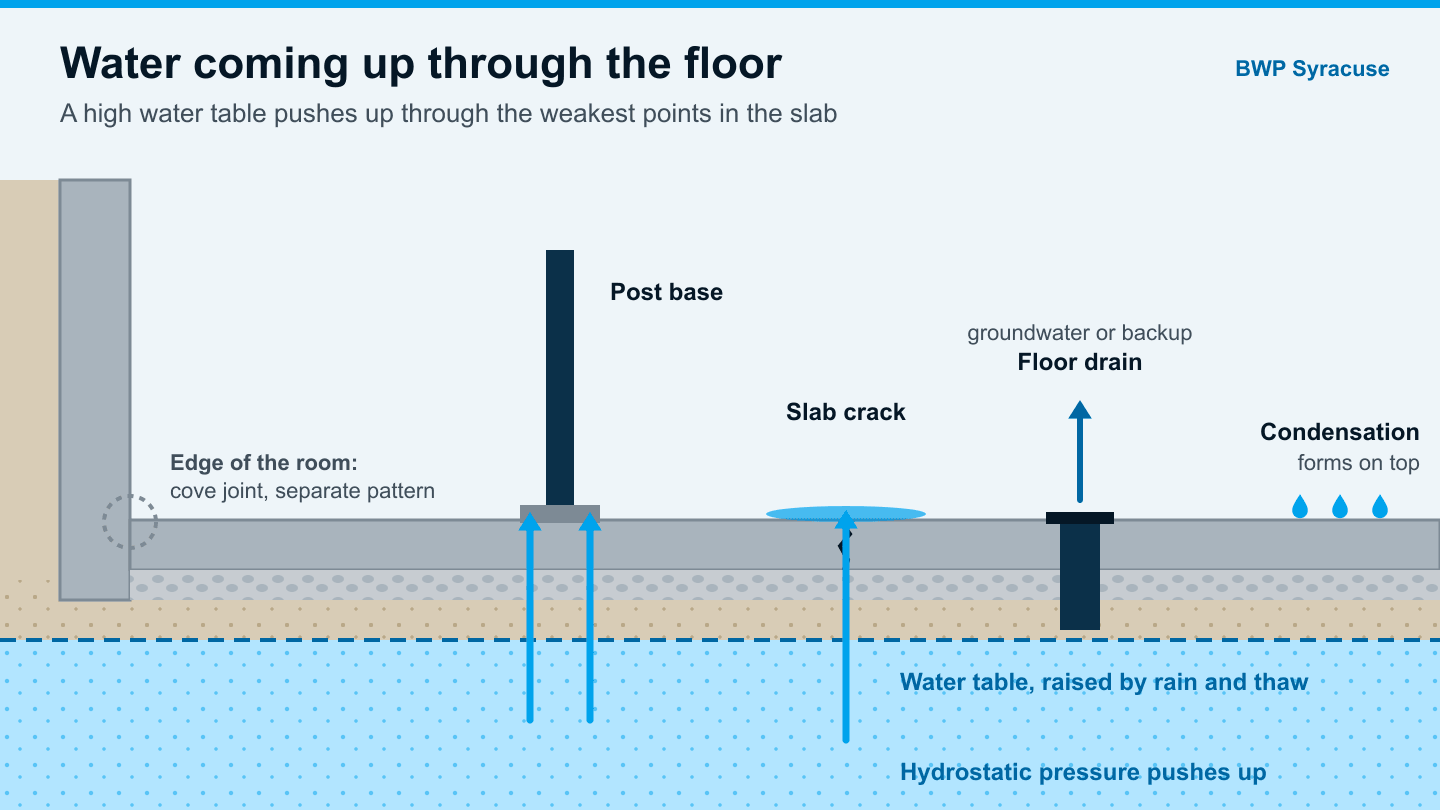
Water coming up through the basement floor, away from the walls, usually means groundwater under the slab is pushing up through a crack, a joint or an opening such as a floor drain or old pipe hole. Less often, the cause is a drain backing up, a leaking pipe under the slab, or moisture that condensed on a cool floor and only looks like it came from below.
The difference matters because each one has a different fix. This guide covers water that appears in the middle of the slab. If the water starts at the edge of the room, where the wall meets the floor, that is a separate pattern covered in water coming in where the wall meets the floor. For the full list of basement water sources, see why a basement gets wet.
How Groundwater Gets Under a Basement Slab
Below every yard there is a level where the soil is completely soaked. That level is the water table. In dry months it may sit well below your basement floor. After long rain or a big snowmelt it rises, and in some neighborhoods it can rise above the bottom of the slab.
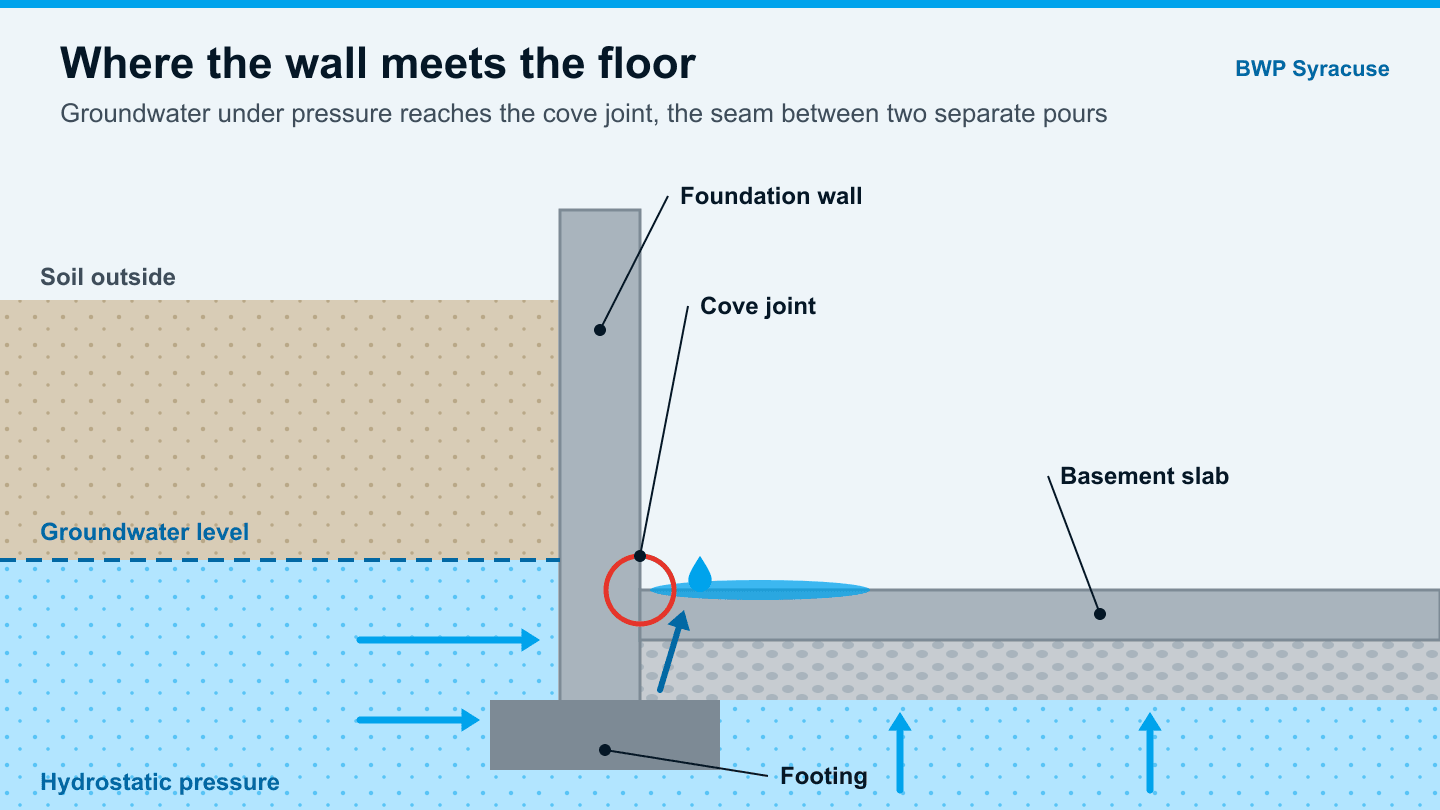
When that happens, the water under the floor is pushed upward by the weight of the water around it. This push is called hydrostatic pressure. Picture pressing an empty plastic cup down into a full sink: the water pushes back up on the bottom of the cup. Your slab is the bottom of the cup.
NDSU Extension’s guidance on controlling basement water seepage (opens in a new tab) says that when the water table is above the basement floor, water can get in where the walls and floor meet and through cracks in the floor. It also says the water generally cannot be stopped with products placed inside the basement, because the pressure comes from outside.
Not every house has a gravel layer or drain pipe under its slab. Older homes in particular may have a thin slab poured right on soil. A footing drain, the perforated pipe that some foundations have around the base of the walls, helps lower water around the edges, but it may not reach water under the center of a large slab, and an old one may be clogged or collapsed.
Where Water Comes Up Through a Basement Floor
Concrete is strong, but it has weak points. Water under pressure looks for the weakest point, and in the middle of a floor there are a few usual suspects.
Slab cracks
Most basement slabs crack as they cure and shrink. These shrinkage cracks are often thin and harmless when dry. When groundwater rises, they become paths, and you see a thin wet line that traces the crack, sometimes with a white mineral crust left behind after it dries. Cracks that have one side higher than the other, or that keep getting wider, are worth having looked at for movement as well as water.
Control joints
Many slabs have straight saw-cut or tooled lines meant to make the slab crack in a planned place. Water follows these joints just as it follows random cracks.
Floor drains
A floor drain is a direct hole through the slab. Water can come up through it for two different reasons. Groundwater can enter a drain that connects to footing drains or to the sewer line under pressure. A blocked or overloaded sewer line can push used water back up through the lowest opening in the house, which is often the basement floor drain. The second case is a contamination issue, not just a water issue.
Old pipe holes and column bases
Older basements often have patched holes where a pipe or oil line once ran, or a lally column (a steel post that supports the beam above) set into its own small pad. The patch or the joint around the post rarely bonds tightly to the surrounding slab. Water that circles a post base or appears at an old patch is following that seam.
Capillary moisture through the concrete
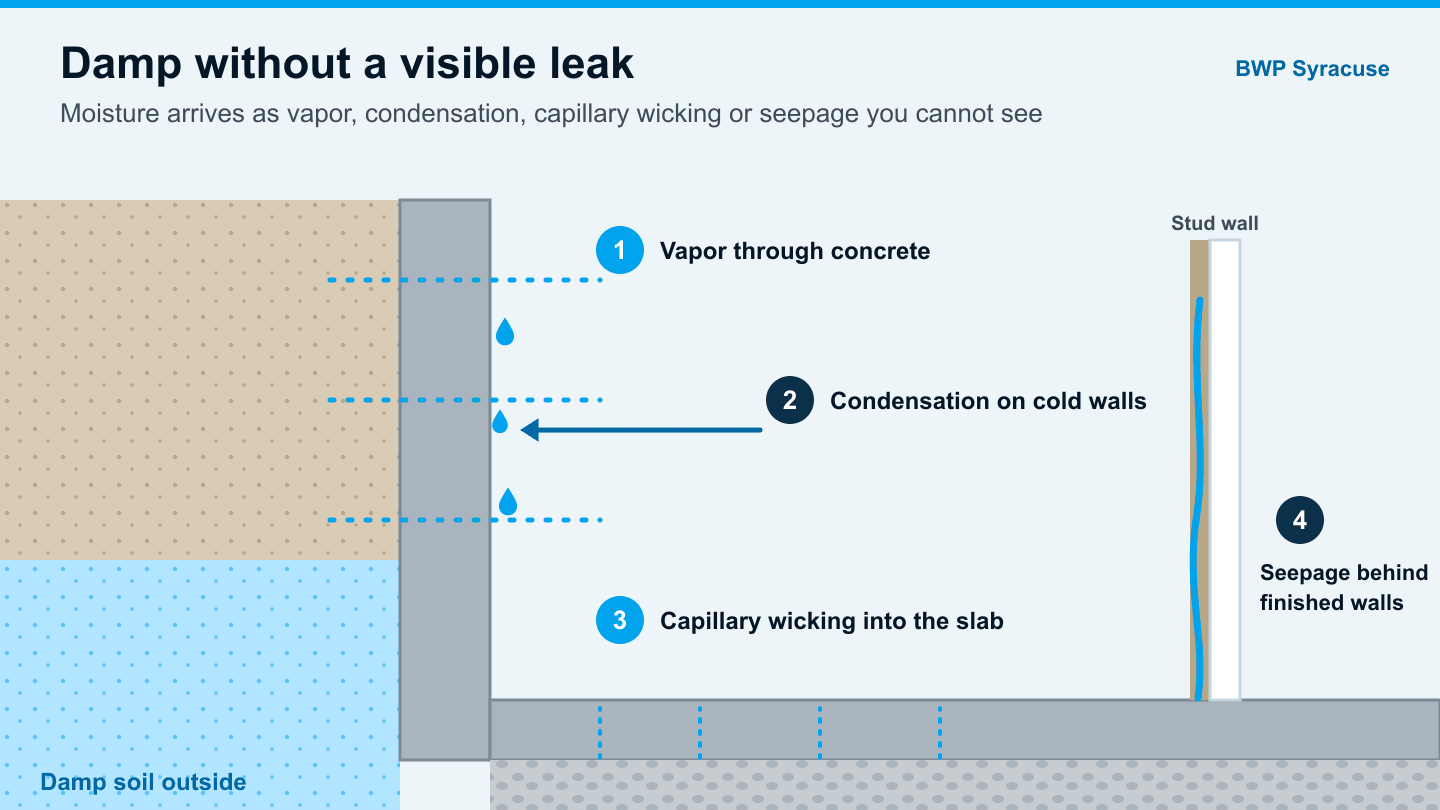
Concrete is full of tiny pores. Water in the soil under the slab can wick up through them the way a paper towel draws up a spill. This is called capillary movement. It usually shows up as dark, damp patches or a floor that never quite dries, not as puddles. Slabs poured without a vapor barrier (a plastic sheet under the concrete) are more prone to it.
A leaking pipe under the slab
Water supply lines and drain lines sometimes run under the floor. A leak there can surface through a crack nowhere near a wall, and it does not care about the weather. A wet spot that grows on dry days, or a water meter that moves with every tap closed, points here.
Coming Up From Below, or Forming on Top?
Before blaming groundwater, rule out condensation. In summer, warm humid air touches a cool concrete slab, and the water vapor in the air turns to liquid on the surface. The floor can look wet, even puddled in low spots, with nothing coming through the concrete at all.
Condensation tends to cover large areas at once, shows up on humid days rather than after rain, and appears on other cold surfaces at the same time, such as cold water pipes. Groundwater tends to follow cracks and openings and show up after rain or during a thaw.
The quick check is a square of clear plastic taped tightly to the floor for a day or two. Moisture under the plastic is coming through the slab; moisture on top of it is condensation. The test is rough and has real limits, which are covered along with other no-leak moisture sources in why a basement feels damp without a leak.
Matching the Pattern to the Source
| What you see | Most consistent with | Next step |
|---|---|---|
| Wet lines tracing cracks after rain or thaw | Groundwater under pressure | Log timing against weather; mark crack edges |
| Water rising from the floor drain during storms only | Groundwater entering the drain system | Watch whether it is clear and odorless; note sump activity |
| Water from the drain after washer or toilet use, or a sewage smell | Blocked or backed-up drain line | Stop water use and call a plumber |
| Water circling a post base or old patch | Seam around a penetration | Check the same spot during the next wet spell |
| Large damp area on humid days, cold pipes sweating | Condensation on a cool slab | Plastic sheet test, hygrometer readings |
| Dark damp patches for weeks, no puddles | Capillary moisture | Plastic sheet test; check for a vapor barrier |
| Growing wet spot in dry weather | Pipe leak under or near the slab | Water meter test, then a plumber |
A Diagnostic Sequence for a Wet Basement Floor
The goal is to separate groundwater, drains, plumbing and condensation before choosing any repair. These checks are safe for most homeowners as long as the water is shallow and nowhere near electrical equipment.
- Make sure the area is safe. If water has reached outlets, cords, a furnace or a water heater, stay out of it and have power cut from a dry location. Water that smells of sewage should not be touched without gloves and boots.
- Find where the water first appears. Dry the floor with towels or a squeegee and watch. Note whether the water returns along a crack, at the drain, around a post or as a general film.
- Note the weather. Write down rain or snowmelt over the previous two days. Repeat over two or three wet spells; one event rarely proves anything.
- Run the plumbing test. Turn off every faucet and appliance and read the water meter, then check it again an hour later. Movement with everything off suggests a supply leak.
- Test the floor drain. On a dry day, run water from an upstairs fixture and watch the floor drain. Water backing up, gurgling or a sewage odor points to the drain line.
- Check the sump, if you have one. Note whether the pump runs often during the event. A pump that runs hard while water still crosses the floor means groundwater is reaching areas the system does not drain.
- Use the plastic sheet test during a dry, humid week to separate capillary moisture from condensation.
How to read the results: water that follows cracks and returns with each storm or thaw is groundwater. Water tied to fixture use is the drain line. Water on dry days with a moving meter is a pipe leak. Moisture only on top of the plastic is condensation. Call a professional if you see groundwater at more than one crack, sewage, a slab that has lifted or dropped, or water that keeps returning after you have ruled out plumbing.
Repair Approaches, and What Each One Does
There is no single repair for a wet slab. The right one depends on which source the diagnosis points to, and some houses need more than one.
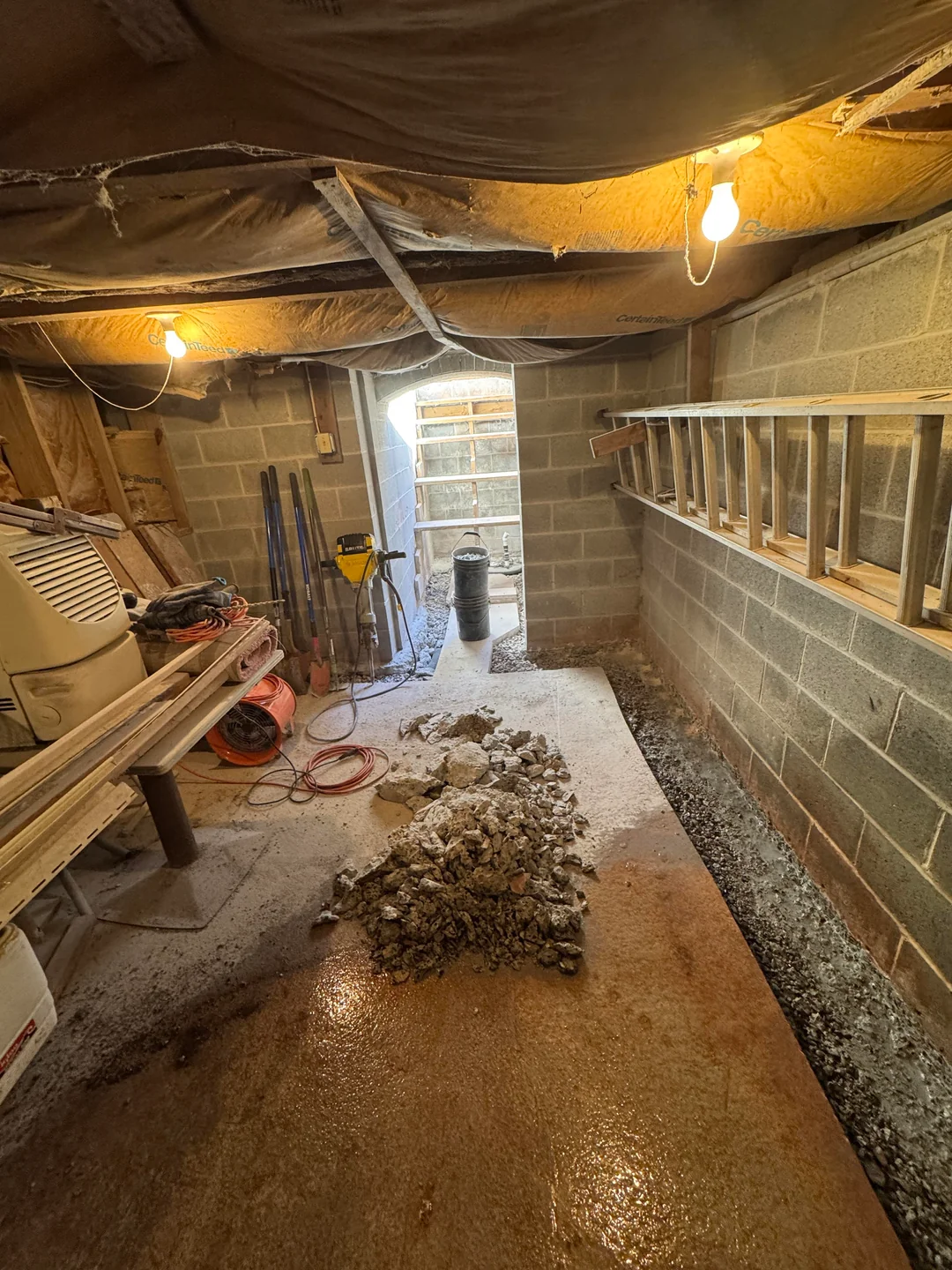
Relieving pressure under the slab. When groundwater is the source, the usual approach is to give it a lower, easier path than up through the concrete. That typically means a drainage pipe in gravel below the slab, often along the perimeter and sometimes across the floor in bigger or wetter basements, carrying water to a sump basin. A sump basin is a pit set into the floor where a sump pump collects that water and pumps it outside. The layout depends on the soil, the size of the slab and where the water rises, so it should be designed around what the floor is doing.
Sealing cracks. Sealing a dry, stable crack can reduce dampness and soil gas. DOE Building America guidance on water management for existing basement floors (opens in a new tab) recommends sealing cracks, holes and penetrations, and is also clear that sealing and coatings alone will not stop dampness where a high water table or poor site drainage is causing water to enter. Sealing an active groundwater crack often just moves the water to the next weak spot.
Fixing drain backflow. If the floor drain is the problem, a plumber can clear or repair the line and may recommend a backwater valve, which is a one-way flap that lets water leave through the drain but closes when water tries to come back in. That is plumbing work, not drainage work.
Controlling capillary moisture and condensation. Dehumidification, sealing the slab surface and, when a floor is being finished, a vapor barrier or a raised subfloor system can manage these moisture sources. They help with vapor and dampness. They do not stop liquid water under pressure.
Repairing a slab leak. A supply or drain pipe leaking under the floor needs a plumber to locate and repair it, sometimes by cutting out a section of slab.
Common Mistakes With a Wet Basement Floor
- Painting or coating the floor to stop groundwater. Coatings can peel or blister when water pushes up beneath them, and the water still finds the cracks.
- Laying carpet or flooring before the source is known. Finished floors hide new water and hold it against the slab, which is where mold problems start.
- Assuming the sump pump covers the whole floor. A pump only removes water that reaches its pit. Water rising in the middle of the slab may never get there.
- Treating sewage backup like groundwater. Water from a backed-up drain needs cleanup as contaminated water and a plumbing repair, not a drainage system.
When to Call a Professional
Call a plumber first if the water is tied to fixture use, smells of sewage or appears with the meter moving. Call a drainage contractor when water rises through cracks, joints or the drain with each wet spell and your plumbing checks out. A slab that has heaved, sunk or cracked with one side higher than the other should also be looked at by someone who can assess movement, since that is a different question from water.
If the pattern points to groundwater and you are weighing options, a free inspection can map where water rises before anyone suggests a fix. Photos of the wet floor taken during an event, with dates, make that visit much more useful.
A wet line that traces the same crack after every thaw is groundwater telling you where the slab is weakest, and that line is the place to start the diagnosis.
Frequently Asked Questions
Can groundwater really push up through solid concrete?
Through solid, uncracked concrete it mostly moves as dampness, not puddles. Liquid water under pressure comes up where the slab is weakest: cracks, joints, old pipe holes, column bases and the floor drain. That is why the wet spots so often trace a line or circle a fixed object rather than appearing at random.
Should I seal the cracks in my basement floor?
Sealing dry, stable cracks is reasonable and can reduce dampness and soil gas. Sealing a crack that water is actively pushing through rarely lasts, because DOE Building America guidance notes sealing alone will not stop dampness where a high water table is the cause. The water often moves to the next crack or joint.
Is water coming up from my floor drain a sewer problem?
It can be either. Water that smells of sewage, or rises when someone runs the washer or flushes upstairs, points to a blocked or backed-up drain line and needs a plumber. Clear water that rises from the drain only during heavy rain or snowmelt can be groundwater entering a drain that connects to footing drains or to the sewer under pressure.
Will a dehumidifier stop water coming through the floor?
No. A dehumidifier dries the air and helps the slab dry afterward, but it does nothing to stop liquid water entering from below. It is the right tool for condensation and mild capillary dampness, not for groundwater pushing through cracks.