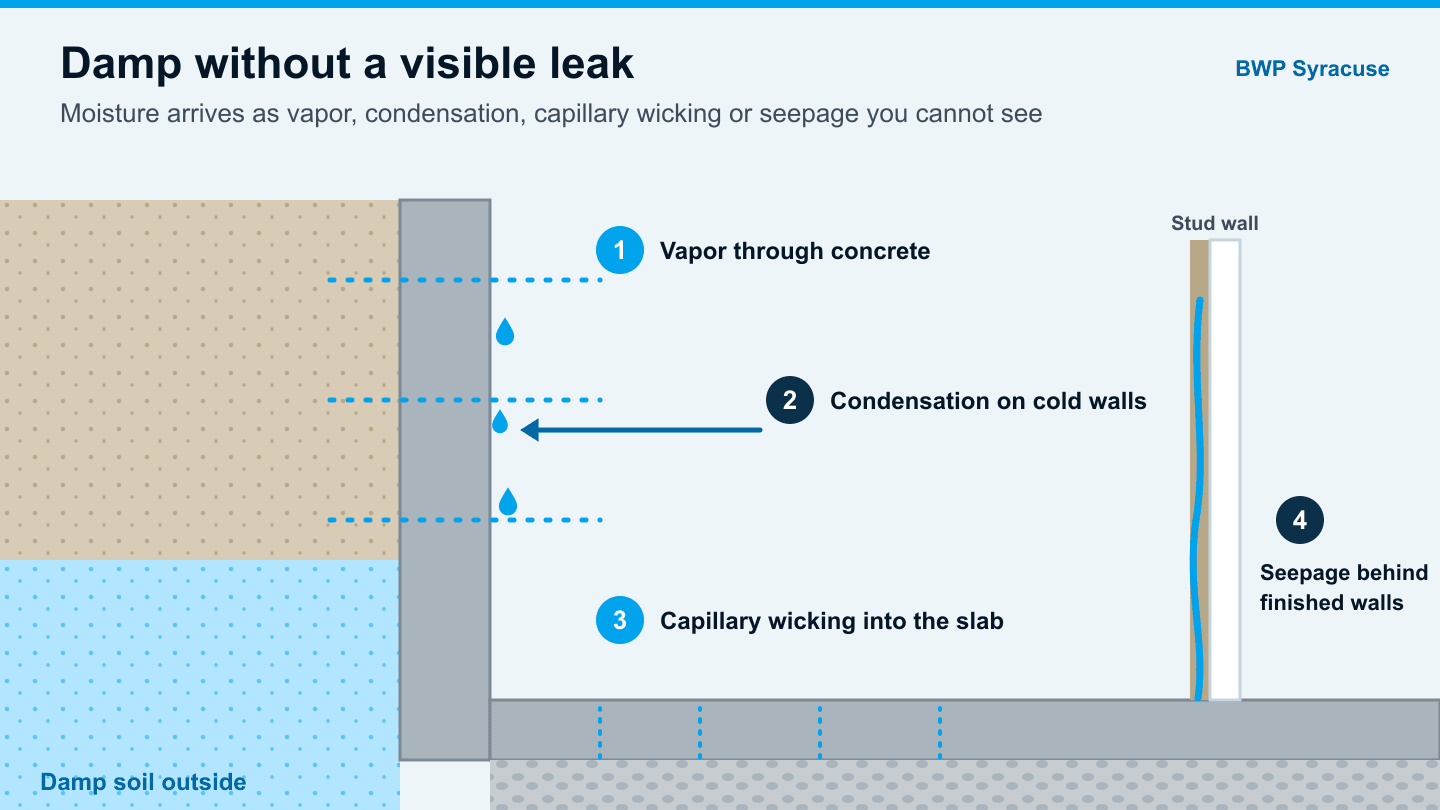
A basement can be damp without any visible leak, since moisture does not have to arrive as dripping or running water. It can come in as water vapor through concrete, condense out of humid air onto cold surfaces, wick up through the foundation, or seep in behind a finished wall where nobody can see it.
So “no leak” is a useful observation, but it is not the end of the diagnosis. The real question is which of those paths is delivering the moisture, since each one has a different fix and a dehumidifier only answers some of them.
Bulk Water vs Water Vapor: The Distinction That Matters
Building-science guidance separates moisture into forms that behave very differently.
Bulk water is liquid water you could collect in a bucket: rain running down a wall, groundwater seeping through a crack, water rising at the seam between the wall and floor. It is heavy, it flows downhill and it needs an opening to get in.
Water vapor is water in its gas form, mixed into the air. You cannot see it, and it does not need a crack. It moves through the air, through tiny pores in concrete and through gaps around the house, always toward drier and cooler areas.
University of Minnesota Extension’s guide to moisture in basements (opens in a new tab) lists four ways moisture moves from outside into a basement: liquid water flow, capillary suction, vapor diffusion and air movement. Only the first one looks like a leak. The other three can make a basement damp with nothing dripping at all.
Basement Damp, No Leak: Seven Ways Moisture Arrives
1. Water vapor passing through concrete
Soil around a basement is almost always damper than the air inside. Water vapor moves from the wetter side to the drier side, and concrete does not stop it completely. EPA’s moisture control guidance (opens in a new tab) explains that water vapor migrates through materials by diffusion, and that liquid water may not be present and nothing may appear wet while vapor slowly moves through what appear to be solid materials.
Vapor diffusion is usually slow. On its own it rarely creates obvious wetness, but it adds steadily to basement humidity and keeps anything placed directly on the slab, such as carpet or cardboard, a little damp all the time.
2. Condensation on cold surfaces
Warm air holds more water vapor than cool air. When air touches a surface colder than its dew point, the temperature at which that air would be saturated, vapor turns into liquid on the surface. EPA’s moisture guidance puts it directly: if the dew point is above the temperature of the surface, water vapor will condense onto that surface.
Basement walls, floors and cold water pipes stay cool most of the year. In summer, humid air reaching those surfaces condenses on them. University of Minnesota Extension notes that many homeowners see this moisture and believe the wall is leaking when it is condensation.
The clues: water beads on cold pipes at the same time the walls feel wet, the dampness appears on warm humid days rather than after rain, and it covers broad areas rather than starting at one point.
3. Capillary moisture wicking through the foundation
Concrete is full of tiny connected pores. Water in the soil can be pulled up and through them, the same way water climbs a paper towel dipped in a glass. The University of Minnesota guide describes water being drawn upward through small pores in the concrete footing and slab and laterally through walls, creating the ring of dampness seen at the base of many basement walls.
Building Science Corporation’s guide to understanding basements (opens in a new tab) recommends a capillary break over the footing to control this “rising damp,” and notes that such breaks were not common in the past. Older foundations are therefore more likely to show a permanently damp band at the bottom of the wall with no leak anywhere.
4. Hidden seepage behind finished walls
In a finished basement, liquid water can enter through the foundation wall and never reach the room. It runs down behind the drywall or paneling, soaks the bottom plate and insulation, and dries out between events. From inside the room, the only signs may be a musty smell, swollen baseboards, bubbling paint along the bottom of the wall or a carpet edge that feels cool and damp.
This is a real leak. It is simply hidden. It is also the easiest cause to mistake for humidity, which is why a finished basement that stays damp deserves a closer look along the bottom of exterior walls.
5. Humid outdoor air and air leakage
Air carries far more moisture than slow diffusion through concrete. Outdoor air enters a basement through open windows, gaps around the rim joist, dryer vents, utility penetrations and basement doors. In summer that air is warm and humid, and it arrives at cool basement surfaces ready to condense.
The clues: dampness tracks the outdoor weather closely, gets worse when windows are open and improves quickly when the house is closed up with air conditioning running.
6. Damp materials that keep releasing moisture
Carpet over a concrete slab, padding, cardboard boxes, stored clothing, firewood and unfinished wood all absorb moisture and give it back slowly. A basement with a lot of stored material can stay damp for weeks after the original moisture source has stopped.
Wet laundry dried indoors, an unvented dryer, a humidifier and aquariums add moisture from the inside, and in a small basement those sources are noticeable.
7. Plumbing moisture
A slow drip under a sink, a sweating water heater connection, a leaking washing machine hose or a condensate line from the furnace or air conditioner can keep one area damp without ever producing a puddle. The dampness is usually centered near the fixture and has no link to the weather.
An indirect contributor: exterior drainage
Downspouts that discharge beside the wall, soil that slopes toward the house and clogged gutters do not create a visible leak on their own, but they keep the soil against the foundation wetter. Wetter soil means more vapor diffusion and more capillary wicking into the concrete. ENERGY STAR’s dehumidifier guidance (opens in a new tab) notes that improving drainage around the foundation may reduce basement humidity.
Why a Dry-Looking Wall Can Still Hold Moisture
Concrete and masonry can hold water inside their pores while the surface looks and feels dry. The surface is where evaporation happens, so it is usually the driest part of a damp wall. Moisture can also sit behind a painted surface, inside the cores of a block wall or under a floor covering.
That is why touching a wall is a weak test. Signs that moisture is moving through a wall that looks dry include white mineral deposits, paint that lifts or flakes, a darker band near the floor and anything placed against the wall, such as a box or rug, feeling damp on the side touching it.
Possible Sources Compared
| Possible source | Visible water? | Common clues | What helps confirm it |
|---|---|---|---|
| Vapor through concrete | No | Steady high humidity, damp items sitting on the slab | Humidity readings over time, a plastic sheet taped to the slab as a rough indicator |
| Condensation | Sometimes, as droplets | Sweating pipes, wet walls on humid days, worse in summer | Comparing the dew point with surface temperature, timing against weather |
| Capillary wicking | No, a damp band | Darker ring at the base of walls, efflorescence near the floor | Persistence through dry weather, older foundation without a capillary break |
| Hidden seepage | Not in the room | Swollen baseboards, damp carpet edge, bubbling paint, musty smell | Checking behind trim or insulation at the base of exterior walls, timing after rain |
| Humid outdoor air | No | Tracks outdoor weather, worse with windows open | Humidity readings with windows open vs closed |
| Damp stored materials | No | Soft boxes, smell when moving items | Removing items and watching the humidity and odor change |
| Plumbing | Sometimes, a small area | Damp near a fixture, no link to weather | Inspecting fittings, a water meter check with all water use off |
How to Measure What Is Happening
Use a hygrometer, and use it for a week
A hygrometer measures relative humidity. It is the most useful single tool for a damp basement, as long as the readings are taken sensibly:
- Place it in the middle of the basement, at roughly chest height, away from the dehumidifier outlet, exterior doors, the dryer and direct sunlight.
- Read it at different times of day for at least a week, including after rain and on humid days.
- Write the readings down with the outdoor weather next to them.
- Compare with upstairs. A basement that reads much higher than the main floor is gaining moisture locally.
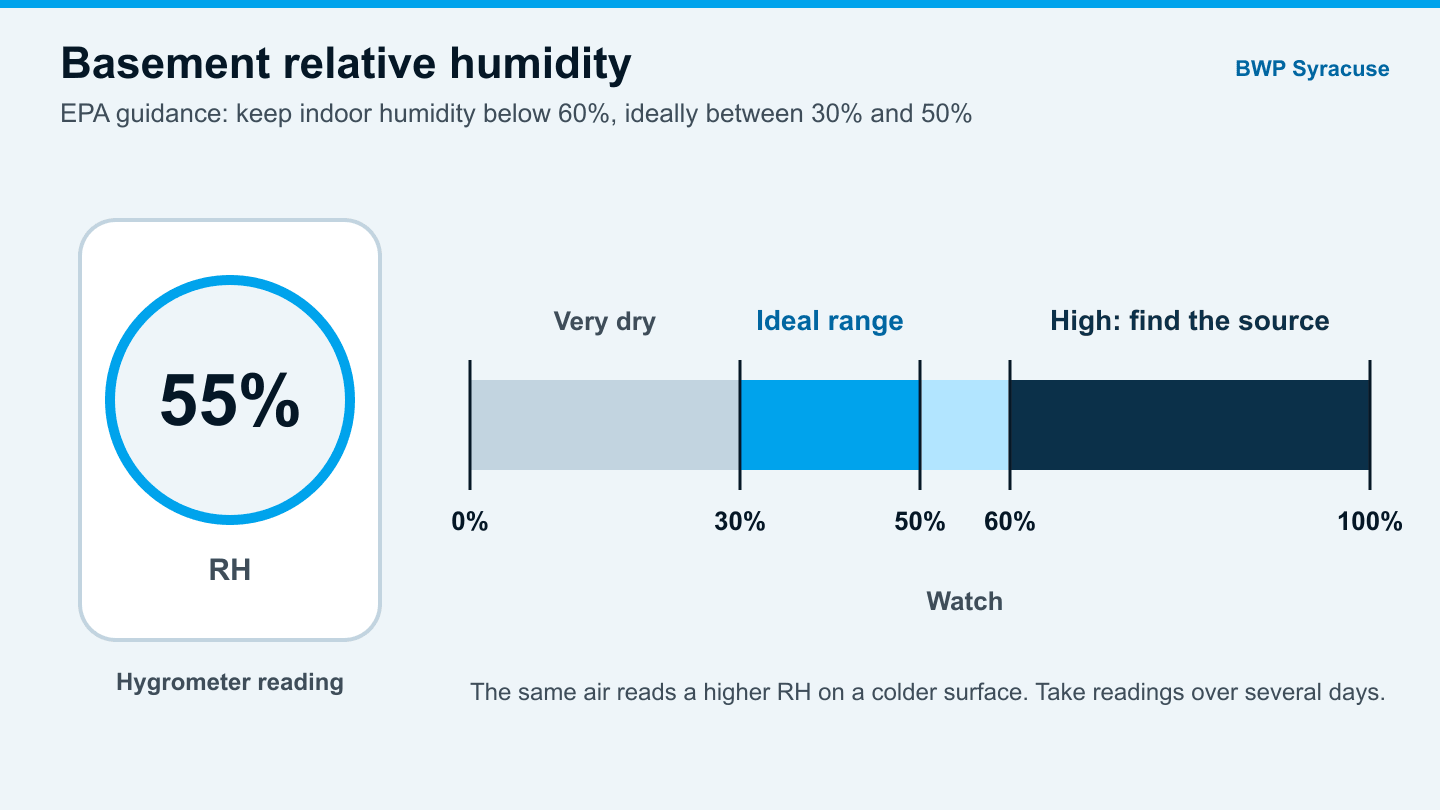
EPA guidance recommends keeping indoor relative humidity below 60 percent, ideally between 30 and 50 percent. Readings consistently above 60 percent point toward a moisture source that needs attention. The full explanation of those ranges, and why one reading is not enough, is in the guide to ideal basement humidity.
Check surface temperature against dew point
Some digital hygrometers display the dew point. If the temperature of a wall, floor or pipe is at or below that number, condensation on that surface is expected. An inexpensive infrared thermometer gives a reasonable surface reading. Condensation that lines up with the numbers points away from a leak.
Understand the limits of consumer moisture meters
Pin and pinless moisture meters are handy for comparing a damp spot with a dry one nearby. They are not built to report the true moisture content of concrete. EPA’s moisture guidance notes that electronic meters with direct reading scales were developed for wood, and that readings on other materials are commonly reported using the lumber scale. On a basement wall, treat meter numbers as relative: higher here, lower there.
Understand the limits of the foil or plastic sheet test
Taping a square of foil or plastic to a wall or floor for a day or two is a popular test. Moisture on the room side suggests condensation, and moisture under the sheet suggests moisture coming through the concrete. ASTM’s standard for this method, D4263, indicating moisture in concrete by the plastic sheet method (opens in a new tab), describes it as a way to indicate the presence of capillary moisture in concrete, designed for use before applying coatings.
That makes it a clue, not a verdict. Room temperature, humidity changes and how well the edges are sealed all affect the result. It cannot tell you where water is entering, how much is moving or whether the wall leaks during a storm. When the result is unclear, or points one way while other signs point another, a professional moisture assessment is more reliable.
When Dehumidification Is Enough
A dehumidifier is the right main tool when the evidence points to humid air, condensation and damp stored materials: dampness that follows summer weather, sweating pipes, no signs of water at the base of the walls and humidity that drops when the machine runs. Pair it with closing windows on humid days, moving stored items off the floor and fixing obvious indoor moisture sources such as an unvented dryer.
The dehumidifier should bring readings below 60 percent and hold them there without running constantly. If it does, and the smell and clammy feel go away, the basement likely had a humidity problem rather than a water problem.
When the Moisture Source Has to Be Corrected
Dehumidification is not enough when the evidence points to liquid water, even if you never see it flowing:
- A damp band at the base of walls that persists through dry weather.
- Swollen baseboards, damp carpet edges or bubbling paint along exterior walls.
- White mineral deposits that return after cleaning.
- Dampness that gets worse a day or two after rain or during a thaw.
- A dehumidifier that runs constantly and still cannot hold the humidity below 60 percent.
Those signs point toward seepage or wicking through the foundation. The seam where the wall meets the floor is a common location, explained in what water at the cove joint usually means. Whether the fix is sealing a specific entry point or relieving water pressure around the perimeter is covered in crack repair or full drainage.
What Does Not Work
- Running a dehumidifier indefinitely against liquid water. A dehumidifier removes vapor from the air. Groundwater seeping behind a wall or wicking through the slab keeps replacing that moisture, so the machine runs forever and the materials in contact with the concrete stay damp. University of Minnesota Extension describes dehumidification as a way to reduce the symptoms of humidity and odor, not a permanent or complete solution.
- Opening windows on humid summer days. Warm outdoor air adds moisture, and that moisture condenses on cool basement surfaces.
- Painting or coating the inside of the wall. The University of Minnesota guide notes that a membrane or coating on the interior without drainage generally will not solve the problem in the long term. Whether Drylok works looks at where masonry coatings help and where they fail.
- Finishing over a damp wall. Framing, insulation and drywall placed against a damp foundation give moisture somewhere to collect out of sight, which often turns a damp basement into a musty one.
The Syracuse Pattern
In practice, Syracuse basements show two different damp seasons. In summer, humid air meets cool foundation walls and floors, and condensation plus high humidity is the most common complaint. In the heating season, indoor air is drier, and ENERGY STAR notes that in colder climates humidity should be in the 30 to 40 percent range during the heating season to prevent window condensation. A basement that stays damp in January, when the air upstairs is dry, is more likely dealing with moisture coming from the foundation.
Spring adds a third pattern. As snowmelt raises groundwater around foundations, walls that were only humid in summer can start wicking or seeping at the base.
When to Call a Professional
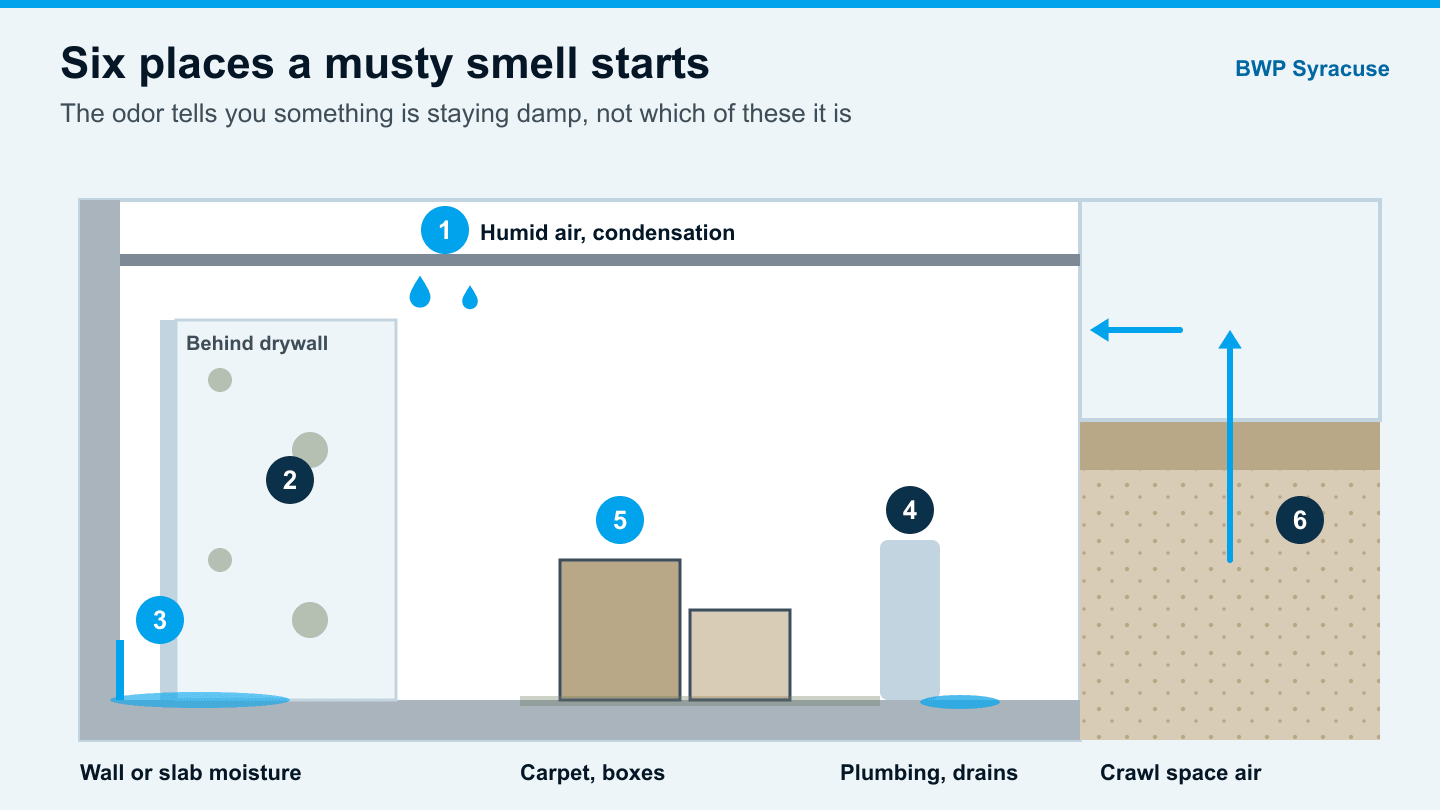
Consider a professional moisture inspection when humidity will not stay below 60 percent with a properly sized dehumidifier, when signs of seepage appear along finished walls, or when the pattern follows rain and snowmelt more than humid weather. A musty smell that persists alongside these signs is also worth investigating, and the six causes of a musty basement smell explains where that odor usually starts.
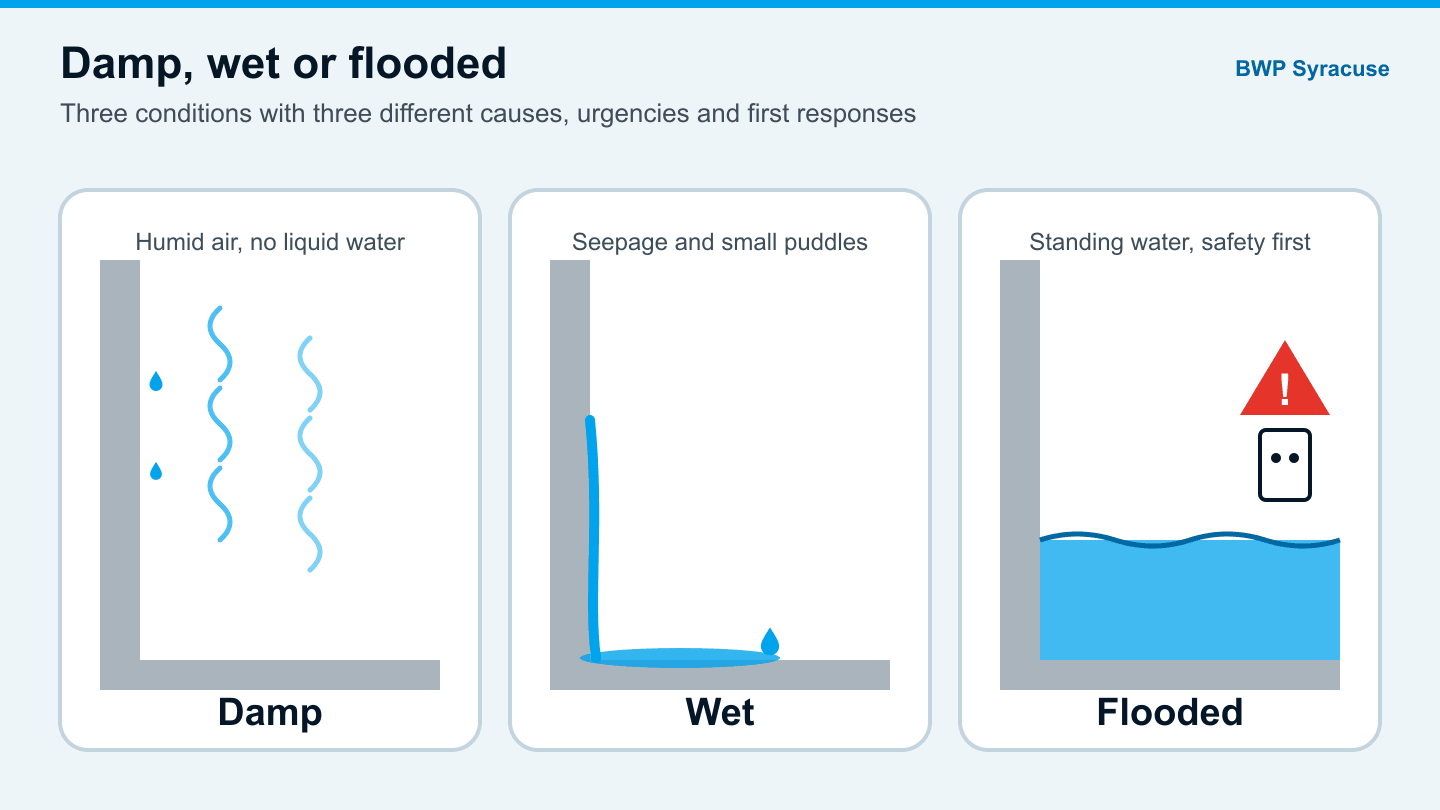
If the dampness is turning into water you can actually see, the difference between damp, wet and flooded basements helps decide how urgent it is. For the wider list of symptoms that usually come with foundation moisture, compare notes with the nine early signs a basement shows.
Still not sure whether the moisture is humidity or water coming through the foundation? A free moisture inspection can separate vapor, condensation and hidden seepage before you choose between a dehumidifier and a repair.
No Leak Does Not Mean No Water
A damp basement with no visible leak is usually getting moisture in a form you cannot see: vapor, water condensing out of the air, or water moving through the concrete itself. Measuring humidity over time, comparing the dampness with the weather and checking the base of the walls tells you which one it is, and that decides whether the answer is controlling the air or stopping the water.
Frequently Asked Questions
Can moisture come up through a concrete basement floor?
Yes, moisture moves through concrete floors as vapor and by capillary wicking, even when the slab looks dry. EPA moisture guidance explains that water vapor migrates slowly through materials that appear solid, and University of Minnesota Extension describes water being drawn up through small pores in the footing and slab. Slabs poured without a vapor barrier underneath are more prone to it.
Is the foil test accurate for basement moisture?
The foil or plastic sheet test is a rough indicator, not an accurate measurement. ASTM describes its plastic sheet method as a way to indicate capillary moisture in concrete before applying coatings. A result can be affected by temperature, humidity and how long the sheet stays in place, and it cannot tell you where a leak starts or how much moisture is moving.
Should I open basement windows to dry out a damp basement?
Do not open basement windows on warm, humid days. Humid outdoor air brings more moisture in, and that moisture condenses on cool basement walls and floors. Ventilating can help on cool, dry days, but in summer it usually makes a damp basement worse.
Are cheap moisture meters accurate on concrete?
Consumer moisture meters are useful for comparing one spot with another, but their readings on concrete and masonry are relative, not true moisture content. EPA moisture guidance notes that electronic meters with direct reading scales were developed for wood, and that results on other materials are often reported using the lumber scale.
Will a dehumidifier fix a damp basement with no leak?
Often it helps a great deal, when humid air and condensation are the main source. It will not solve dampness that comes from water seeping behind finished walls, wicking through the foundation or a plumbing leak, and a unit that runs constantly without lowering the humidity is a sign that another source is involved.
How do I tell condensation from seepage on a basement wall?
Tape a square of plastic sheet to the wall for 24 to 48 hours, then check which side is wet. Moisture on the room side is condensation from humid air. Moisture under the plastic, against the concrete, is coming through the wall. The two need different fixes, so it is worth knowing which one you have before buying anything.
Can a damp basement with no leak still grow mold?
Yes, mold does not need a leak, only surfaces that stay damp. EPA guidance links mold growth to moisture and recommends keeping indoor humidity below 60 percent. Cardboard boxes, carpet and wood stored against a cool basement wall are the usual first places it appears.