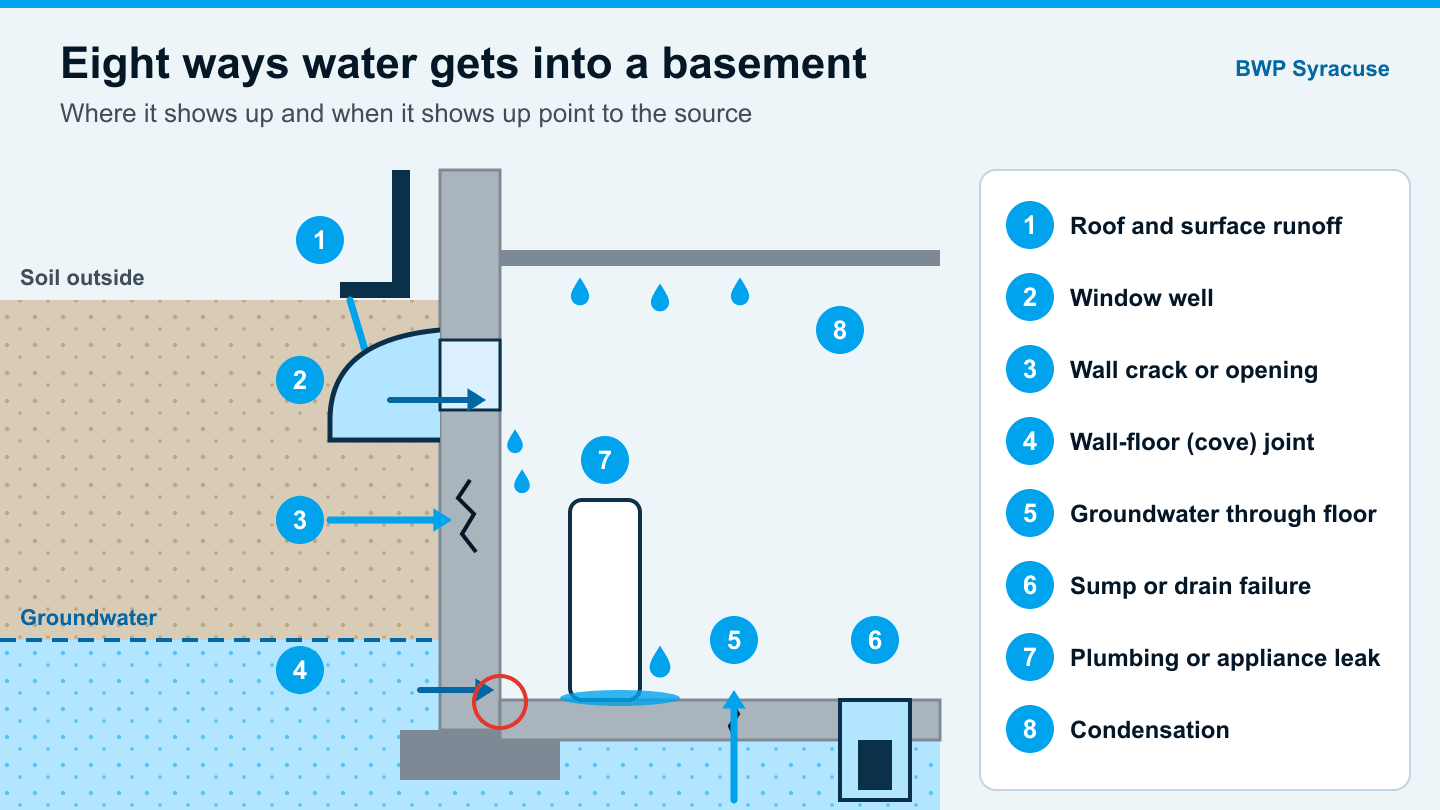
Why is my basement wet? In most homes the water comes from one of a small set of identifiable sources: roof and surface runoff, a window well, an opening in the foundation wall, groundwater at the wall-floor joint or under the floor, a failed sump or drain system, plumbing, or condensation. When the water appears and where it first shows up are the two clues that sort those causes apart.
That matters because the fixes are completely different. A downspout extension will not stop groundwater under the slab, and a new drainage system will not stop a leaking washer hose. This page gives each cause a short description and the clue that points to it, then sends you to the deeper guide for the one that matches.
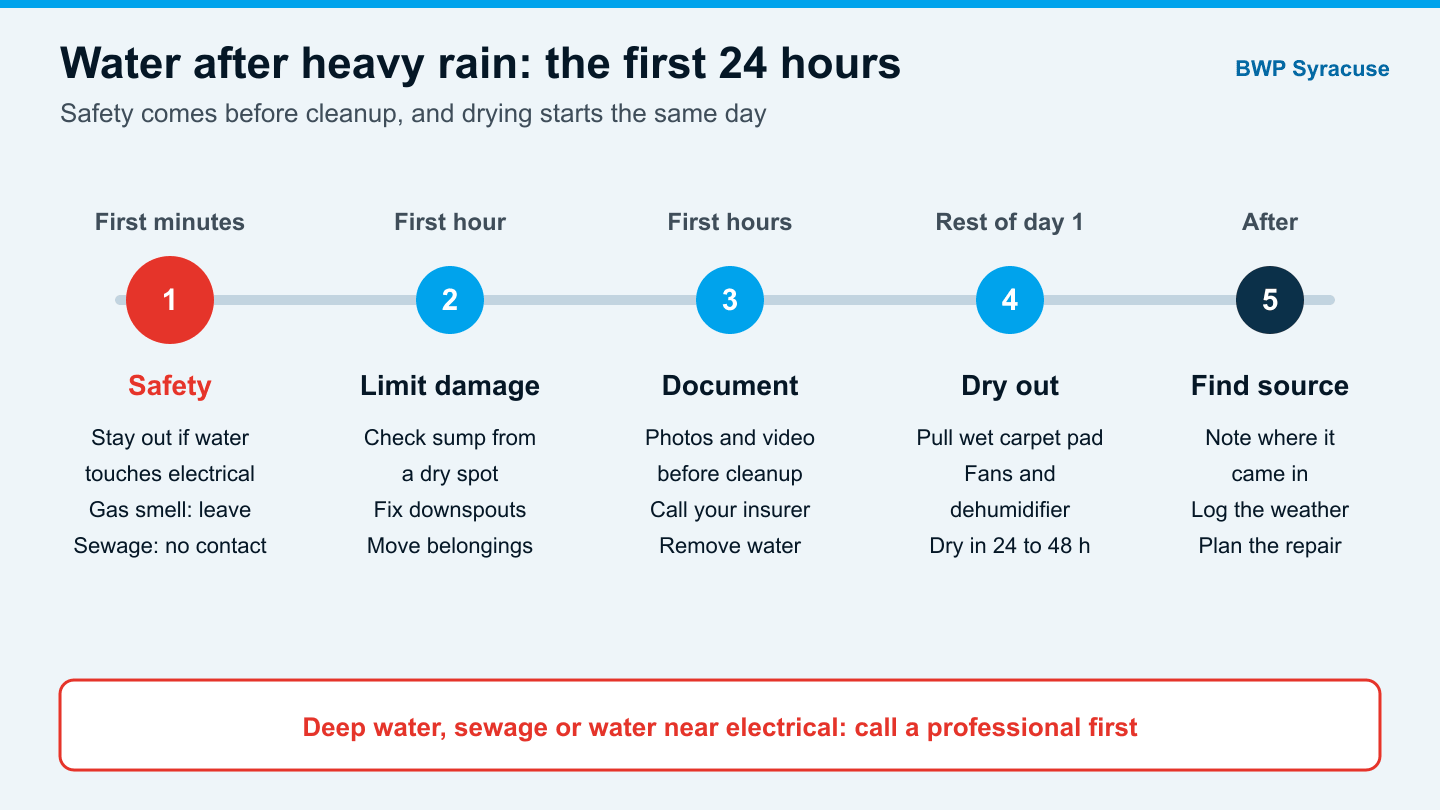
If the basement is wet right now and the water is more than a damp spot, start with what to do in the first 24 hours after heavy rain and come back here once things are safe.
Two Questions That Narrow It Down Fast
When does the water appear? Within hours of heavy rain points toward surface water. During snowmelt or after several days of rain points toward groundwater. On dry days points toward plumbing. On humid summer days with no rain points toward condensation.
Where does it first appear? Under a window, at one corner or partway up a wall points to a local entry such as a window well, a downspout or a crack. A line along the base of the walls points to the wall-floor joint. A puddle in the middle of the room points to the slab, a floor drain or plumbing.
Keep those two questions in mind as you read the causes below. Most wet basements fit one of them clearly once you have watched two or three events.
Why Is My Basement Wet? The 8 Most Common Causes
1. Roof and surface runoff next to the foundation
Gutters that overflow, downspouts that empty right beside the wall and ground that slopes toward the house all put a lot of water into the soil next to the basement. That water soaks down along the foundation and gets in through whatever openings it finds. The typical sign is water that appears within hours of a heavy rain, on one side or at one corner, often directly below a downspout. A gutter overflowing above the wet spot during a storm is about as clear as basement clues get.
2. A leaking window well
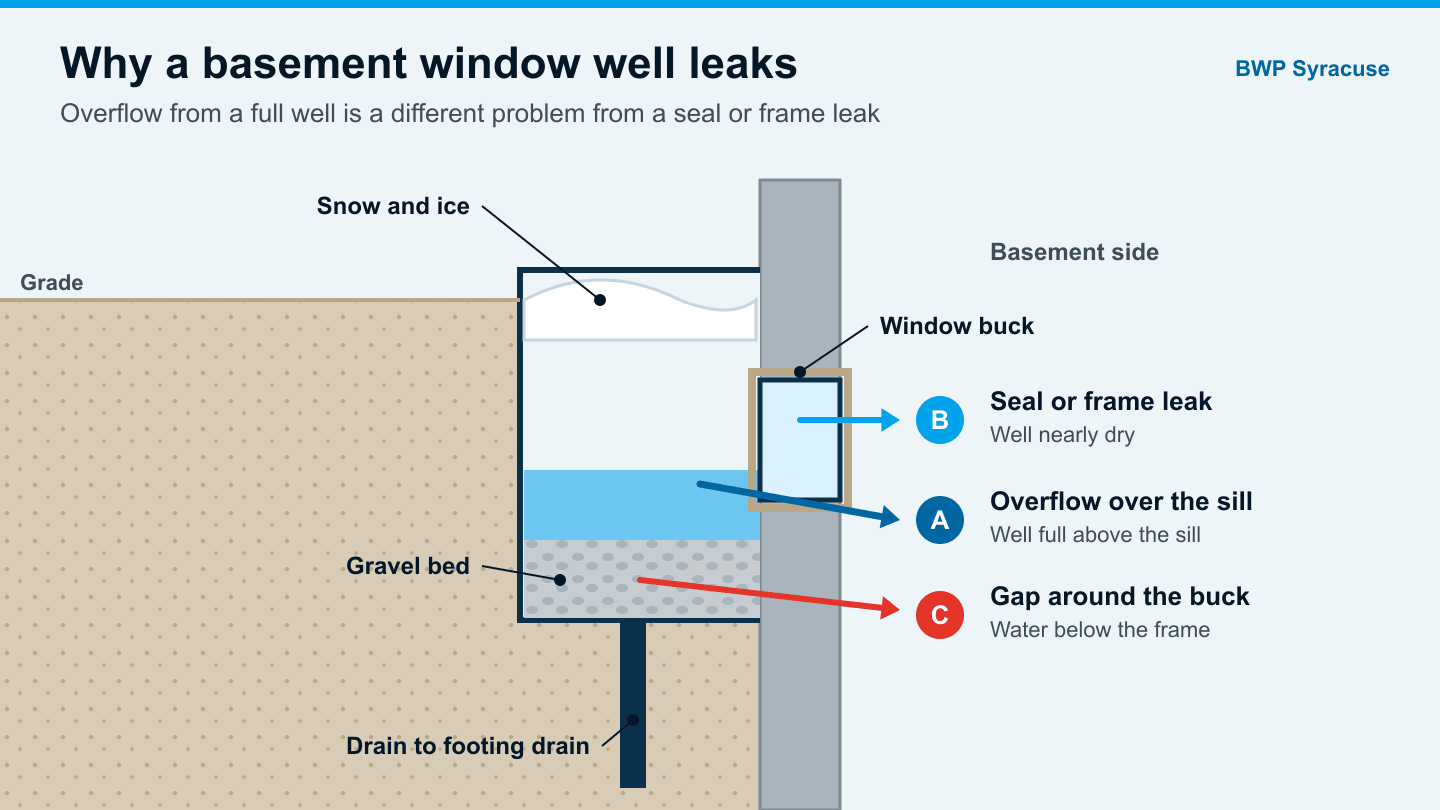
A basement window that sits below ground level has a well around it, and that well catches rain and snow. If the gravel at the bottom is clogged or there is no drain, water fills the well and spills over the sill. Seals and frames can also fail with the well nearly dry. The sign is water on the wall directly under a window, usually during long rain or snowmelt. Telling overflow from a seal leak takes a couple of simple tests, covered in how to find the source of a leaking basement window well.
3. Cracks and openings in the foundation wall
Poured walls develop shrinkage cracks, and walls also have tie-rod holes (small plugs left from the forms), pipe and wire openings, and in block or stone foundations, porous mortar joints. Water in the soil outside follows these paths in. The sign is a wet streak that starts partway up the wall and runs down, often with white mineral deposits along the crack after it dries. Water that enters through one crack is a different problem from pressure along the whole perimeter, and crack repair or a full drainage system explains how to tell which one you have.
4. Groundwater at the wall-floor joint
The seam where the wall meets the floor slab, called the cove joint, is the lowest opening around the room. When the soil around the footing becomes saturated, water pushes up through that seam under hydrostatic pressure, which is the push that standing water exerts because of its weight. The sign is a wet line along the base of one or more walls with dry wall above it, often in spring or after days of rain. That pattern has its own guide: water coming in where the wall meets the floor.
5. Groundwater coming up through the floor
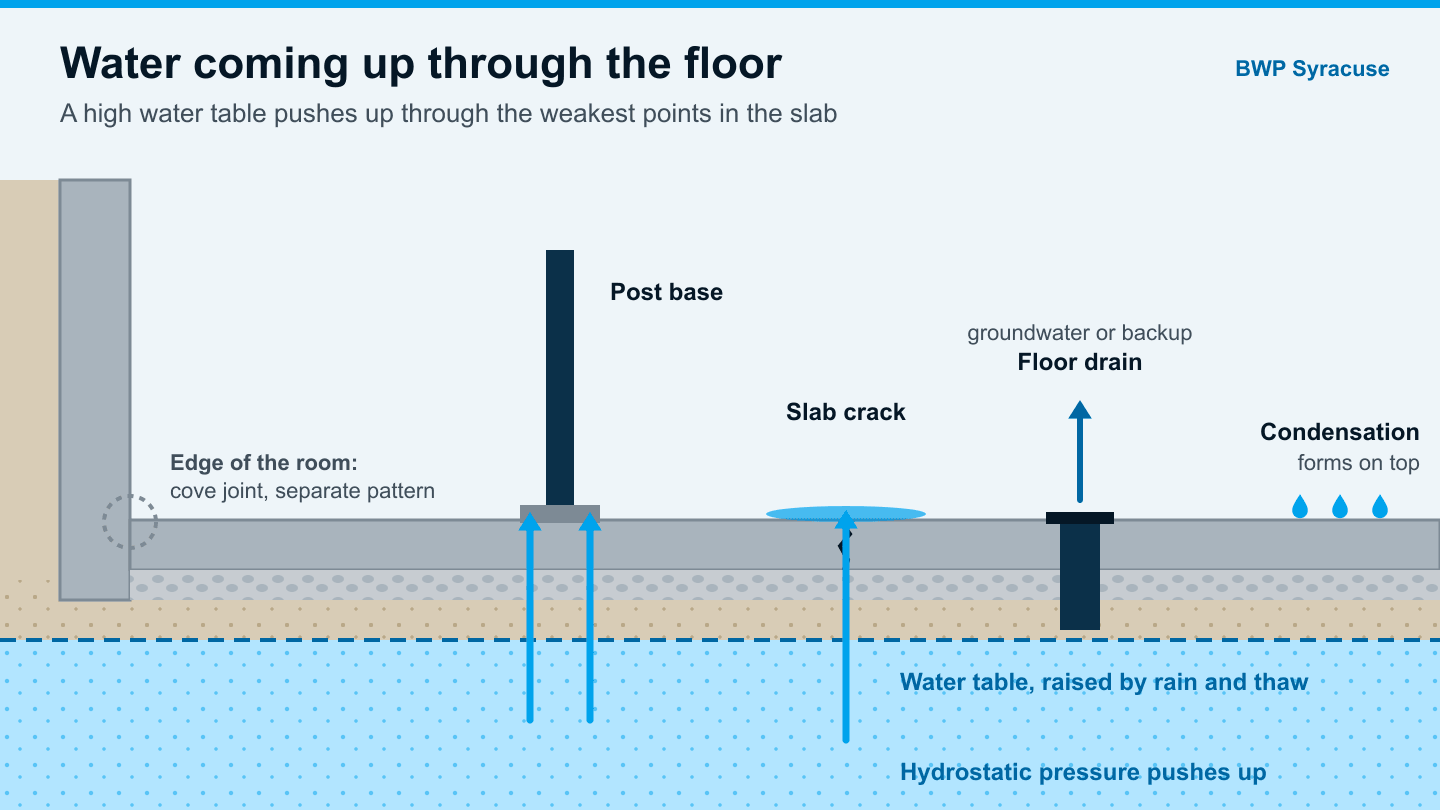
When the water table, the level below which the soil is fully soaked, rises above the bottom of the slab, water can come up through floor cracks, control joints, old pipe holes and the edges of post bases. NDSU Extension’s guidance on basement water seepage (opens in a new tab) notes that when the water table is above the basement floor, water can get in where the walls and floor meet and through cracks in the floor. The sign is water tracing a crack in the middle of the room after a wet spell. The full diagnosis, including how to rule out condensation and drains, is in water coming up through the basement floor.
6. A sump pump or drainage system that stopped working
Many basements have a footing drain, a perforated pipe around the base of the foundation that carries water to a sump basin, the pit where a sump pump collects it and pumps it outside. If the pump fails, loses power, has a stuck float switch or pumps into a frozen or blocked discharge line, water that was being handled quietly for years suddenly shows up. The sign is a full sump pit with a silent pump, or water appearing around the pit and along the walls during a storm, especially after a power outage. Look at the pit only from a dry spot, and never reach into it with the pump plugged in.
7. Plumbing, appliances and drain backups
Supply pipes, water heaters, washing machine hoses, condensate lines from furnaces and air conditioners, and the floor drain can all put water on a basement floor. A blocked sewer line can push water back up through the floor drain when fixtures upstairs are used. The sign is water that does not follow the weather: it shows up on dry days, near a fixture, after laundry or a shower, or with a sewage smell. A water meter that moves with every tap closed confirms a supply leak.
8. Condensation on cool walls, pipes and floors
In summer, warm humid air reaches cool basement surfaces and its water vapor turns to liquid. Walls, the slab and cold water pipes can all look wet, and many homeowners take it for a leak. EPA’s mold and moisture guide (opens in a new tab) advises keeping indoor humidity below 60 percent, ideally between 30 and 50 percent. The sign is wetness on humid days with no rain, spread across many cool surfaces at once, along with a high hygrometer reading. The other no-leak moisture sources are covered in why a basement feels damp with no visible leak.
Comparing the Causes Side by Side
| Cause | Typical symptoms | Likely entry location | Next diagnostic step |
|---|---|---|---|
| Roof and surface runoff | Water within hours of heavy rain, one side or corner | Partway up the wall or at the base below a downspout | Watch gutters and downspouts during a storm; check slope of soil |
| Window well | Wet wall under a window; worse in snowmelt | Over the sill or at the frame corners | Look at the water level in the well; hose test the well |
| Wall cracks and openings | Wet streak starting partway up the wall; mineral staining | Crack, tie-rod hole, pipe opening, mortar joint | Trace the wet line upward to its highest point |
| Groundwater at the cove joint | Wet line along the base of walls, wall above dry | Wall-floor seam, often several walls | Log timing against rain and thaw; paper towel up the wall |
| Groundwater through the floor | Water tracing slab cracks mid-room after wet spells | Floor cracks, joints, post bases, old pipe holes | Dry the floor and watch where water returns |
| Sump or drain failure | Full pit, silent pump, water near the pit or after an outage | Around the sump and along the perimeter | Check power, float and discharge line from a dry spot |
| Plumbing, appliances, drain backup | Water on dry days, near fixtures, possible sewage odor | Near the water heater, washer, pipes or floor drain | Water meter test; run an upstairs fixture and watch the drain |
| Condensation | Wet surfaces on humid days, sweating cold pipes | Broad areas of wall and floor at once | Hygrometer readings; plastic sheet test |
Reading the Timing
Timing is the most underrated clue, because most people only notice water once and then clean it up. A few patterns repeat often enough to be worth knowing.
Within a few hours of a downpour. Surface water is the usual driver: gutters, downspouts, grading or a window well. The soil right against the foundation fills up faster than water can drain away, and the closest opening lets it in.
A day or more after rain, or during a thaw. This lag points to groundwater. The soil has to become saturated before the water level rises against the footing and under the slab. Syracuse averages a lot of snow, and a concentrated thaw in late winter puts a large volume of water into the ground at once, often while the top layer is still frozen and cannot absorb it.
Only in spring. Seasonally high groundwater, window wells holding melting snow or a sump that runs hard only during thaws. A basement that is dry from June to October and damp along the floor line every March fits this well.
On dry days. Plumbing, appliances or a drain backup. Weather has nothing to do with these, so a dry-week puddle is one of the clearest clues of all.
On humid summer days. Condensation, especially when the wet areas are broad and cold pipes are sweating at the same time.
A 20-Minute First Look
The goal of this check is to narrow the list from eight causes to one or two before you spend money. Do it on a dry day, then repeat the observation steps during the next rain.
- Make sure it is safe. If water is touching outlets, cords or appliances, stay out of it and have the power cut from a dry spot. If the water smells of sewage, do not touch it bare-handed.
- Find the highest wet point. Dry the area, then watch where water first returns: high on the wall, under a window, at the wall-floor seam or in the middle of the floor.
- Check the outside on the same side. Look at the gutter above, where the downspout empties, which way the soil slopes and whether a window well is holding water.
- Check the sump, if you have one. From a dry spot, see whether the pit is full and whether the pump runs.
- Run a water meter test. Shut off every faucet and water-using appliance and note the meter. Movement over an hour points to a supply leak.
- Take a humidity reading. A cheap hygrometer reading above 60 percent on a humid day makes condensation a real candidate.
- Start a log. Date, weather in the previous 48 hours, where the water appeared and a photo.
How to read it: a wet spot that matches a downspout, window or crack on the same side is a local problem. Water along several walls at the floor line, or rising through the slab, is groundwater. Water with no weather link is plumbing or condensation. Call a professional if water keeps returning after you have fixed the obvious outside items, if it appears along more than one wall, or if it comes with cracks that are widening or a wall that has moved.
Mistakes That Lead to the Wrong Fix
Sealing the inside to stop water from outside. Coatings and caulk can help with dampness and small gaps, but NDSU Extension notes that water under outside pressure generally cannot be stopped with products placed inside the basement.
Buying a dehumidifier for liquid water. A dehumidifier dries the air. It is the right tool for condensation and for drying after an event, not for water coming through a joint or crack.
Treating one event as the whole story. One wet afternoon can come from an overflowing gutter. The same spot getting wet after every thaw for three years is a different problem. Wait for a pattern before committing to a large repair, unless the water is causing damage now.
Finishing the basement first. Drywall and flooring hide the evidence and hold water against the foundation. Sort out the source before covering anything.
When to Bring In a Professional
Some of these causes are homeowner fixes: cleaning gutters, extending downspouts, clearing a window well or replacing a washer hose. Others are not. Groundwater at the joint or through the floor, cracks that leak every season, and sump systems that cannot keep up usually need drainage or foundation work, and water from a drain backup needs a plumber.
If you are seeing more than one of the early warning signs, such as efflorescence, musty smells or peeling paint near the floor, the list of signs a basement needs attention is a good cross-check. For water that keeps coming back, BWP Syracuse handles basement waterproofing and interior drainage and offers a free inspection to pin down the source before recommending anything. Bring your log and photos; they shorten the diagnosis.
Write down the date, the weather and the exact spot every time the basement gets wet, because three of those notes will usually tell you which of the eight causes you are dealing with.
Frequently Asked Questions
Why is my basement wet when it has not rained?
Water on a dry week usually points to plumbing or condensation rather than groundwater. Check supply lines, the water heater, washer hoses and the floor drain, and do a water meter test with everything off. If the wetness shows up on humid summer days on cool walls and pipes, it is more likely condensation, covered in why a basement feels damp with no leak.
Why does my basement only get wet in spring?
Spring brings snowmelt and rain together, often while the ground is still partly frozen. Groundwater tends to be highest in late winter and spring, so water that appears only then usually comes from below: the wall-floor joint, floor cracks or a sump that cannot keep up. Window wells packed with melting snow are another spring-only source.
Is a wet basement dangerous?
The immediate danger is electrical. Do not walk into standing water that could be touching outlets, cords or appliances, and do not touch a sump pump or its plug while standing in water. Longer term, materials that stay wet can grow mold. Small, occasional dampness is not an emergency, but it is worth tracking down.
Can a basement be wet from the inside and the outside at the same time?
Yes, and it is common. A basement can have condensation on the walls in summer and groundwater at the floor joint in spring. Treating only one source leaves the other in place, which is why noting the date and weather each time you see water is so useful.