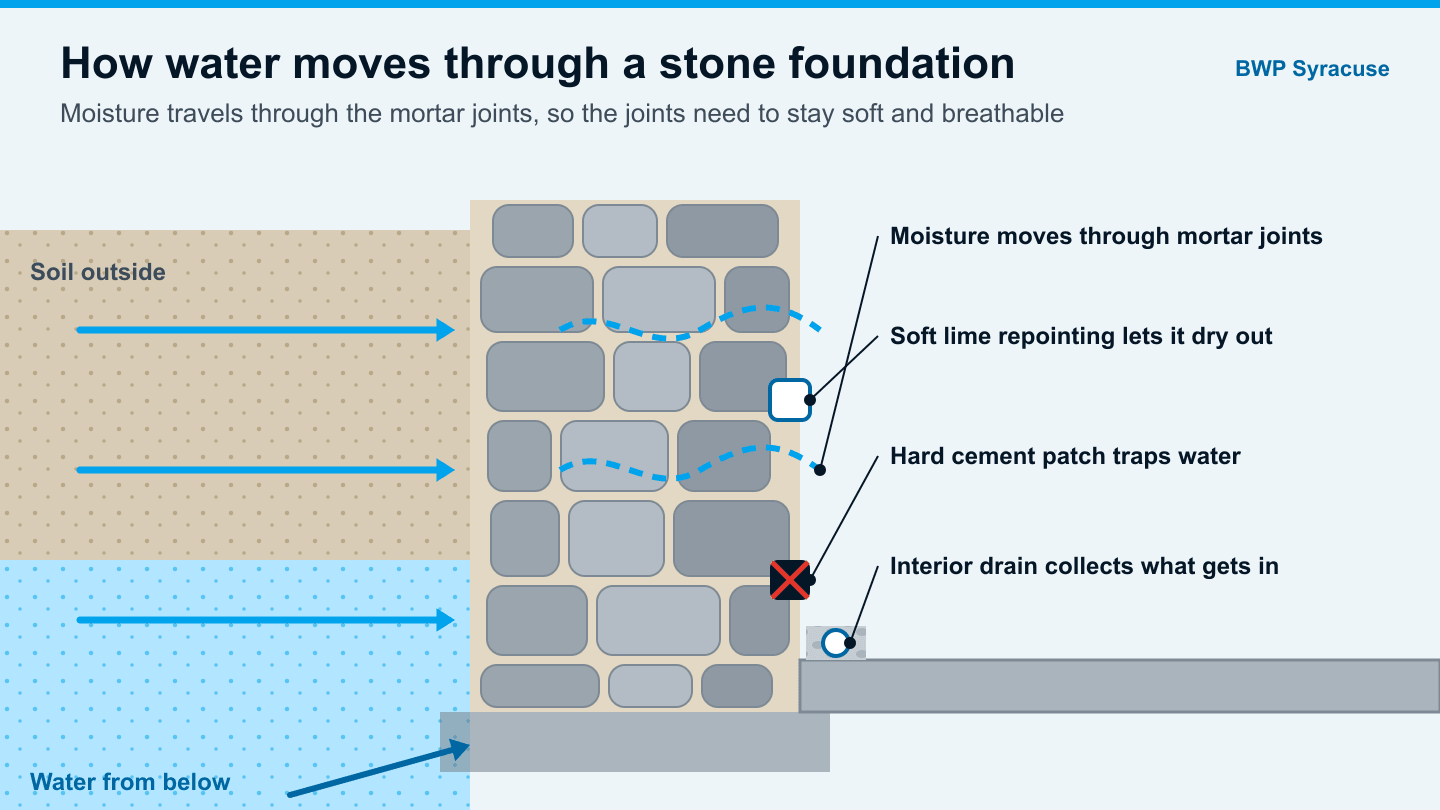
Waterproofing a stone foundation usually means managing water rather than sealing it out: keep surface water away from the wall, repair failing joints with a compatible lime-based mortar, and collect the water that still gets in with interior drainage. The aim is a controlled, reasonably dry basement. Hard cement mortar and waterproof coatings applied to the inside face can trap moisture in the wall and make things worse.
Stone walls behave differently from poured concrete, so the methods that suit a 1990s basement often don’t suit an 1890s one. Check the wall’s condition first, then pick the intervention that matches the water you actually have.
How a stone foundation differs from poured concrete
A rubble or fieldstone foundation is built from irregular stones set in mortar. Water rarely passes through the stones themselves. It travels through the mortar joints, which make up a large share of the wall’s face and are softer and more porous than the stone around them.
Several features set these walls apart:
- Lime mortar. Older mortar was often mostly lime and sand. National Park Service guidance notes that mortar in masonry built between 1873 and 1930 can range from pure lime mixes to various blends of lime and Portland cement. Lime mortar is softer and lets moisture move through it.
- Uneven faces. The inside and outside surfaces are irregular, so membranes and coatings don’t bond evenly the way they do on flat concrete.
- Often no footing drain. Many of these foundations predate the perforated pipe that newer homes have around the footing to carry groundwater away.
- Often no capillary break. There is usually no barrier under the floor or on top of the footing to stop water from wicking upward through the masonry. Capillary movement is the way water climbs through tiny pores, the way a paper towel draws water up from a spill.
- Thick, mixed construction. Some walls are two faces of stone with smaller stones and mortar filling the middle, which affects how they respond to digging and repair.
Joseph Lstiburek of Building Science Corporation puts it bluntly in his article on rubble foundations (opens in a new tab): unless you are very lucky, almost all rubble foundations leak and are damp. That isn’t a defect so much as how these walls were built. They were designed for cellars that held coal and potatoes, not for carpeted family rooms.
The Syracuse context
Syracuse has many homes built before 1940. Some sit on stone foundations, while others of the same era have brick, block or early poured concrete, and many have had sections rebuilt over the years. Check what your own walls are made of rather than assuming from the age of the house. Long snowy winters and a concentrated March thaw mean these walls see a lot of water in a short window each spring, which is when stone basements tend to show their worst behavior.
Why sealing a stone wall from the inside backfires
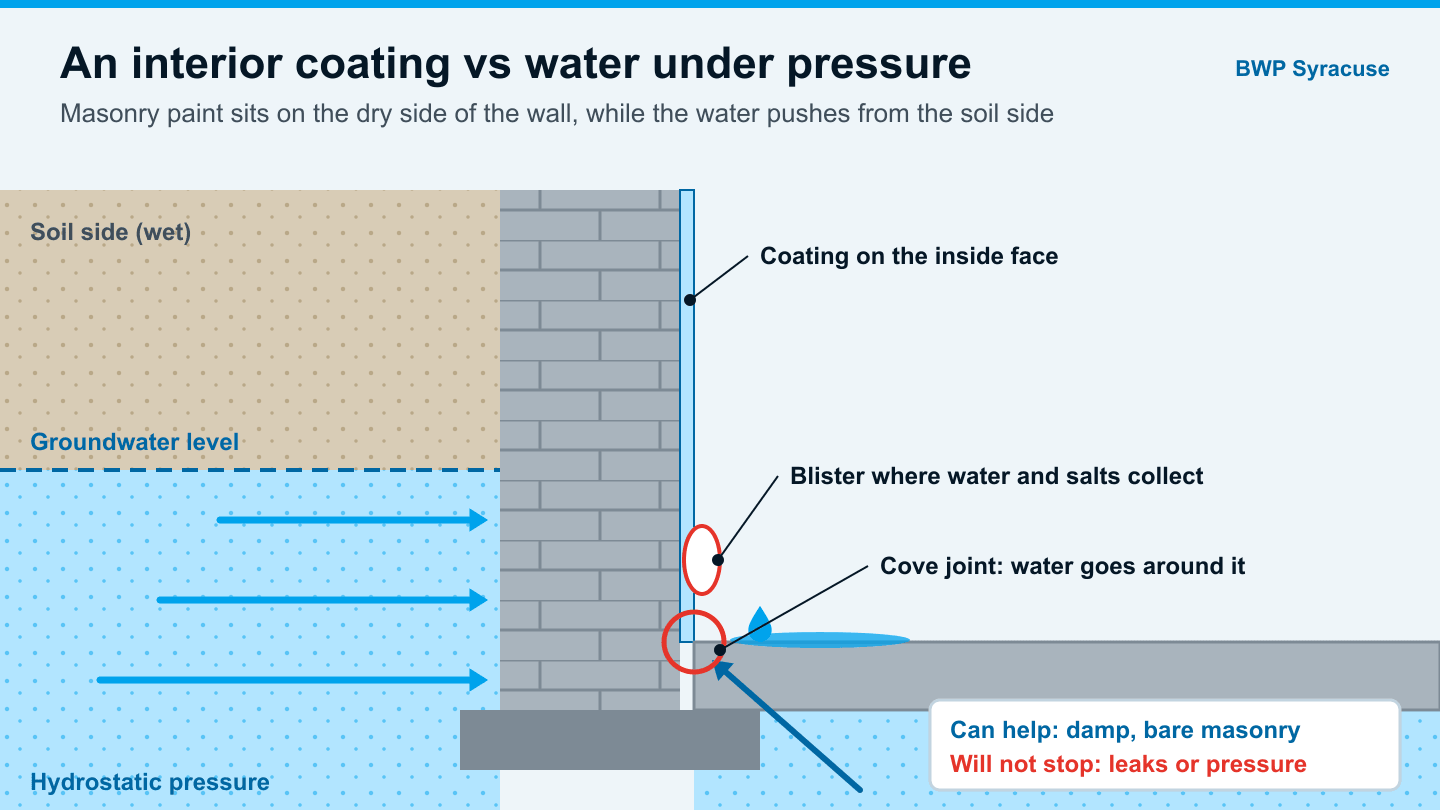
A stone wall in wet soil takes on water from the outside and from below. If that water can’t leave through the inside face or the mortar joints, it stays in the wall. The usual response, a coat of waterproof paint or a hard cement repointing job, closes the exits without closing the entrances.
The National Park Service’s Preservation Brief 2 on repointing mortar joints (opens in a new tab) explains the principle. New mortar should be softer and more vapor permeable than the masonry units and no harder or less permeable than the historic mortar. The brief describes mortar as sacrificial: it is meant to weather and be replaced so that the stones don’t have to. It also notes that a straight Portland cement and sand mortar is extremely hard, resists the movement of water and shrinks as it sets.
Put a hard, dense mortar into a wall of soft lime mortar and the moisture that used to leave through the joints has to leave through the stone, or not at all. A common field pattern is a cement-patched or painted stone wall where the coating peels, the new joints crack away from the old and white mineral deposits build up at the edges. Efflorescence is a sign of water moving and evaporating, and efflorescence on basement walls covers what those deposits tell you. The same logic applies to masonry paints, as explained in does Drylok work.
Check the wall’s condition before choosing anything
Goal: separate a wall that is wet but sound from a wall that needs structural attention first. Drainage work beside an unstable stone wall can make it worse, so this step decides everything after it.
- Look for loose or missing stones. Note any stones that have shifted, dropped out or sit proud of the wall face. Don’t pull on them.
- Check the mortar. Mortar that crumbles into sand when lightly scratched, or joints that are recessed deep behind the stone face, show mortar loss. Note whether it’s a few spots or most of a wall.
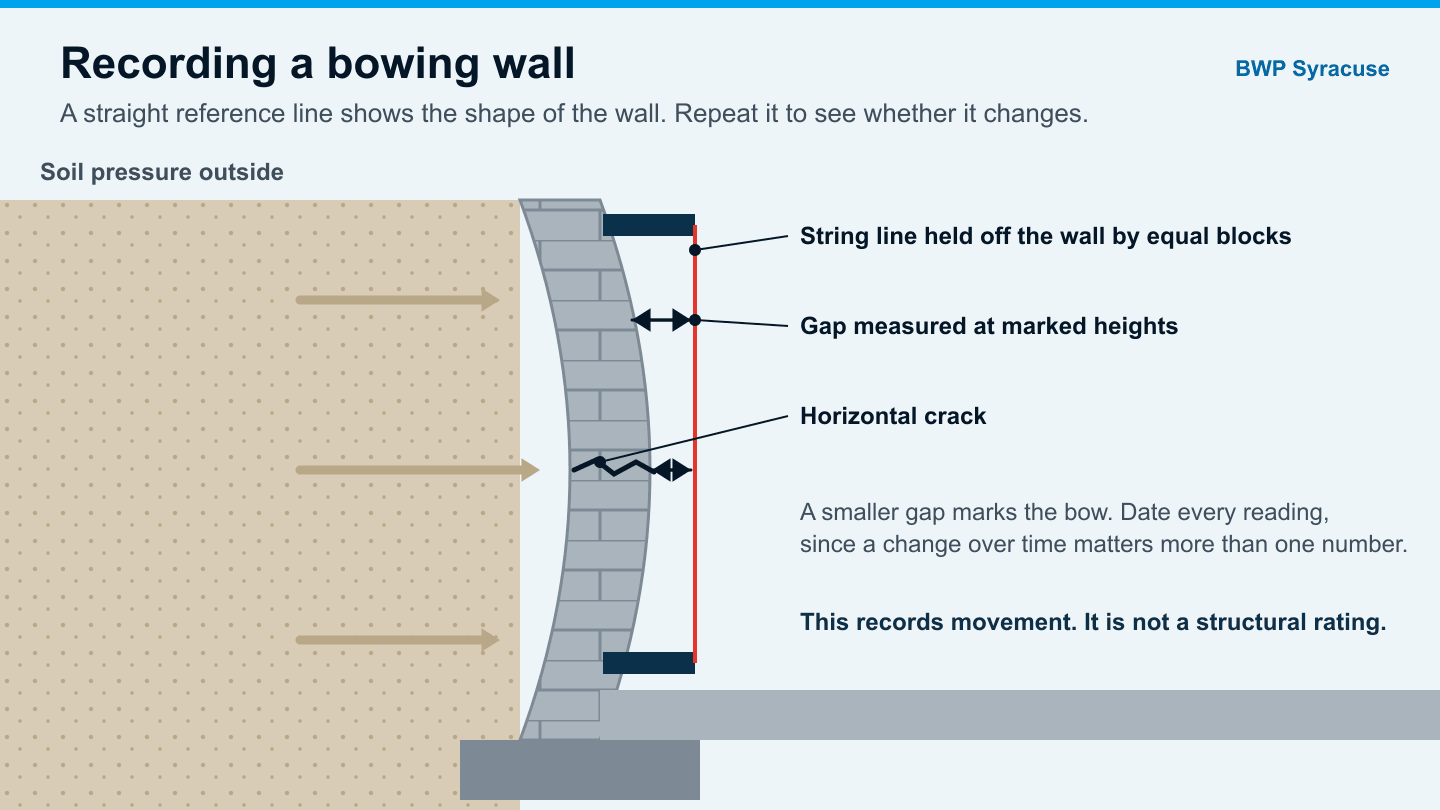
- Sight along each wall. Look for sections that bulge inward, lean or are out of line with the rest of the wall. Compare corners with the middle.
- Check the framing above. Look for sagging joists, a sill that has dropped or new cracks in the floors and plaster upstairs near that wall.
- Map the water. Record where and when water appears: high on the wall, at the base, through the floor, at a window or near a downspout. Note whether it follows rain, snowmelt or neither.
- Walk the outside. Check where downspouts discharge, whether soil slopes toward the house and whether window wells or plantings hold water against the wall.
How to read the result:
- Sound wall, worn joints, damp surfaces: surface drainage, compatible repointing and humidity control are the usual starting points.
- Sound wall, water collecting at the base or coming through the floor: drainage that collects the water and carries it to a sump is usually needed as well.
- Loose stones, bulging, leaning or framing movement: treat it as a structural question first. When a bowing basement wall needs attention explains what to watch.
When to call a professional: any bulging, leaning or displaced stone, mortar loss across large areas, or water collecting on the floor. A structural engineer or a mason experienced with old masonry should look at structural signs. Stay out of a basement with standing water near outlets, cords or a furnace until the power to that area is off.
The main interventions, from the outside in
| Intervention | What it does | Fits when | Watch out for |
|---|---|---|---|
| Gutters, downspouts and grading | Sends roof and surface water away from the wall | Almost always, as a first step | Doesn’t help with a high water table on its own |
| Repointing with compatible mortar | Restores worn joints so the wall sheds water and stays sound | Joints are sandy, recessed or missing | Hard cement mortar can trap moisture and damage stone |
| Lime-based parging | Adds a breathable protective coat to the wall face | A rough face needs protection or a smoother surface | It is a finish, not a water barrier |
| Interior drainage and membrane | Collects water at the base and carries it to a sump | Water collects at the base or through the floor | Trenching near shallow footings needs care |
| Exterior drainage work | Lowers water against the outside of the wall | Access is clear and the wall is sound | Excavation can destabilize a stone wall |
| Dehumidification | Removes moisture from the air | All damp stone basements | Treats the air, not the water entering |
Surface water first
The cheapest water to manage is the water that never reaches the wall. Extend downspouts well away from the foundation, clear gutters so they don’t overflow at the corners and regrade soil so it slopes away from the house. Lstiburek’s account of his own rubble basement lists lowering the grade right beside the wall as a necessity. For a stone wall that only gets damp, this step alone can make a visible difference.
Repointing with compatible mortar
Repointing means raking out failed mortar to a sound depth and packing new mortar into the joint. For a lime-mortar wall, that usually means a lime-based mix, matched to the old mortar’s strength and permeability. Because some walls from this era already contain Portland cement, a mason should assess the existing mortar rather than reaching for a standard bag mix.
Done well, repointing reduces water entry at failed joints and keeps stones locked in place. It does not make the wall waterproof, and it was never meant to. Repointed lime joints will still pass some moisture, which is how the wall stays healthy.
Parging
Parging is a thin coat of mortar troweled over the wall face. On a stone foundation, a breathable lime-based parge can protect the joints and give a cleaner surface. A dense cement parge over a damp stone wall tends to trap moisture and crack or fall away in sheets, often taking some of the surface with it.
Interior drainage and membranes
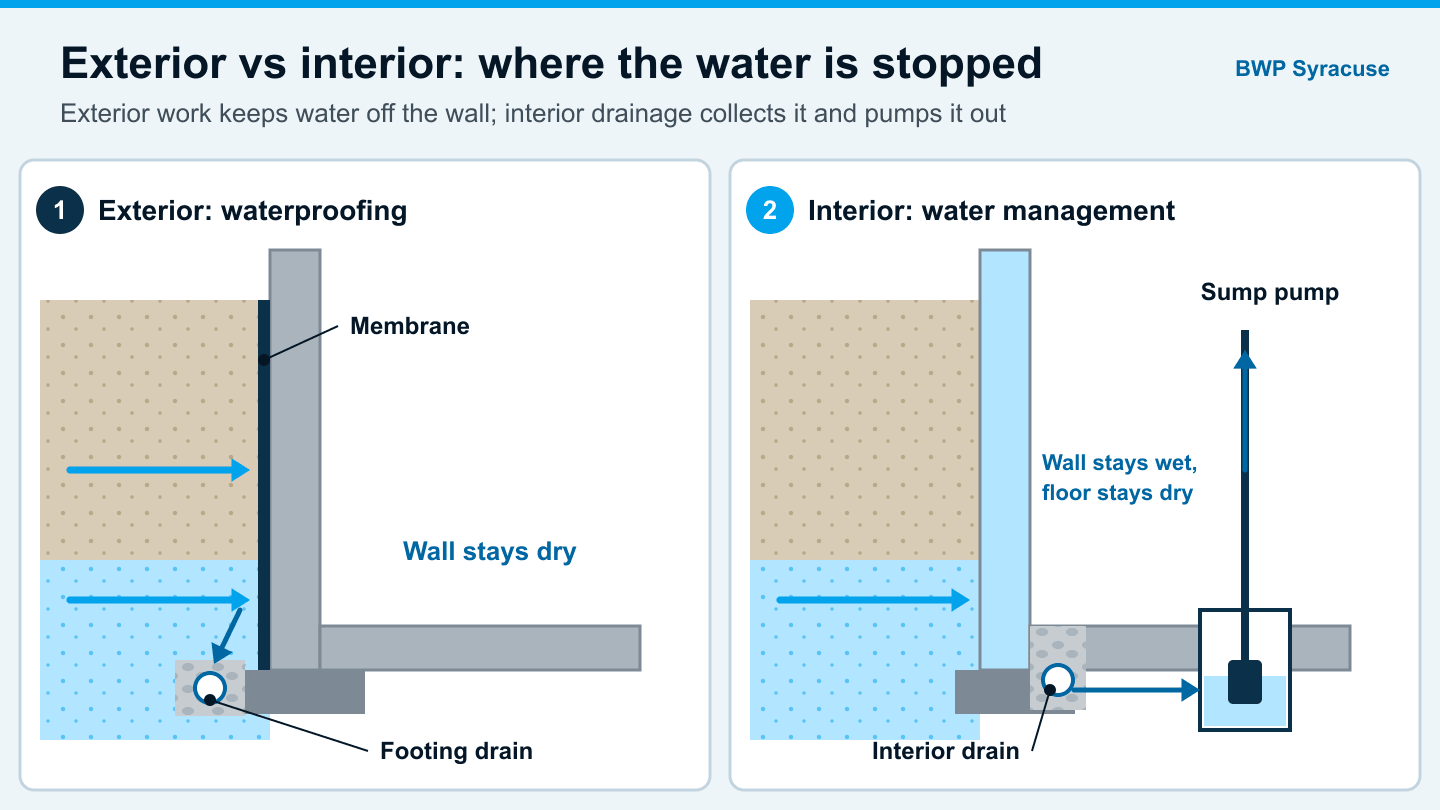
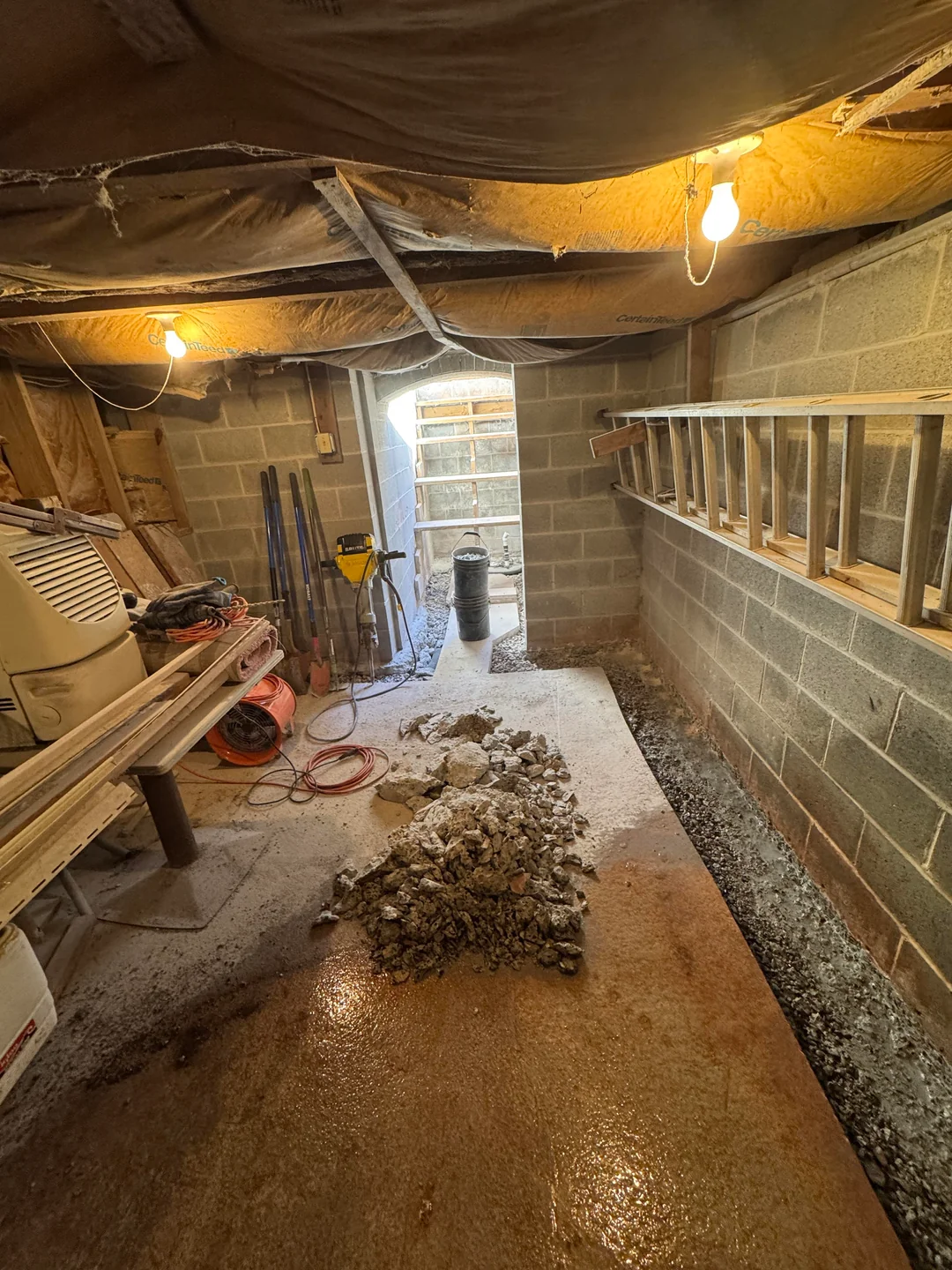
Where water collects at the base of the walls or rises through the floor, interior drainage is usually the most practical fix. A perimeter drain set at the footing level collects the water and carries it to a sump basin, a pit in the floor where a pump sends the water outside. Some systems add a dimpled plastic membrane on the wall face that catches water seeping through the stone and directs it down into the drain, rather than trying to hold it in the wall.
Lstiburek’s rubble basement takes this approach: the wall continues to leak groundwater, and that water is collected on the interior and expelled back outside. Stone walls can have shallow or irregular footings, so trench depth and placement need a contractor who works on these foundations.
Exterior drainage work
Digging out the outside of a stone foundation lets a crew add a footing drain and protect the wall face, but it is a bigger decision on stone than on concrete. Removing the soil that has supported an old wall for a century can let it move, uneven stone needs a parge coat before most membranes will bond, and porches, driveways and neighboring houses often limit access. The trade-offs are compared in interior vs exterior waterproofing.
Humidity control
Even a well-drained stone basement releases moisture through the masonry. A dehumidifier sized for the space and a hygrometer to check the result keep the air in range. The target levels are covered in the ideal basement humidity level.
What a realistic result looks like
A stone basement that has been handled well usually looks like this: walls that may still darken a little in March, no water collecting on the floor, a sump that runs in wet seasons and humidity held near 50 percent. That is a good outcome for this kind of wall.
If you plan to finish the space, design for a wall that will keep passing some moisture. Drywall, fiberglass batts or carpet placed against damp stone tend to hold moisture and grow mold. Finishing approaches for stone basements usually keep a drainage space or membrane between the stone and the new wall, connected to drainage at the base.
Mistakes to avoid when waterproofing a stone foundation
- Repointing with hard cement mortar in a wall built with lime mortar.
- Painting the whole wall with a waterproof coating to stop dampness.
- Sealing the base of the wall while water is still rising from below, which pushes the water to the next weak spot.
- Excavating beside the wall before checking it for bulging, leaning or loose stones.
- Removing loose stones to “clean up” a wall without a plan to reset them.
- Closing the wall in with drywall before the water is under control.
For how a stone wall’s options fit among all the main approaches, the overview of waterproofing methods for basements compares each one.
A stone foundation stays sound by letting water out as well as keeping most of it away.
Frequently Asked Questions
Can a stone foundation basement be made completely dry?
Usually not in the sense of a sealed concrete basement. The realistic goal is a basement where water is kept away from the wall, collected where it still enters and removed, and humidity is held in a normal range. Building scientist Joseph Lstiburek, writing for Building Science Corporation, notes that almost all rubble foundations leak and are damp, and describes managing that water rather than stopping it.
Should I repoint a stone foundation with Portland cement mortar?
Not without knowing what the wall was built with. National Park Service guidance on repointing says new mortar should be softer and more vapor permeable than the stone and no harder than the original mortar. A hard cement mortar in a lime-mortar wall can trap moisture and push damage into the stone. Have the existing mortar assessed by a mason who works on older masonry.
Is parging a stone foundation a good idea?
It can be, as a protective or cosmetic finish. A breathable, lime-based parge lets moisture leave the wall, while a dense cement parge can trap it and tends to crack and fall off. Parging is not a water barrier on its own, so it does not replace drainage.
Do stone foundations need a sump pump?
Not always. A stone basement that only gets damp may be handled with surface drainage, repointing and dehumidification. If water collects at the base of the walls or comes up through the floor in wet seasons, an interior perimeter drain that feeds a sump pump is the usual way to collect it and send it outside.
How do I know if my stone foundation is failing?
Warning signs include stones that are loose or have fallen out, a section that bulges or leans inward, mortar that has washed out deeply between many stones, and cracks or sagging in the floor framing above. Those call for an evaluation by a structural engineer or an experienced mason before any drainage work, since digging beside an unstable wall can make it worse.