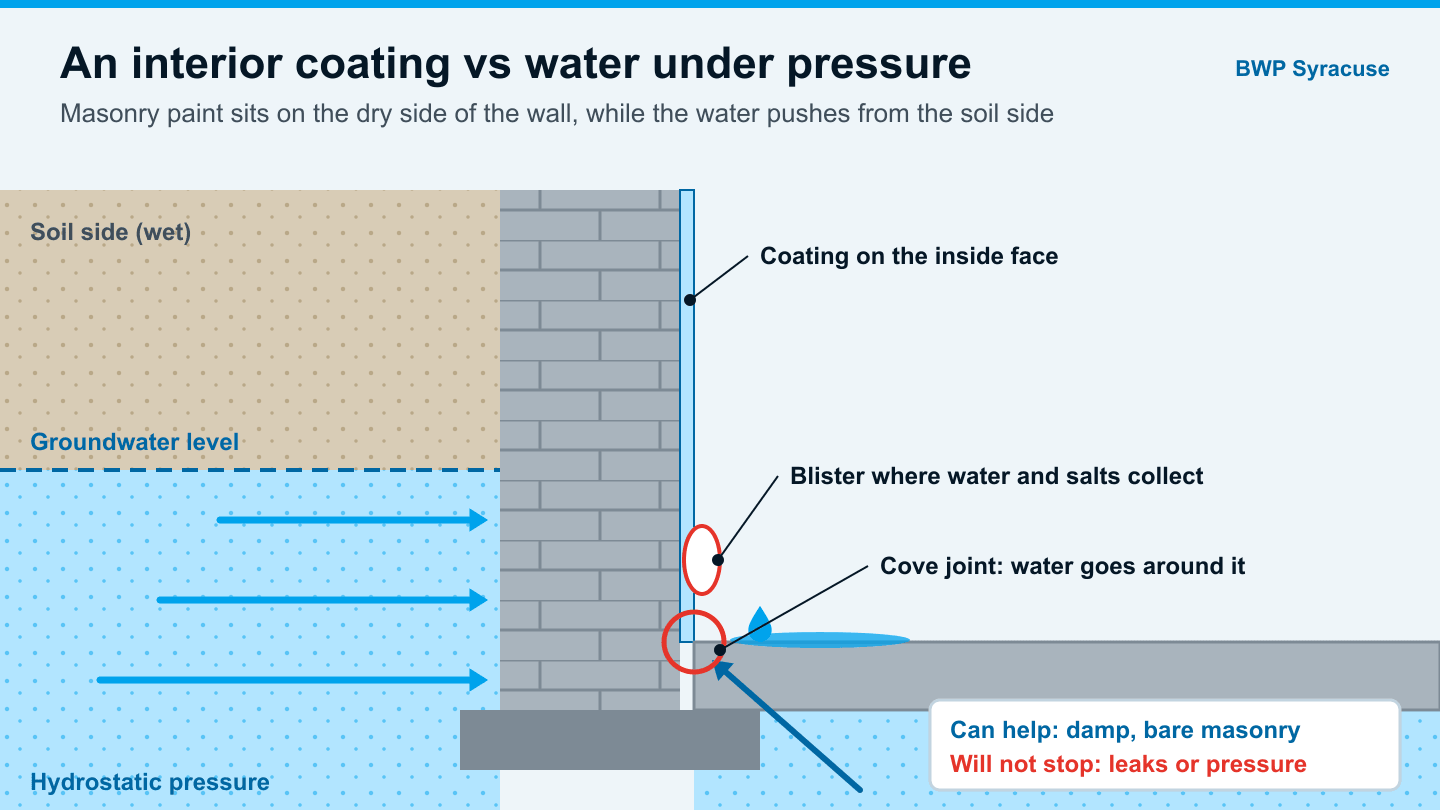
Does Drylok work? Yes, for what it was designed to do: reduce water and dampness passing through porous, clean, bare masonry. It is not a reliable fix for an active leak, a moving crack, water at the cove joint or groundwater pushing against the wall, because a coating on the inside does nothing to the water outside.
That gap between the product’s purpose and the problem many people buy it for explains most of the mixed reviews. A homeowner with a slightly damp block wall can get a good result. A homeowner with water seeping along the floor every March usually gets a painted wall and the same puddle.
What Drylok and similar masonry coatings are designed to do
Drylok is a line of masonry waterproofing paints made by United Gilsonite Laboratories. Its manufacturer explains in its DRYLOK Latex Masonry Waterproofer FAQ (opens in a new tab) that the product works by entering the pores of the masonry and expanding as it dries to become part of the wall surface. It is meant for concrete, block, brick and stucco, inside or out.
The manufacturer’s DRYLOK Extreme product data sheet (opens in a new tab) (August 2026 version, as of October 2026) states that the product was tested to ASTM D-7088 and resists 15 PSI of hydrostatic pressure, which it describes as equivalent to a wall of water 33 feet high. Hydrostatic pressure is the push that standing water exerts because of its weight, and it rises as the water gets deeper against your foundation.
That rating is a manufacturer test result on a properly prepared sample. A real basement wall is not a uniform test panel. It has mortar joints, form-tie holes, hairline cracks that open and close with the seasons, old paint in some spots and a seam where the wall meets the floor. The coating only holds where it is fully bonded to bare masonry, and water under pressure looks for every place it isn’t.
Other products in this group work in similar ways. Masonry waterproofing paints form a thick film, clear penetrating sealers soak into the surface without a visible coat, and crystalline coatings react with the concrete. All of them treat the wall surface. None of them collect water, lower the water level outside or relieve pressure.
Damp masonry, active leaks and water under pressure are three different problems
The question is less “does it work” and more “does it match the water you have.” Before buying any coating, figure out which of these describes your wall.
| Condition | What you usually see | Can a coating alone help? |
|---|---|---|
| Damp masonry | Dark, cool patches, a damp feel, no running water, worse in wet seasons | Often yes, if the wall is bare and clean |
| Active leakage | Water that drips, runs or trickles from a crack, tie hole or mortar joint | Rarely, the entry point needs its own repair |
| Water under pressure | A wet line at the base of several walls, water at the cove joint or through the floor after thaws | No, the water has to be relieved and drained |
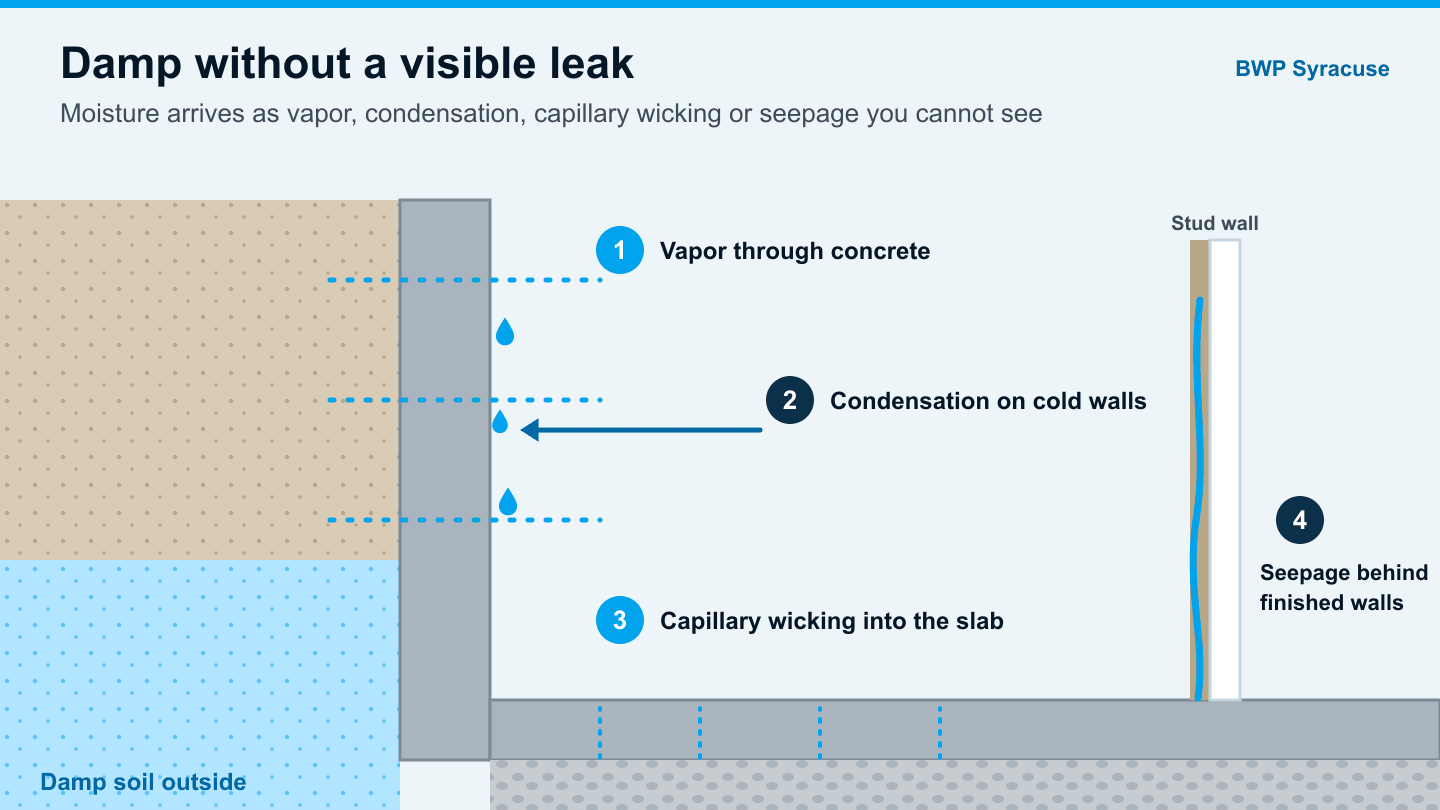
Rule out condensation first. In summer, humid air can sweat on cool basement walls, and no coating will change that because the water is coming from the air, not the wall. A common homeowner test is to tape a two-foot square of clear plastic tightly to the wall and check it after a day or two. Moisture on the room side of the plastic points to condensation. Moisture between the plastic and the wall points to water moving through the masonry. Other no-drip moisture sources are covered in why a basement feels damp with no visible leak.
Where masonry coatings fall short
They need bare, clean masonry
Because the product has to soak into the pores, anything sitting on the surface gets in the way. The manufacturer’s FAQ says existing coatings must be removed, and the Extreme data sheet says the surface must be free of dirt, grease, oil, form-release compounds and paint. Applying it over an existing coating voids the warranty. A basement painted once with ordinary latex paint is no longer a good surface for a penetrating waterproofer until that paint is gone.
Efflorescence and salts get in the way
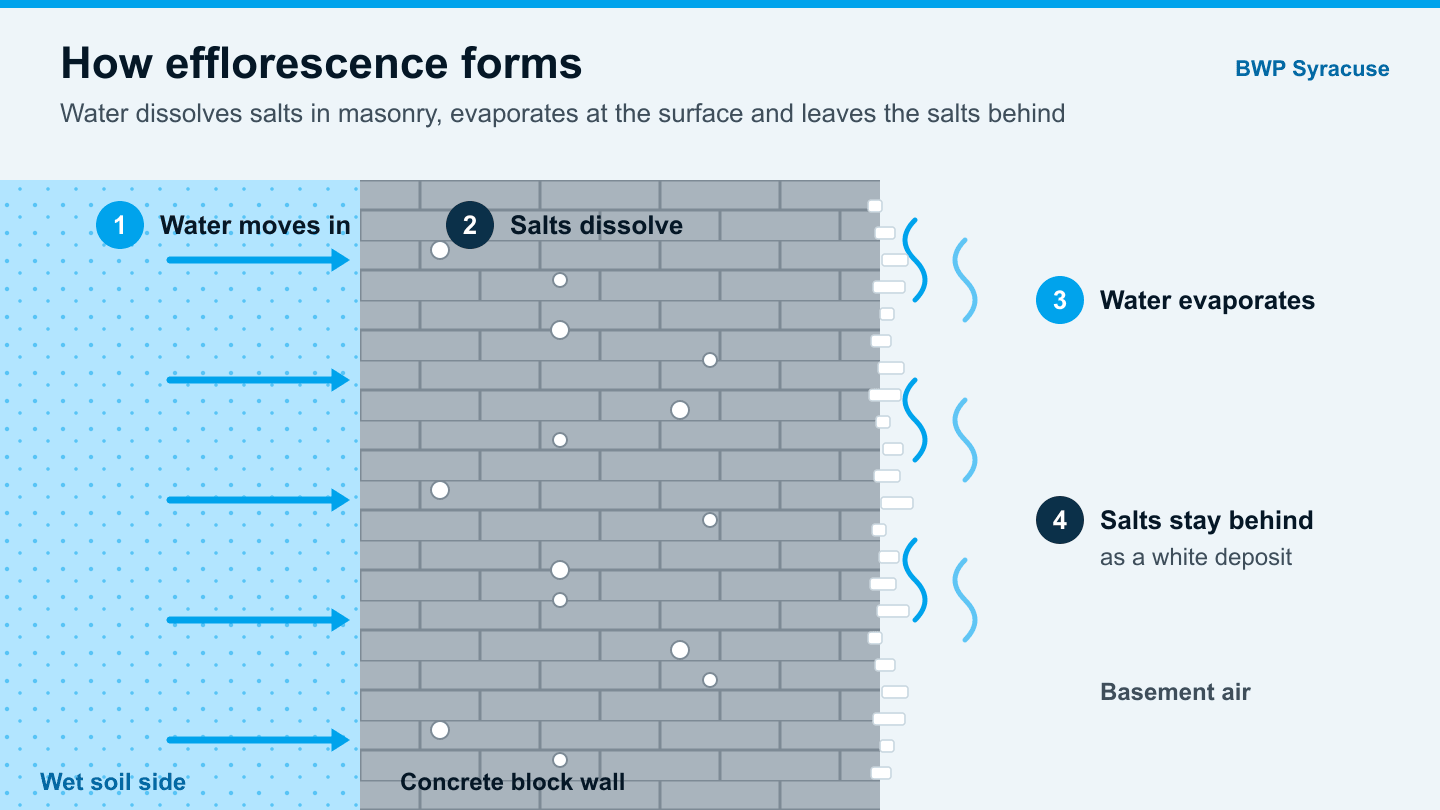
Efflorescence is the white, powdery mineral deposit that water leaves behind when it evaporates from masonry. The data sheet says it must be removed before coating, using an acid etching product according to its directions. A common field pattern is a coating that goes on over salts, or over a wall still delivering salts, and then blisters or flakes as more deposits form behind it. If your wall keeps producing white powder, efflorescence on basement walls explains what it says about the water behind it.
Cracks and the cove joint are not paint jobs
According to the manufacturer, the coating fills fine, hairline cracks, and bigger cracks and chips should be patched first with its hydraulic cement product. The Extreme data sheet also says to patch the floor-to-wall joint, called the cove joint, before coating.
Patching those openings can slow seepage, but it does not change why water reaches them. Cracks in a foundation often move slightly with temperature and moisture, which can break a rigid patch. The cove joint is where groundwater under the slab most often appears, and sealing it tends to move the water to the next weak point. Water coming in where the wall meets the floor explains that pattern in detail.
Pressure comes from the wrong side
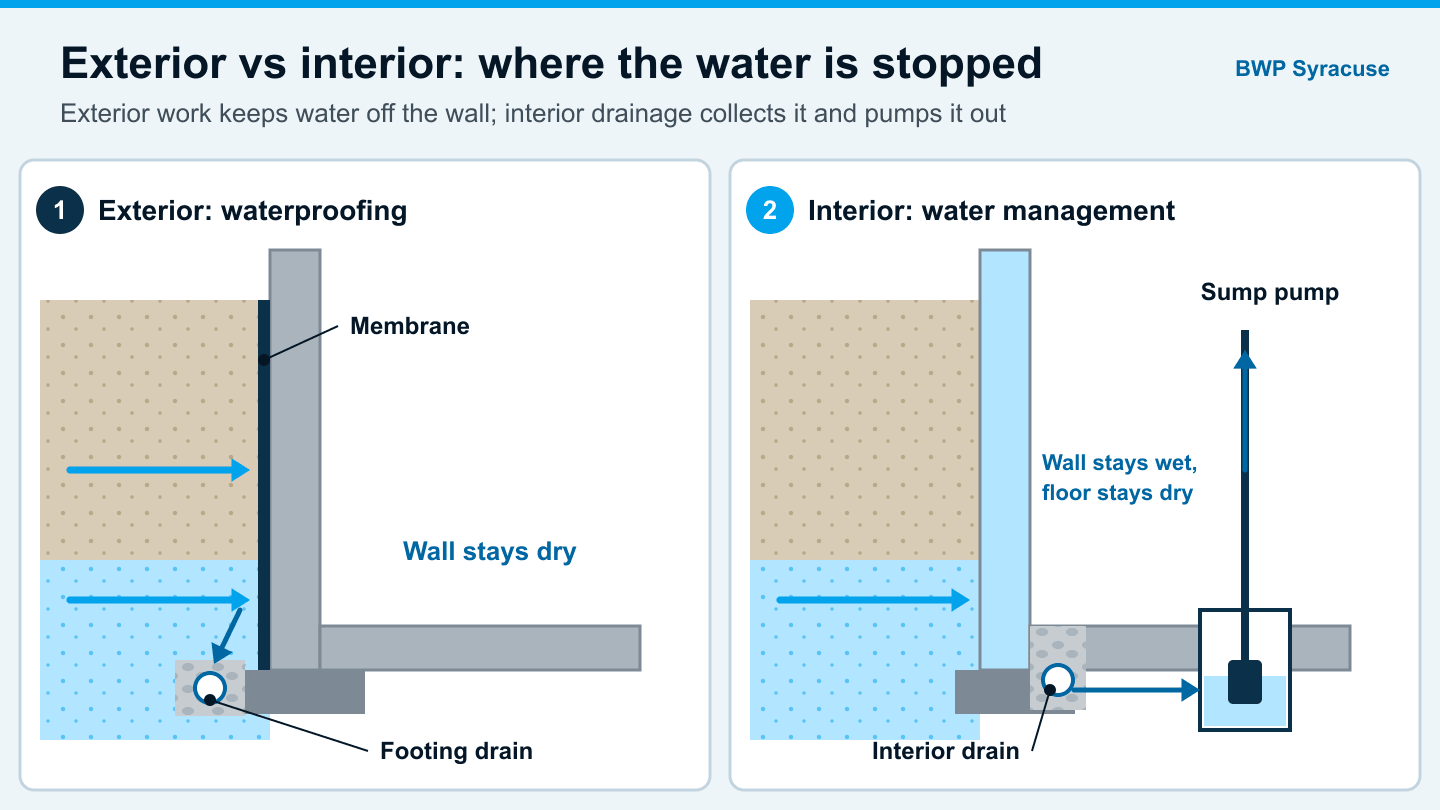
An interior coating sits on what builders call the negative side of the wall, the side away from the water. The soil side stays wet, the masonry behind the paint stays saturated, and the coating is the only thing holding the water back. When groundwater rises during a long rain or a spring thaw, water under pressure is pushing the coating off the wall rather than pressing it into place.
The manufacturer lists the product for exterior use as well, and on the outside of a wall the coating faces the water directly, the positive side. That is a different situation from painting the inside of a basement. Below grade, though, the outside of the wall is buried, and getting to it means excavation. Once a wall is dug out, the usual approach is a purpose-made foundation membrane and a footing drain rather than paint.
Is your wall a good candidate? A prep and application checklist
Goal: decide whether a coating fits your wall, and if it does, give it the surface it needs to bond.
- Watch the wall through one wet spell. Note whether you see dampness only, or water that runs, drips or collects at the base. Running water or a wet cove joint means stop here.
- Do the plastic-sheet test described above to rule out condensation.
- Wait for a dry period. The manufacturer says air and surface temperatures must be 50°F or higher and that results are best on dry surfaces. In Syracuse, the March thaw is usually the worst time to coat a basement wall, not the best.
- Remove old paint and coatings. If the paint could predate 1978, treat it as possible lead paint. The data sheet warns that scraping or sanding old paint can release lead dust and advises a NIOSH-approved respirator and HEPA cleanup.
- Remove efflorescence and open the surface. Follow the etching product’s directions, wear eye and skin protection and ventilate. The data sheet’s own test: water droplets should soak into the surface like a sponge. If they bead up, the coating will not penetrate.
- Patch holes and cracks with hydraulic cement and smooth the patch flush with the wall.
- Apply two coats. Work the first coat into the pores and backbrush if you roll it so pinholes fill. The Extreme data sheet calls for about two hours between coats.
- Watch the wall through the next wet season before you frame, insulate or store anything against it.
What to look for and how to read the result: a wall that stays dry and uniform through heavy rain suggests the problem really was seepage through porous masonry. The manufacturer says leaking after two coats means pores or pinholes are still open and those areas should be recoated. Water that returns at cracks, the cove joint or the floor tells you the coating was never the right tool.
When to call a professional: if water runs or collects, if the same walls get wet every spring, or if you see cracks that widen or walls that lean, have the basement inspected before you buy more product.
Common application mistakes
- Coating over old paint. The product cannot reach the masonry, and the old paint becomes the weak layer.
- Coating over efflorescence. The salts are proof that water is still moving through the wall, and they can push the new coat off.
- Applying in damp, cool conditions. The data sheet notes that cure and dry times stretch out in humid, cool weather.
- Skipping the second coat or the backbrushing. Open pinholes are the most common reason a wall still weeps in spots.
- Coating an actively leaking wall. Paint is not designed to stop water that is already running.
- Finishing the basement right after. Drywall over a coated wall can hide the next leak until there is damage behind it.
Signs a coating alone won’t fix it
- Water appears along the cove joint on more than one wall after rain or snowmelt.
- Water comes up through cracks in the floor.
- The basement gets wet after most heavy storms, not just in one corner.
- An earlier coating is blistering or peeling with white powder behind it.
- A crack is wider at one end, runs horizontally or the wall bows inward. That is a structural question, covered in when a bowing basement wall needs attention.
- A sump pump runs constantly in wet weather and the walls still get wet.
If water is on the floor near outlets, extension cords or appliances, keep off the wet floor and do not touch anything electrical until power to that area is off. Drying out comes second to that.
When Drylok doesn’t work, what to do instead
The usual sequence starts outside: extend downspouts and fix grading so less water reaches the wall. A single leaking crack can often be closed with crack injection. Water under pressure at the base of the walls usually calls for interior drainage that carries it to a sump pump, and excavation with an exterior membrane is the option that stops water at the outside face of the wall. Each one solves a different problem, and our side-by-side comparison of waterproofing methods for basements explains which fits which.
A masonry coating is a finish for a wall that is already close to dry, not a dam for groundwater.
Frequently Asked Questions
Can you put Drylok over painted basement walls?
No. The manufacturer says existing coatings have to be removed first, because the product works by soaking into bare masonry pores. The DRYLOK Extreme data sheet also states that applying it over existing coatings voids the warranty. In older homes, scraping or sanding old paint can release lead dust, so treat any pre-1978 paint as possible lead paint before you disturb it.
Will Drylok stop water coming up through the basement floor?
A wall coating is not the answer for water rising through the slab. The DRYLOK Extreme data sheet says that product is not recommended for horizontal surfaces with foot traffic, and water coming up through a floor is usually groundwater under pressure below the slab. That calls for drainage that lowers the water level, not a surface film. See water coming up through the basement floor.
Can I use Drylok on a stone foundation?
It is usually a poor match. Rubble stone walls have uneven faces, many mortar joints and moisture that needs a way to dry out, and an impermeable film can trap that moisture in the mortar. Waterproofing a stone foundation covers drainage and compatible repointing instead.
Does Drylok prevent mold in a basement?
Only in a narrow sense. The DRYLOK Extreme data sheet says it is formulated to resist mildew growth on the dry paint film itself. It does not lower basement humidity, dry out stored items or stop growth on wood and drywall, so the moisture source and the humidity level still need attention.
If Drylok still leaks after two coats, should I add a third?
The manufacturer says that leaking after two coats means some pores or pinholes are still open and those areas should be recoated. That applies to scattered damp spots on the wall face. If the water is coming from a crack, the cove joint or the floor, more coats will not change it.