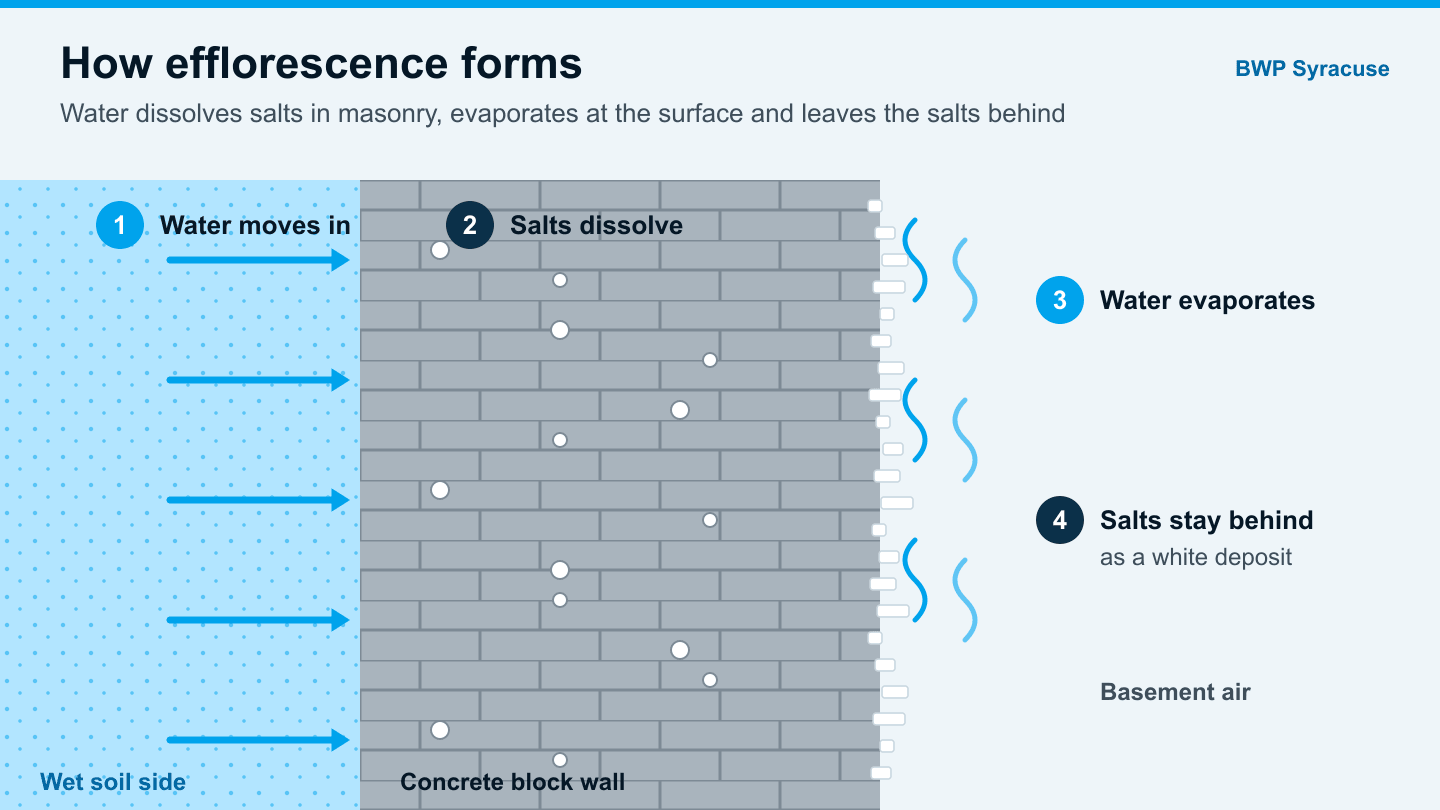
Efflorescence on basement walls is a white or grayish deposit of mineral salts left behind when water moves through concrete or masonry and evaporates at the surface. The deposit itself is not mold and is usually not harmful to the wall, but efflorescence that keeps coming back is evidence that moisture is still moving through or across the masonry.
That second point matters more than the white powder does. Brushing efflorescence off takes a few minutes. Understanding why it formed tells you whether the basement has a minor moisture quirk or a water path that needs attention.
What Efflorescence on Basement Walls Actually Is
Efflorescence is salt. Concrete, concrete block, brick, mortar and stone all contain soluble compounds, and soil and groundwater carry dissolved minerals of their own. The Brick Industry Association’s technical note on efflorescence causes and prevention (opens in a new tab) describes the deposit as sulfate and carbonate compounds of sodium, potassium, calcium, magnesium and aluminum, left on the surface when water containing dissolved salts evaporates.
Concrete masonry guidance from the Concrete Masonry and Hardscapes Association (CMHA), in TEK 08-03A on controlling and removing efflorescence (opens in a new tab), sets out three conditions that must all be present:
- Soluble compounds in the masonry or in the water reaching it.
- Moisture to dissolve those compounds and carry them.
- A force that moves the solution, such as evaporation or hydrostatic pressure.
Take away any one of the three and efflorescence stops forming. In a basement, the salts are almost always present, so the variable you can actually influence is the moisture.
How Water Carries Salt to the Surface
The process has four steps, and they happen slowly enough that you rarely see them in real time.
- Water enters the masonry. It might come from wet soil against the outside of the wall, groundwater wicking up from the footing, water running down from above grade or condensation on the inside face.
- Salts dissolve. As water moves through the pores of the concrete, block or mortar, it picks up soluble minerals.
- Water travels toward the drier side. In a basement, that is usually the interior face, where the air is drier than the soil outside.
- Water evaporates and the salt stays. The water leaves as vapor, and the dissolved minerals crystallize on the surface as a white bloom.
CMHA notes that masonry in contact with soil, such as basement walls, may absorb groundwater containing soluble salts. The Brick Industry Association adds that when masonry is in direct contact with the earth, groundwater may rise through capillary action several feet above the ground. That is why efflorescence often forms a band starting at the floor and fading higher up the wall.
Why it often shows up in winter
CMHA also notes that efflorescence is more common in winter, when a slower rate of evaporation allows salts to migrate to the surface. Cooler, slower drying gives the water time to carry more salt all the way through the wall before it evaporates.
Where Efflorescence Appears
Efflorescence can form on nearly any mineral-based surface in a basement:
- Poured concrete walls, often in patches or along form tie lines and cracks.
- Concrete block walls, frequently concentrated along mortar joints or in horizontal bands.
- Brick and older stone foundations, where lime-based mortar and porous stone move water readily.
- Concrete floors, especially near the perimeter and around cracks in the slab.
The shape of the deposit is informative. A band along the bottom of the wall, a streak below a crack, a patch under a window and a thin haze spread across a whole wall usually have different moisture sources behind them.
Is Efflorescence Dangerous?
For the wall, surface efflorescence is generally a cosmetic issue. CMHA states that although it may be an aesthetic concern, efflorescence will not affect structural performance. The Brick Industry Association describes it as usually not harmful to brick masonry.
For people, NDSU Extension has described soluble salt deposits on basement walls and floors as harmless from a human health standpoint. That does not make every white material harmless, since mold can also appear white, which is why the identification step below matters.
The real concern with efflorescence is not the powder. It is what the powder shows about moisture, and one specific situation where salts do cause damage.
Efflorescence vs subflorescence vs spalling
Salts do not always crystallize on the surface. When water evaporates just beneath the face of the masonry, the salts crystallize inside the pores instead. This is called subflorescence or cryptoflorescence.
The National Park Service’s Preservation Brief 1 on cleaning and water-repellent treatments (opens in a new tab) explains that salts crystallizing beneath the surface can eventually cause the masonry surface to spall, particularly when a water-repellent coating has been applied. The Brick Industry Association notes that salts crystallizing within masonry can develop high pressures that may result in spalling.
Spalling is the actual damage: the surface of the concrete, brick or block flakes, pops off or crumbles. So the progression to watch for is not “more white powder.” It is white deposits together with a surface that is flaking, pitting or shedding grit.
Efflorescence, Mold and Deteriorating Masonry Compared
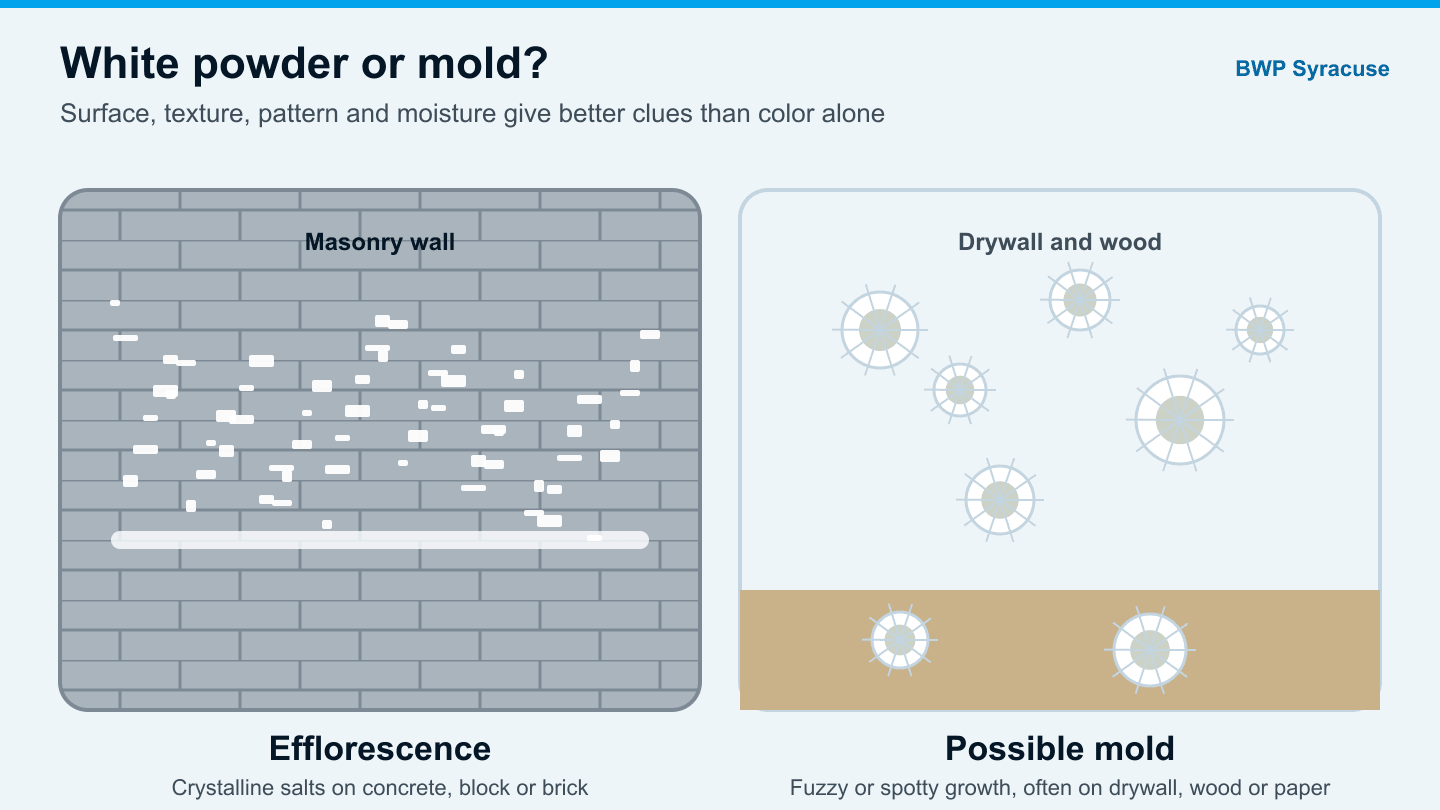
These three are easy to confuse on a basement wall. The table separates what each one is and what to do about it. None of these visual clues is proof on its own.
| What it is | Typical appearance | Where it appears | Main concern | Next step | |
|---|---|---|---|---|---|
| Efflorescence | Mineral salts left when water evaporates | White or grayish powder or crystals, often in bands, streaks or along mortar joints | Concrete, block, brick, stone and mortar | Shows moisture moving through the masonry | Find the moisture path, then dry brush |
| Possible mold | A living fungal growth | Fuzzy, spotty or patchy, can be white, gray, green or black | More often on drywall, wood, paper, dust or paint | Health concerns and damage to organic materials | Do not brush it dry, fix moisture, follow EPA cleanup guidance |
| Spalling or deteriorating masonry | Physical breakdown of the surface | Flaking, pitting, crumbling or loose pieces, sometimes with white salts | Concrete, block, brick and soft stone, often near grade | Loss of surface material, possible salt or freeze damage | Have the wall evaluated and address the moisture before any repair |
White material growing on a painted surface, drywall, wood or cardboard deserves a closer look before anyone assumes it is efflorescence. The white powder vs mold comparison walks through the clues that separate the two, and what not to disturb.
What Recurring Efflorescence Tells You About Moisture
A single light bloom on a new wall can simply be construction moisture drying out, and masonry guidance recognizes that early-age efflorescence often fades once the wall dries. Efflorescence that returns after cleaning, season after season, is different. It tells you water keeps reaching the wall.
The location of the deposit points toward the likely source:
- A band along the bottom of the wall is consistent with groundwater wicking up from the footing or water at the floor line. CMHA notes that efflorescence near ground level may point to groundwater as the cause.
- A streak below a crack points to water entering at that crack and running down the face.
- A patch around or below a window points to water from the window well or the window itself.
- Deposits concentrated near grade on the outside wall face can involve de-icing salts from walks and driveways as well as soil moisture.
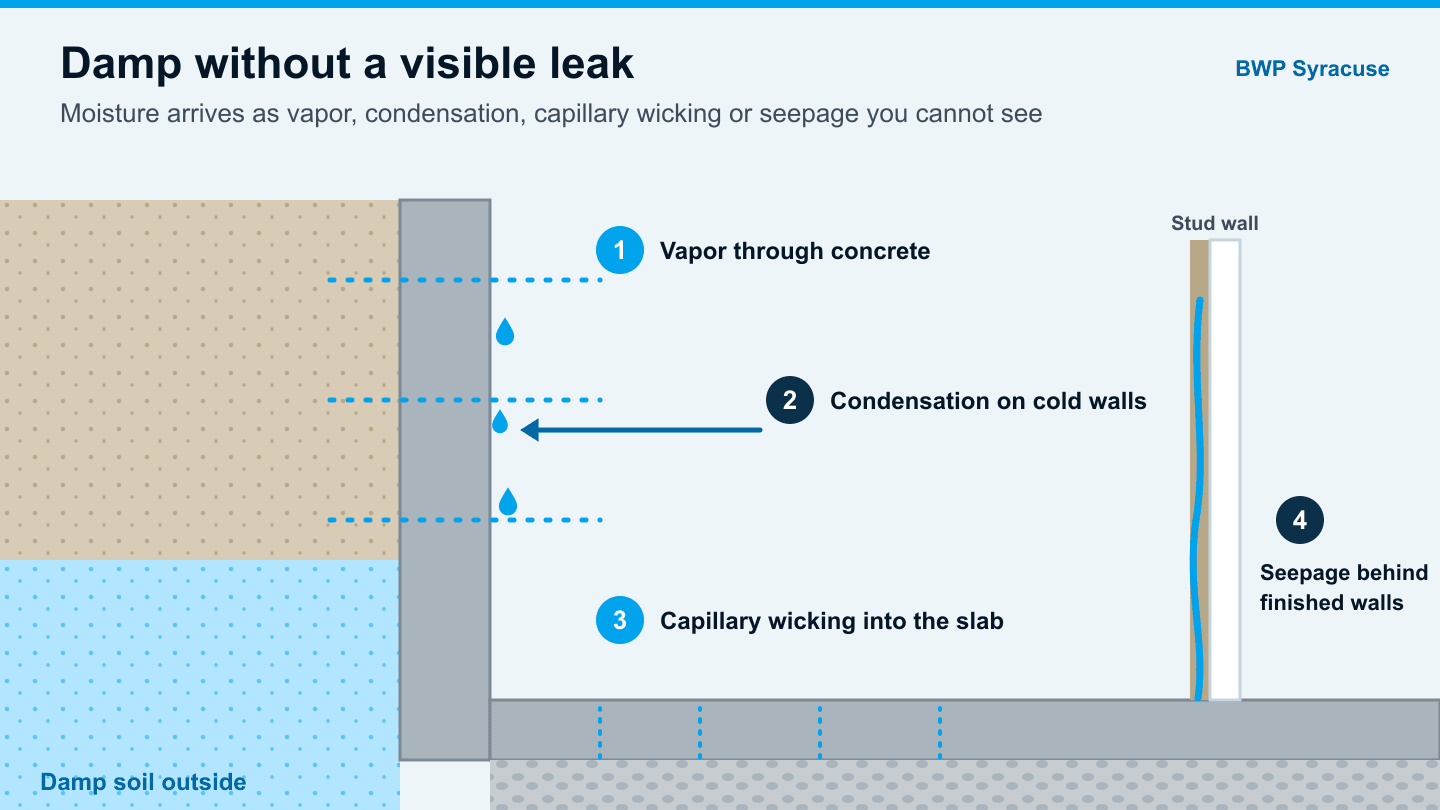
- A light haze across a whole wall with high humidity readings may involve condensation and vapor movement rather than a single water path.
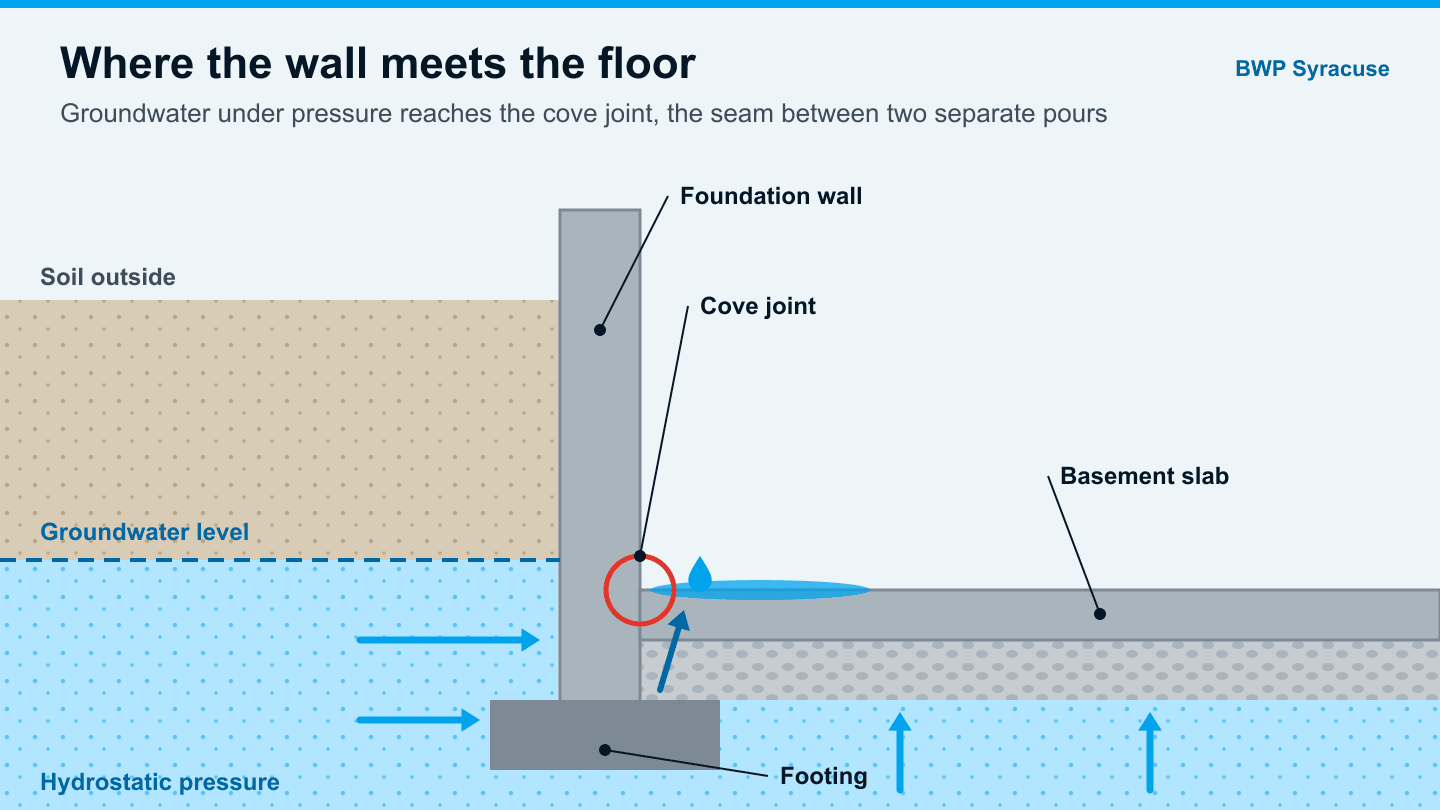
Efflorescence along the base of the wall often travels together with dampness or water at the seam, which is covered in what water at the cove joint usually means. If the wall looks dry but the basement feels damp, the no-visible-leak moisture guide explains how vapor and capillary moisture reach a basement without dripping.
Why Efflorescence Comes Back After Cleaning
Cleaning removes the salt on the surface. It does nothing to the salts still inside the masonry or in the water reaching it. As long as moisture keeps moving through the wall, it keeps delivering salt to the face, and the bloom returns.
Some cleaning methods make the return faster. CMHA warns that using water to remove surface deposits puts additional water into the wall, which can carry more salt to the surface as it dries. Heavy rinsing or pressure washing a basement wall is effectively a way to create the next round of efflorescence.
What Does Not Work
Several common responses treat the appearance and leave the cause in place, or make the wall worse.
- Painting over it. Paint covers the deposit for a while, then lifts, bubbles or peels as moisture and salt keep arriving from behind.
- Clear sealers and water repellents as the only fix. The Brick Industry Association does not recommend coatings as the sole treatment for efflorescence. Trapping salts beneath a coating is exactly the condition the National Park Service links to subflorescence and spalling.
- Pressure washing or heavy rinsing. More water in the wall means more salt at the surface later.
- Muriatic acid on older masonry. The National Park Service warns that hydrochloric (muriatic) acid should not be used on historic masonry, since it can dissolve lime-based mortar, damage brick and some stone, and leave chloride deposits. In practice, lime-mortar brick and stone foundations are common under older Syracuse houses.
- A dehumidifier alone. University of Minnesota Extension’s guide to moisture in basements (opens in a new tab) notes that drying out the basement air can draw moisture into the basement more rapidly, which can increase efflorescence and spalling where a moisture problem already exists. A dehumidifier still has a place in humidity control, as covered in the guide to ideal basement humidity, but it does not stop water moving through the wall.
Safe Cleaning Principles
Cleaning is reasonable once the moisture source is understood, and it helps you see whether the deposit returns. CMHA guidance puts the order clearly: repair the moisture problem before removing the efflorescence. These principles follow that masonry guidance.
- Confirm it is efflorescence first. If the material is fuzzy, growing on paint, drywall, wood or paper, or you are unsure, do not dry brush it. Treat it as possible mold.
- Protect yourself. Wear gloves and eye protection, and avoid raising dust in a closed space.
- Start dry. CMHA notes that most efflorescence can be removed by dry brushing, and the Brick Industry Association also recommends dry brushing. Use a stiff natural or nylon bristle brush and vacuum up the loosened material.
- Use water sparingly. If a light rinse is needed, use as little water as possible and let the wall dry fully afterward.
- Leave acids to professionals. CMHA describes dilute acid as a last resort that requires pre-wetting the wall and testing a small area first. Avoid acids entirely on older lime-mortar and stone foundations.
- Avoid wire brushes. CMHA warns that wire brush filings left behind can cause further staining.
- Photograph and date the cleaned wall. A photo taken right after cleaning is the baseline for seeing how quickly, and where, the deposit returns.
Some white deposits do not respond to brushing or water. Masonry guidance notes that calcium carbonate deposits and certain other white stains are not readily water-soluble, and that a number of white stains can be confused with efflorescence. A deposit that behaves differently from what you expect is worth having identified before trying stronger cleaning methods.
The Syracuse Context
Syracuse basements have a few features that make efflorescence common. In practice, many older houses here sit on block, brick or stone foundations, and older mortar moves water readily. Long, cold winters slow evaporation, which CMHA links to more efflorescence. And the snowmelt season brings groundwater close to foundations at the same time walls are still cold.
Road and sidewalk de-icing salt adds another source. The National Park Service’s glossary of historic masonry deterioration (opens in a new tab) notes that capillary action can pull soluble salts, including chlorides from salting streets and sidewalks in winter, from the ground into masonry. Foundation walls beside a salted driveway or walk can show heavier deposits for that reason.
When Efflorescence Calls for a Moisture Investigation
Efflorescence on its own is not an emergency. It becomes worth investigating when:
- It returns within weeks or months after careful dry cleaning.
- It grows heavier each season, or spreads to new walls.
- The masonry surface under it is flaking, pitting or crumbling.
- It forms a band along the floor line together with dampness or water at the seam.
- The basement also smells musty or reads high humidity for long stretches.
- Paint or finishes on the wall keep lifting or blistering.
At that point, the question is where the water is coming from. A band at the base of the wall may point toward groundwater and drainage. A streak below a crack may point toward a single entry point. Where the pattern shows water pushing in around the foundation perimeter, interior drainage and basement waterproofing is one of the approaches an inspection would evaluate. For the broader list of symptoms that usually travel with efflorescence, compare notes with the nine early signs a basement gives.
If the deposits keep returning and you cannot tell whether the water is wicking up, running down a crack or arriving as condensation, a free moisture inspection can trace the path before you spend money on coatings or cleaning products.
The Deposit Is the Clue, Not the Problem
Cleaning the white deposit changes the appearance of the wall. Finding the moisture path changes whether it comes back. Efflorescence on basement walls is one of the most honest signals a foundation gives, since it only forms where water has traveled, and reading where it appears is usually more useful than scrubbing it away.
Frequently Asked Questions
Is efflorescence mold?
No, efflorescence is a mineral salt deposit, not a living growth. It forms when water carries dissolved salts to the surface of masonry and evaporates. Mold can also look white, though, and color alone cannot tell the two apart, so compare surface, texture and pattern using the white powder vs mold guide.
Is efflorescence harmful to breathe or touch?
NDSU Extension describes soluble salt deposits on basement walls and floors as harmless from a human health standpoint. Wear gloves and eye protection when brushing it off anyway, and avoid raising dust. If you are not sure the material is efflorescence, treat it as possible mold and do not brush it dry.
Will efflorescence go away on its own?
Sometimes. Efflorescence from construction moisture in newer masonry can stop once the wall dries out. Efflorescence that keeps returning season after season means water is still moving through the wall, and it will keep coming back until that moisture source changes.
Can I paint over efflorescence?
Painting or sealing over efflorescence is not a fix. The Brick Industry Association does not recommend coatings as the sole treatment, since salts that crystallize beneath a coating can build pressure inside the masonry and cause the surface to flake or spall. The paint also tends to lift as moisture keeps arriving from behind.
Does efflorescence mean my basement leaks?
It means water has moved through or across the masonry, but efflorescence does not always mean an active leak. It can come from groundwater wicking into the wall, condensation, or moisture left over from construction. Where it appears and whether it returns after cleaning tell you more than its presence alone.
How do I clean efflorescence off a basement wall?
Brush it off dry with a stiff nylon or wire brush first, then vacuum the dust. Washing it with water can push the salts back into the concrete and make them reappear. Stubborn deposits can be treated with a masonry cleaner made for efflorescence, following the label and protecting your skin and eyes.
Can efflorescence damage a concrete or block wall?
Efflorescence on the surface is cosmetic, but the moisture behind it is not. When salts crystallize inside the masonry instead of on the face, a process called subflorescence, they can make the surface flake and spall over time. The lasting fix is reducing the water moving through the wall.