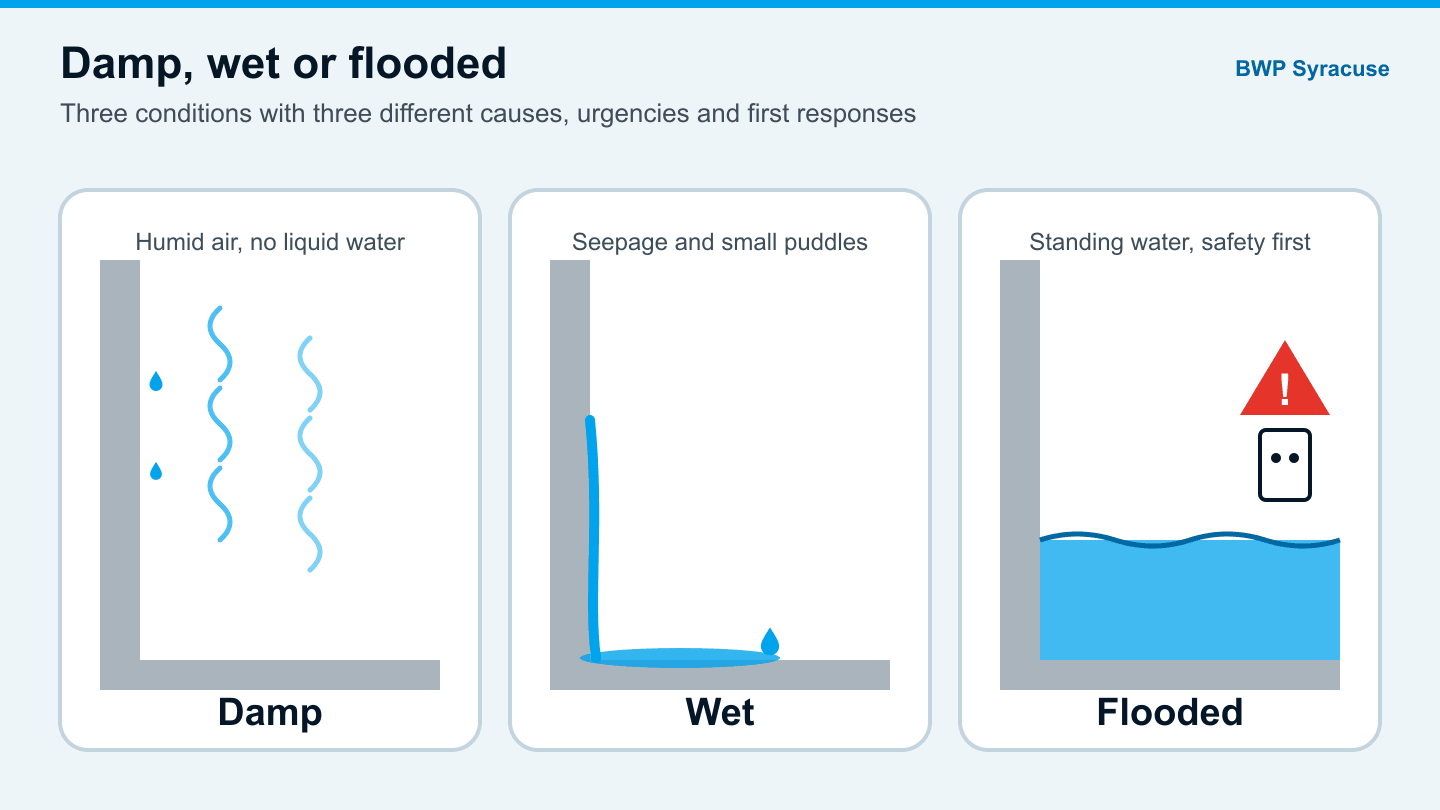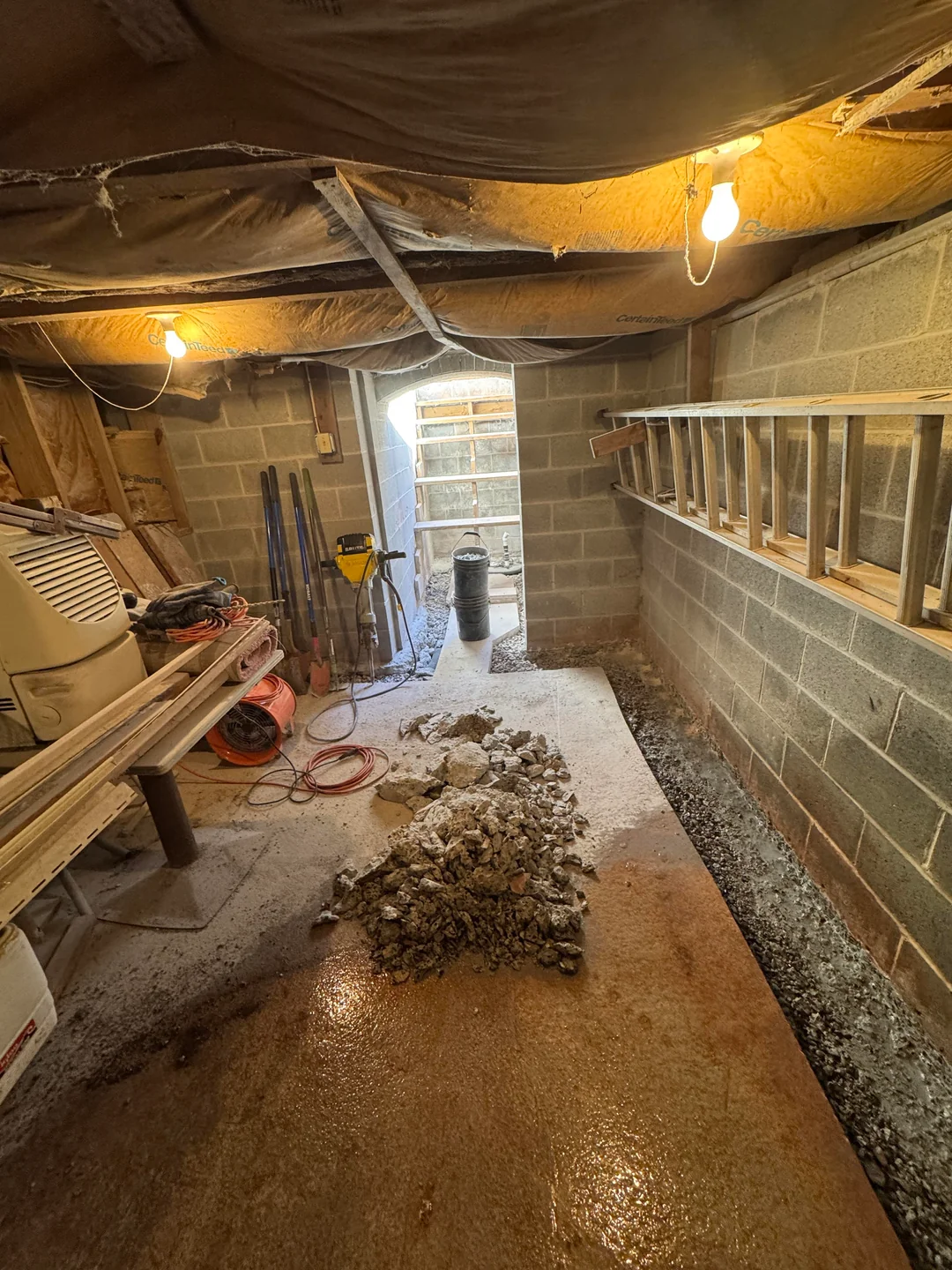
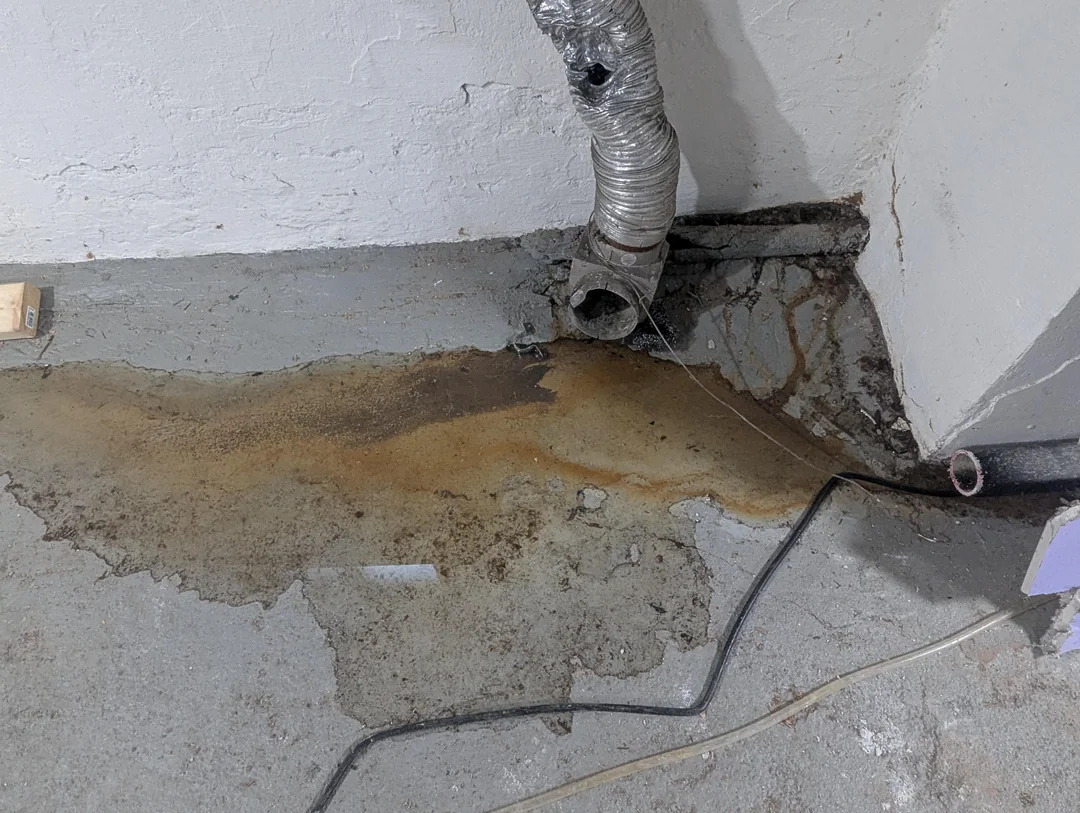
Standing water is the last symptom, not the first. By the time you are running a shop vac in March, the foundation has usually been telling you about it for two or three years.
Here is what it says first.
1. A white chalky bloom on the walls
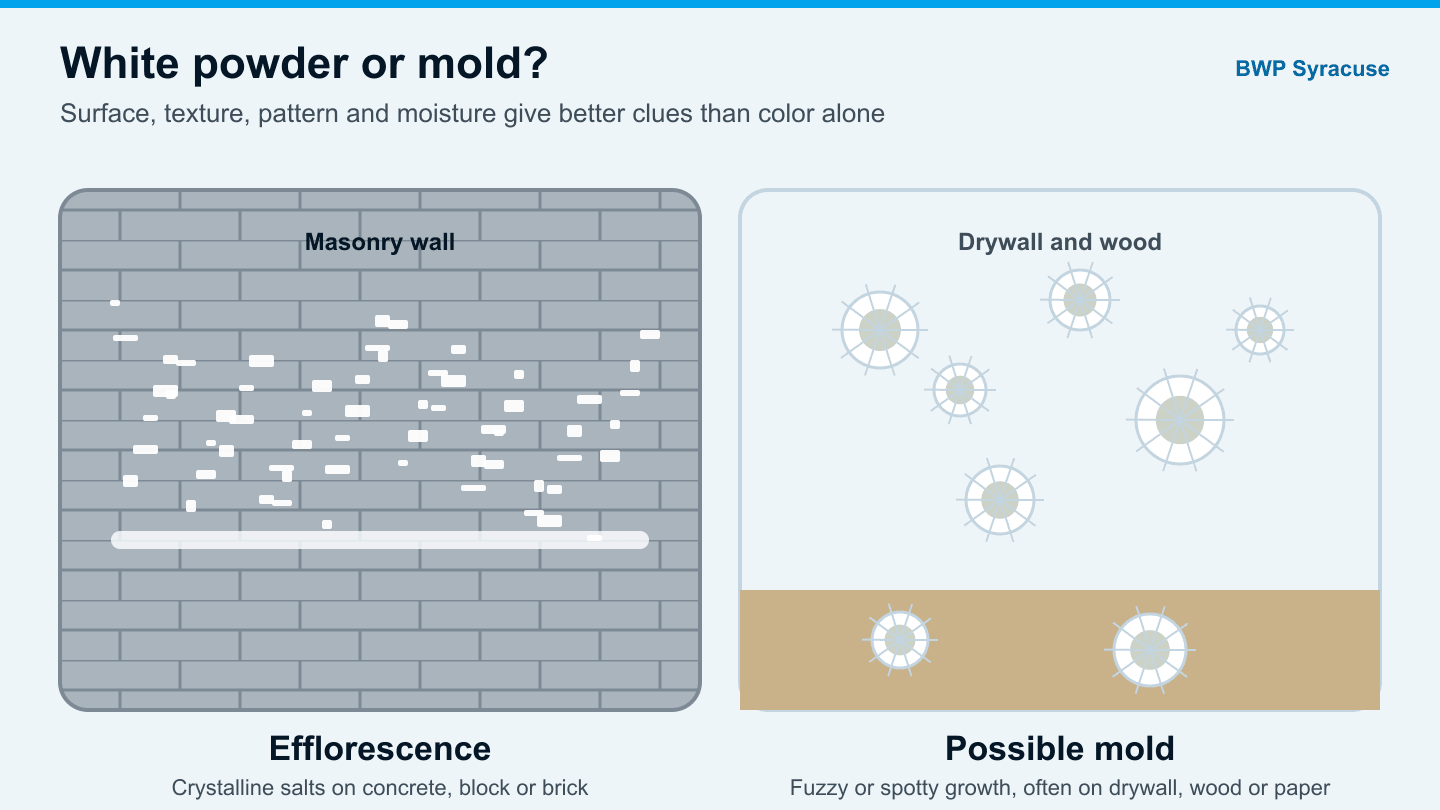
That is efflorescence (opens in a new tab), mineral salts left behind as water evaporates through the concrete or block. It is not mold and it is harmless in itself, but it is evidence that moisture is moving through your wall. You can brush it off; it will come back. What efflorescence on basement walls tells you goes deeper into where the salt comes from, and how to tell white powder from mold covers the look-alike.
2. A musty smell that never fully leaves
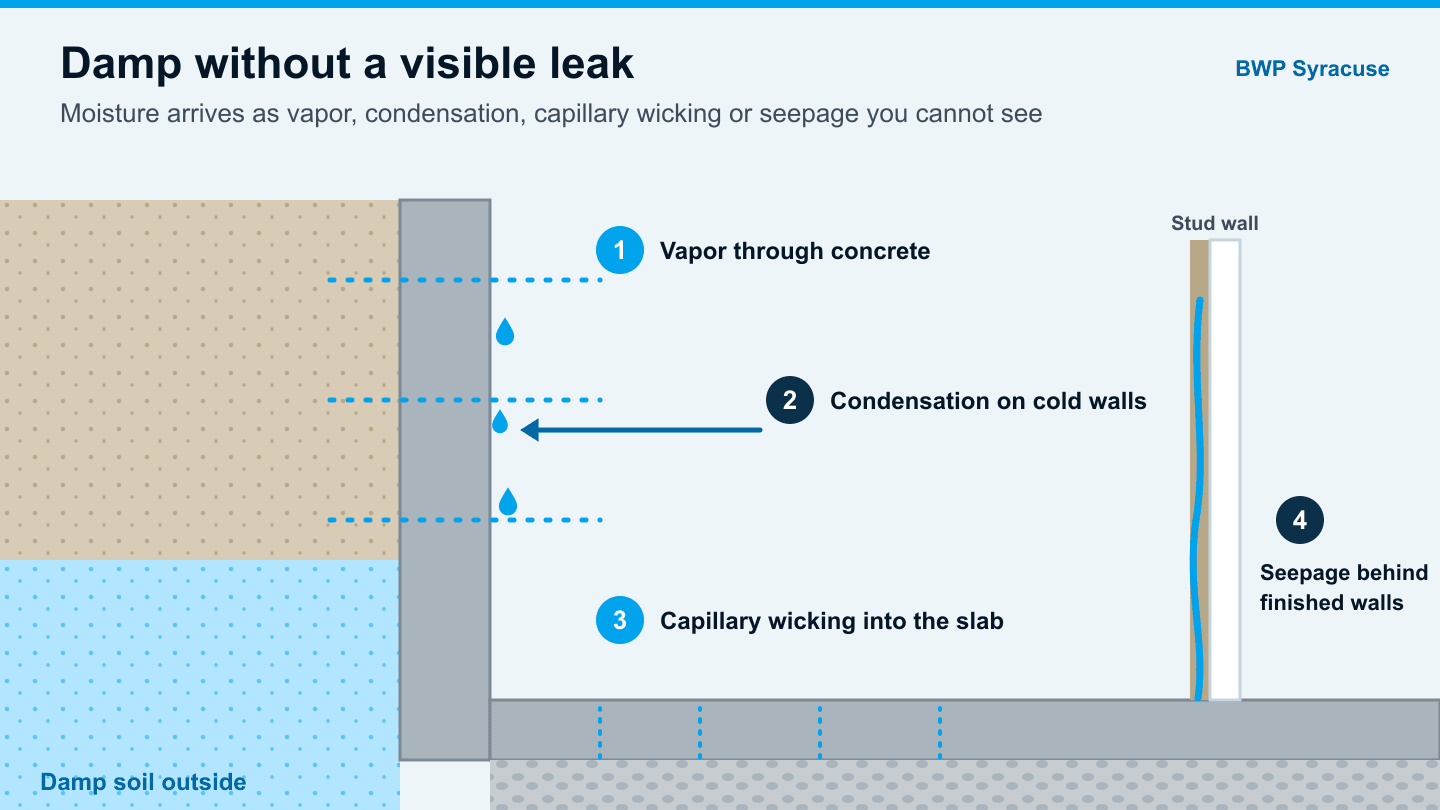
Your nose often picks up microbial growth before your eyes do. A basement that smells like a damp towel usually has something staying damp, often with relative humidity (opens in a new tab) running above 60%, and in a closed-up Syracuse winter that air ends up in your bedrooms. Sixty percent is the upper limit the EPA guidance on mold and moisture (opens in a new tab) uses too, and it is worth reading what the EPA says about mold and health (opens in a new tab) before anyone sells you a remediation package. The six causes of a musty basement smell show where that odor usually starts, and the guide to ideal basement humidity explains how to take a reading you can trust.
3. A dark line where the wall meets the floor
The cove joint is the seam between wall and slab, and it is the single most common entry point in Syracuse. A stain there after a thaw is hydrostatic water, not condensation (opens in a new tab), and it usually means you are looking at a pressure problem rather than a crack. What water where the wall meets the floor means walks through the look-alikes worth ruling out first.
4. Peeling paint or bubbling floor finish
Coatings fail from behind when vapor pushes out through the slab or wall. If your basement floor paint keeps lifting, the water is under it, and no coating sold as damp proofing (opens in a new tab) will change that.
5. Rust at the base of appliances or steel posts
Water wicks up. Rust rings on a furnace base, a water heater or a lally column are a reliable indicator that the slab is periodically wet, even if you have never actually seen standing water. The same moisture eventually reaches the steel reinforcement inside the wall (opens in a new tab), which is a considerably more expensive problem.
6. Doors and windows that stick seasonally
If interior doors bind in spring and swing freely in August, the foundation is moving with soil moisture and frost. In Syracuse that is a normal amount of movement, but frost heaving (opens in a new tab) opens cracks a little wider every year.
7. Cracks that are getting wider
Put a pencil mark and a date at each end of a crack. Photograph it monthly. Static cracks are almost always cosmetic. Growing ones are not, and our freeze-thaw cycling is very good at turning a hairline into a pathway. Once it is a pathway, full-depth crack injection is the only repair that removes it rather than covering it. A horizontal crack, or a wall that has started to push inward, is a structural question instead, covered in when a bowing basement wall needs evaluation.
8. Bouncy floors above a crawl space
A floor that flexes as you cross it tells you the framing underneath has lost capacity, almost always because moisture has been sitting under the house for years. That is wood-decay fungi (opens in a new tab) working on the joist ends, it does not improve on its own, and it gets more expensive every season you leave it. It is a crawl space repair job before it is a sealing job.
9. Insects that prefer moisture
Silverfish, centipedes and pill bugs are moisture indicators. A sudden population is a humidity reading you did not have to buy a meter for, and in a dirt crawl space it usually points at encapsulation rather than pest control.
What to do with this
If you recognize three or more, get a moisture assessment before the thaw. Diagnosis is free, it takes about forty minutes, and knowing which of the nine you have determines whether you are looking at a $600 fix or a $30,000 one. The 2026 cost breakdown sets out both ends of that range honestly.
Finding out in October is considerably better than finding out at 2am in March with four inches of water on the floor, which is exactly what the November checklist is designed to prevent.