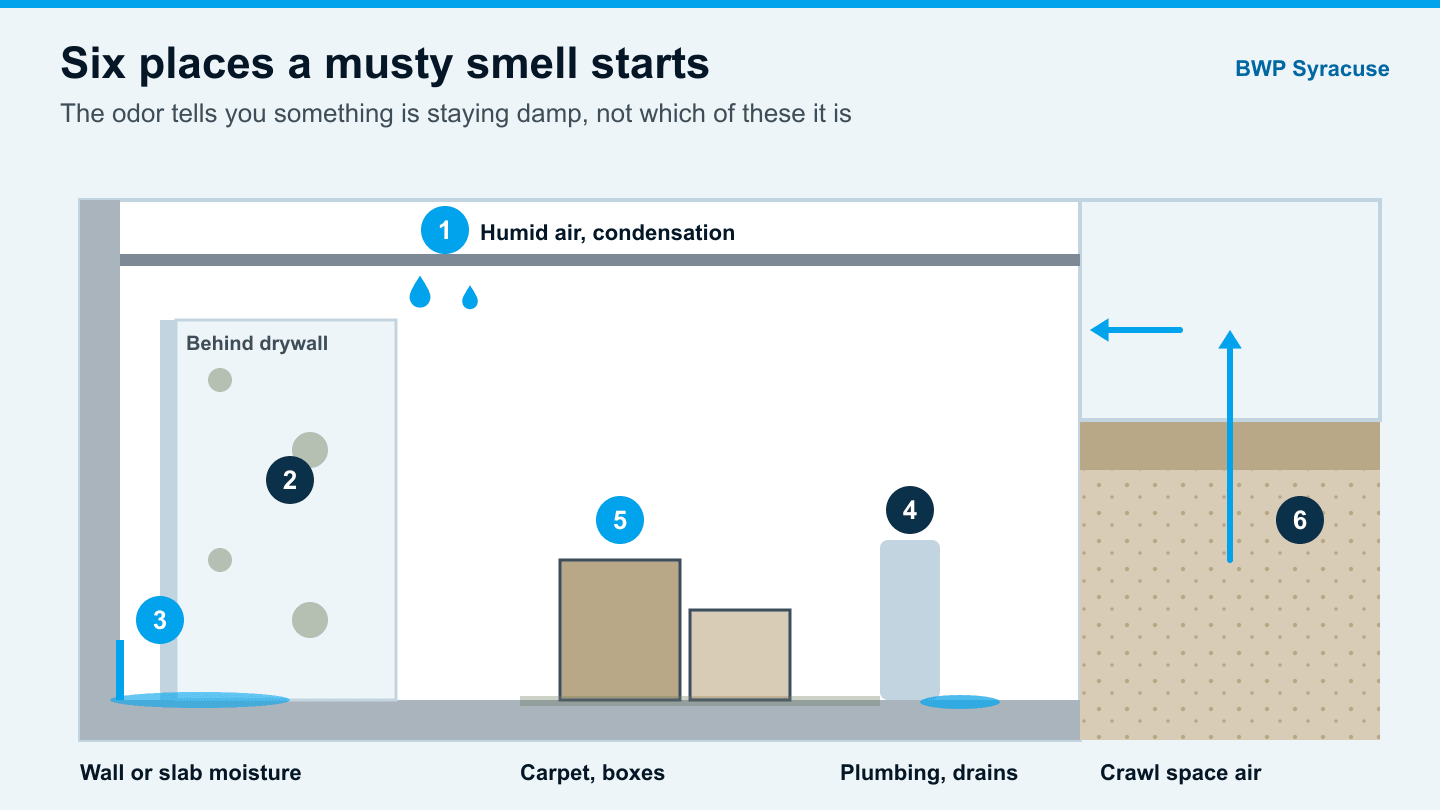
A musty smell in the basement that will not go away usually means something down there is staying damp, and that dampness is supporting mold or other microbial growth or keeping porous materials wet. The smell alone cannot tell you where the moisture is or whether visible mold is present, since the same odor can come from humid air, a hidden leak, wet carpet or growth behind a wall.
That is why air fresheners fail. The goal is not to make the basement smell better. The goal is to find what is staying wet.
What a Musty Basement Smell Actually Is
The earthy, damp-cloth smell most people call “musty” comes from gases released by mold and other microorganisms as they grow on damp materials. EPA’s mold course on finding mold and moisture (opens in a new tab) says damp or musty odors suggest that water is or was present and mold growth is likely, and that moldy or musty odors should alert an investigator to the possible presence of mold.
Note the careful wording. The odor is a reason to look, not proof of what you will find. It also does not tell you how much growth exists, what kind it is or which material it is on.
Why the smell outlasts the water
Many homeowners notice the smell weeks after a leak has dried up. Porous materials such as carpet padding, drywall paper, cardboard and wood absorb water and release it slowly. Growth that started while they were wet can continue in pockets that never fully dried, even after the floor looks fine. A smell that lingers after a known water event is often pointing at one of those materials.
First, Rule Out Odors That Are Not Musty
Some basement smells are safety issues or belong to another trade entirely. Separate them before looking for dampness.
- Sewage or rotten-egg smell near a floor drain. A drain that rarely carries water can dry out, and the trap that normally blocks sewer gas stops working. Pouring water into floor drains that are seldom used is a simple first check. A smell that persists, or sewage coming up through the drain, is a plumbing problem.
- Chemical, solvent or burning smells. These point to stored products, appliances or electrical equipment, not basement moisture.
- A dead-animal smell. This usually comes from a rodent in a wall, ceiling or crawl space.
Everything below assumes the smell is the damp, earthy kind.
The 6 Causes of a Musty Smell in the Basement
1. High relative humidity and condensation
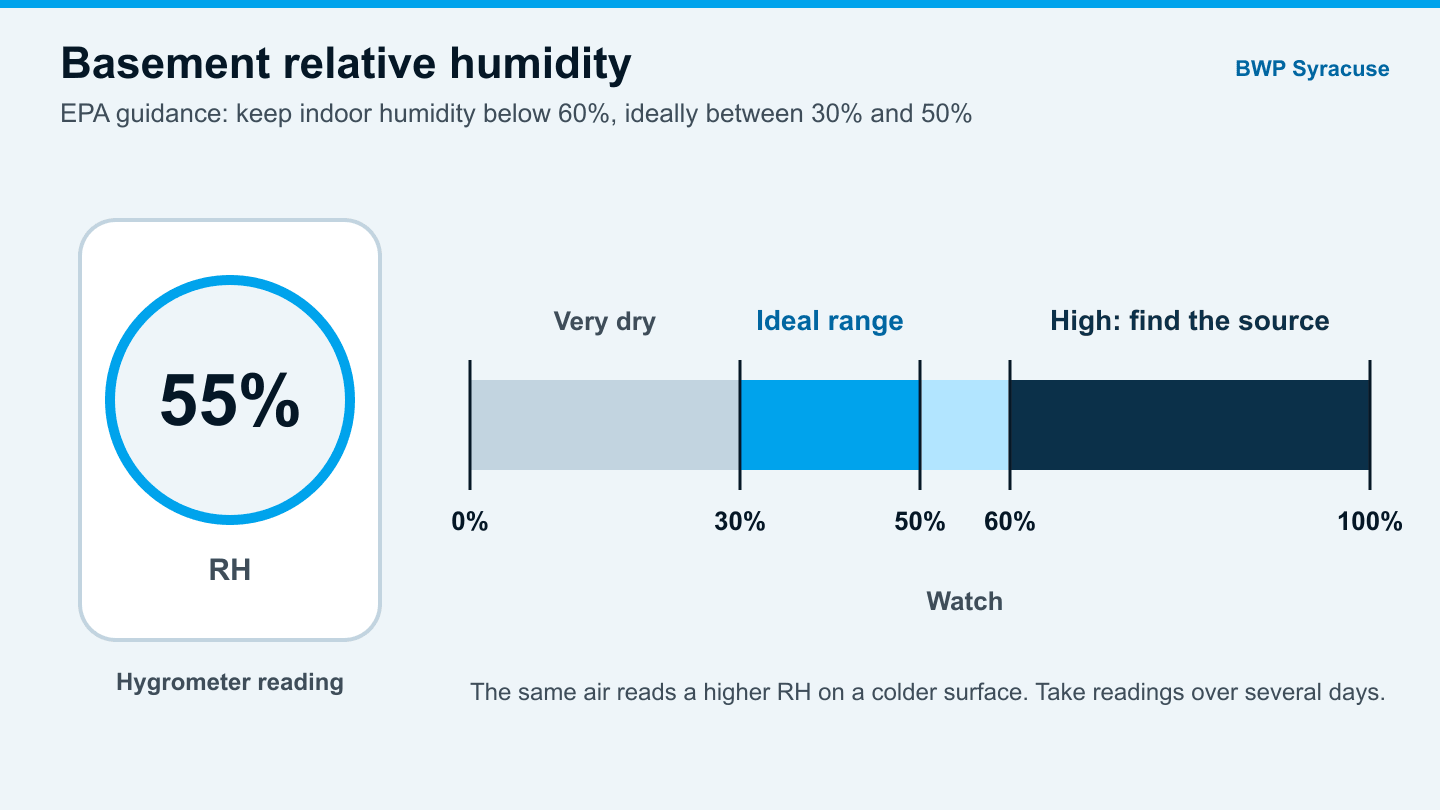
Relative humidity is how much water vapor the air holds compared with the most it could hold at that temperature. Basements run cool, so the same air that feels comfortable upstairs reads a higher humidity downstairs. When warm, humid air touches a surface colder than its dew point, water condenses on it.
EPA’s brief guide to mold, moisture and your home (opens in a new tab) recommends keeping indoor relative humidity below 60 percent, ideally between 30 and 50 percent, and states that the key to mold control is moisture control. Surfaces that stay damp from condensation, such as cold water pipes, exterior walls and the floor, can support growth even when no leak exists.
The clues: sweating pipes, a clammy feel, a smell that is worst in July and August, and a hygrometer that sits in the 60s or higher for days at a time. How to measure and interpret those readings is covered in the guide to ideal basement humidity.
2. Hidden mold or microbial growth
Growth does not need to be visible to produce odor. Common hidden locations include:
- Behind finished drywall, especially on the back of the paper facing near the floor.
- Under carpet and in the padding, where moisture from the slab collects.
- On the rim joist, the band of framing that sits on top of the foundation wall, where warm indoor air meets a cold surface.
- Inside wall cavities with fiberglass insulation that got wet.
- Under stairs, inside closets and behind stored items where air never moves.
EPA’s mold course also notes that you may suspect mold even when you cannot see it if a building smells moldy. A smell that is strongest in one corner, or near a finished wall, is a reason to look behind or under that area carefully rather than to spray it.
3. Foundation or slab moisture
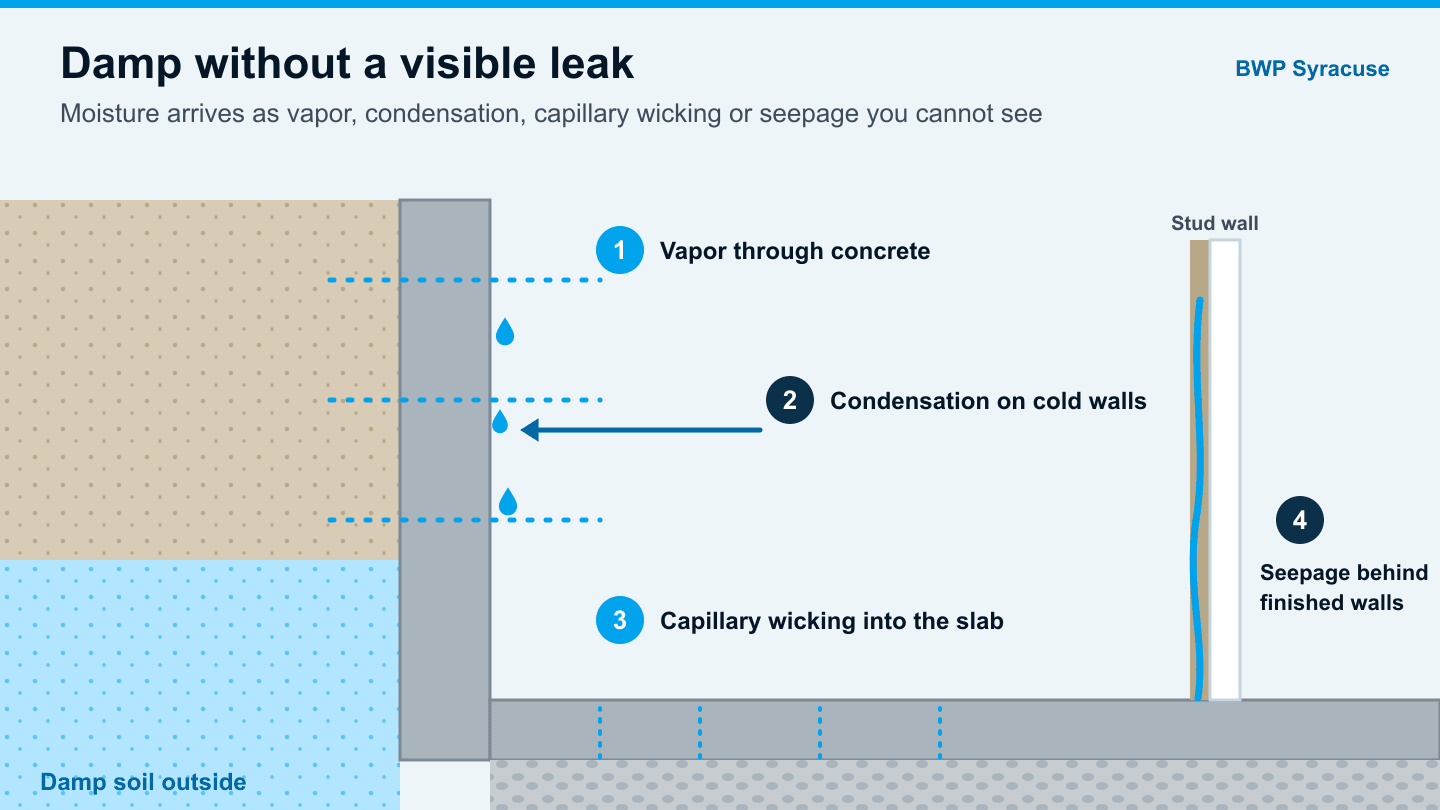
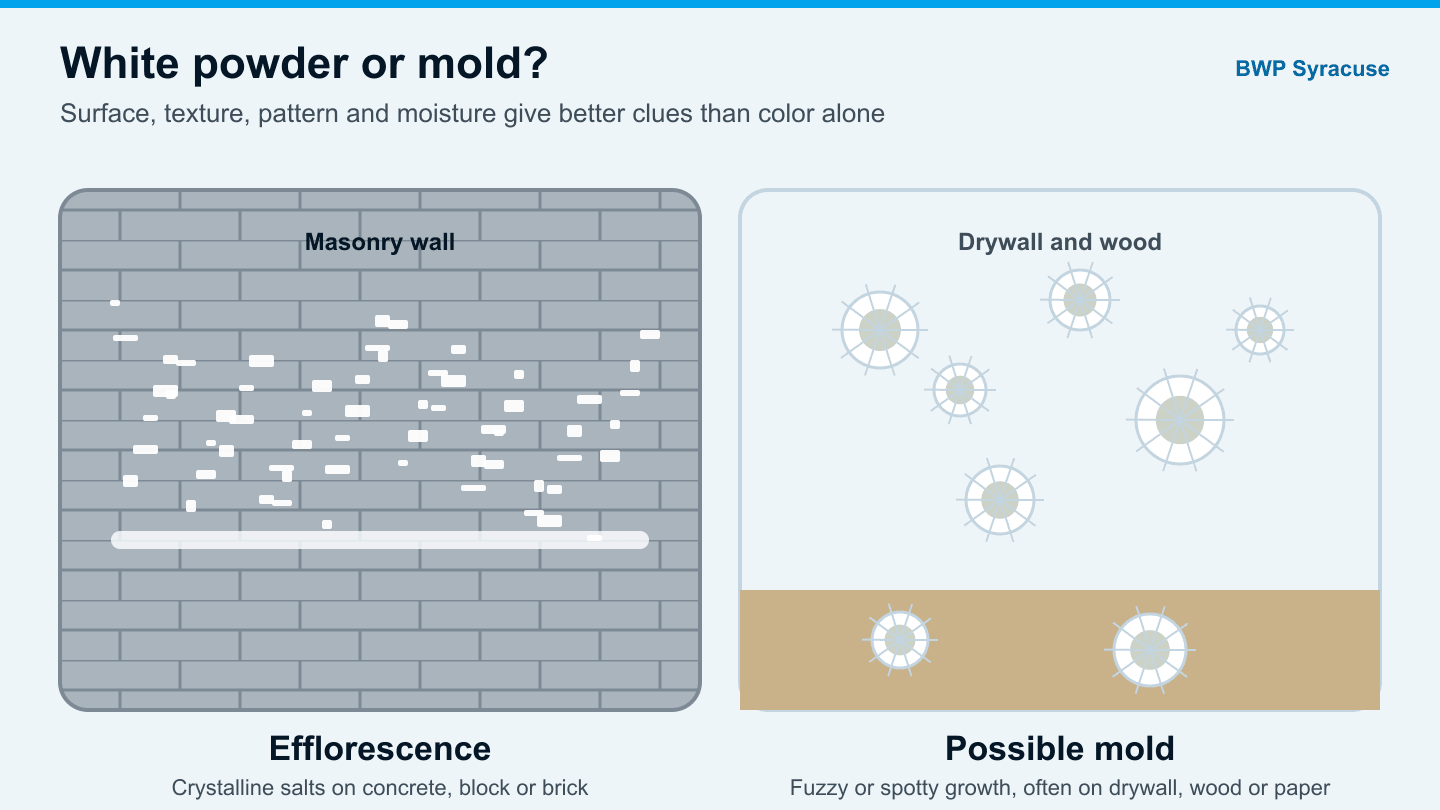
Concrete and masonry are porous. Water in the soil can move into the basement as liquid seepage, by capillary wicking up through the footing and slab, or as vapor passing through the concrete. None of those needs to leave a puddle. A dark band along the bottom of a wall, white mineral deposits, damp spots under rugs and peeling floor paint all point toward moisture coming from the foundation.
This cause often keeps carpet, padding and the bottom edge of drywall damp without anyone noticing until the smell appears. The ways moisture reaches a basement without a visible drip are covered in detail in why a basement is damp with no visible leak.
4. Plumbing or drainage leaks
A slow drip from a supply line, a weeping fitting on the water heater, a washing machine drain hose or a condensate line from the furnace can wet a hidden area for months. Floor drains and sump pits can hold standing water and debris that develop their own odor.
The clues: a smell centered near a fixture, staining on the underside of the floor above, water marks on the ceiling of a finished basement or a damp area that has no connection to the weather.
5. Damp porous materials
Some basements smell musty mostly because of what is stored in them. Cardboard boxes on a concrete floor, rolled rugs, upholstered furniture, old books, paper and firewood all absorb moisture from humid air and from the slab. Carpet installed directly over concrete is one of the most common sources, since the padding can stay damp for long periods.
The clue: the smell gets stronger when you move boxes or lift a corner of carpet, and the bottoms of cardboard boxes feel soft or show staining.
6. Moist crawl-space or basement air moving through the house
Air moves upward through a house, with warm air rising and leaving through upper floors and the attic while replacement air is drawn in from below. Air from a basement or a connected crawl space with bare soil, damp insulation or growth on the framing can carry its odor into living areas. A musty smell in a first-floor room directly above a crawl space often traces back to the space below.
The clues: the smell is noticeable upstairs, the house has a dirt or gravel crawl space, and the crawl space insulation is sagging or damp. If you can see growth on the framing down there, read what to do about mold in a crawl space before disturbing it.
Clue Table: Narrowing Down the Source
| Clue | Possible source | First safe check |
|---|---|---|
| Smell worst in humid summer weather | High humidity and condensation | Place a hygrometer away from the dehumidifier and read it for a week |
| Cold pipes and walls sweat | Condensation | Check readings against the weather, and look for water marks under pipes |
| Smell strongest near a finished wall | Growth on the back of drywall or in the cavity | Look along the bottom edge for staining, bubbling paint or soft drywall, without cutting into it |
| Smell stronger when lifting carpet | Damp padding over the slab | Lift a corner with gloves on and check the pad and slab for moisture |
| Smell near a floor drain | Dry trap or drain issue, not moisture | Pour water into the drain and see whether the odor fades over a day |
| Smell near a water heater, washer or sink | Plumbing leak | Check fittings, hoses and the floor beneath them for drips |
| White deposits or a dark band at the base of walls | Foundation moisture | Photograph it, note the season, and watch it after rain and snowmelt |
| Smell in rooms above a crawl space | Crawl-space air | Look into the crawl space with a flashlight for damp soil, insulation or framing |
| Soft or stained cardboard boxes | Damp stored materials | Move boxes off the floor and see whether the smell eases |
Every one of these checks is a clue, not a confirmation. Two or three sources often combine, for example a humid basement with carpet over a damp slab.
How to Narrow It Down Safely
- Measure humidity first. A basic hygrometer costs little and gives you a number to work with. Read it at different times of day for several days, away from the dehumidifier outlet.
- Walk the basement with a flashlight. Look at the base of every wall, under stairs, behind stored items, around plumbing and along the rim joist. Look for staining, deposits and soft materials.
- Remove the easy suspects. Move cardboard off the floor, lift rugs and air out stored fabrics. If the smell drops, stored materials were part of it.
- Check the plumbing. Look for drips at fittings, the water heater and appliance hoses.
- Watch what happens after rain. A smell that worsens a day or two after wet weather points more toward the foundation than toward humidity alone.
- Look into the crawl space, if there is one, from the access opening.
When Visible Mold Changes the Next Step
If the search turns up visible growth, the moisture source still matters most, but the cleanup decision changes. EPA’s brief guide says that if the moldy area is less than about 10 square feet, roughly a 3 foot by 3 foot patch, in most cases you can handle the job yourself following its guidelines. Larger areas, growth caused by sewage or contaminated water, and growth inside HVAC systems are better handled by professionals with experience cleaning mold.
Testing is usually not the next step. CDC’s mold guidance (opens in a new tab) states that CDC does not recommend mold testing and that you do not need to know the type of mold. The same guidance notes that mold can look like spots of many different colors and can smell musty.
White material on basement walls can be mold or mineral efflorescence, and the two are easy to confuse. The white powder vs mold comparison covers the clues and what not to disturb.
If anyone in the house has health symptoms they connect to the basement, that is a conversation for a healthcare professional. The moisture investigation can happen in parallel.
What a Dehumidifier Can and Cannot Do
A dehumidifier lowers humidity in the air, which slows condensation and helps damp materials dry. ENERGY STAR’s dehumidifier guidance (opens in a new tab) describes a slightly to moderately damp space as one that feels damp and has a musty odor that may be intermittent, with relative humidity in the 50 to 75 percent range, and recommends using a separate hygrometer to check the actual level.
A dehumidifier cannot stop liquid water entering through a wall, crack or slab, and it cannot dry out padding or drywall that keeps getting wet. University of Minnesota Extension’s guide to moisture in basements (opens in a new tab) describes dehumidification as a way to reduce the symptoms of humidity and odor, but not a permanent or complete solution. A machine that runs constantly and never brings the reading down is often a sign of an active moisture source.
What Does Not Work
- Air fresheners, candles and odor sprays. They add fragrance on top of the source. The material that is staying damp keeps producing odor, and the masking scent makes it harder to notice when the problem gets worse.
- Bleach sprayed on walls and floors. EPA does not recommend biocides such as chlorine bleach as a routine part of mold cleanup, and spraying bleach does nothing about moisture. Never mix bleach with ammonia or other cleaners, since toxic fumes can result.
- Opening basement windows on humid summer days. Warm outdoor air carries more moisture, and that moisture condenses on cool basement surfaces.
- Sealing up a finished wall that smells. Painting over stains or adding paneling can trap growth and moisture behind a new surface.
- Baking soda and charcoal alone. They may absorb some odor in a closed space, but they do not remove moisture or growth.
The Syracuse Pattern
In practice, Syracuse basements often smell worst in mid to late summer. Warm, humid air reaches cool below-grade walls and floors, and surfaces that were dry in winter start to sweat. The same basement may smell better from late fall through winter, when heated indoor air is drier, and then show a second rise in odor after the spring thaw if groundwater dampens the walls and slab.
Tracking when the smell peaks helps separate causes. A summer-only smell leans toward humidity and condensation. A smell that follows snowmelt or heavy rain leans toward foundation moisture.
When to Bring in a Professional
A professional inspection makes sense when:
- The smell continues after humidity is held below 60 percent for several weeks.
- There are signs of foundation moisture such as a damp band, white deposits or water at the base of the walls.
- Visible growth covers more than about 10 square feet, or the smell is strongest behind finished walls.
- A crawl space below the house has damp soil, wet insulation or soft framing.
The right professional depends on the source. A plumber handles leaks and drains. A mold remediation company handles large growth. A foundation moisture inspection addresses water coming through the walls or slab, and a damp crawl space usually points toward crawl space encapsulation once the source is confirmed. The broader set of early warning signs that often travel with a musty smell is in the nine signs a basement shows first.
If the smell keeps coming back and you cannot find what is staying wet, a free moisture inspection can trace the source before you spend money on odor products or cleanup.
Find What Is Staying Wet
A musty smell in the basement is useful information. It tells you moisture is lingering somewhere, and it keeps telling you until that moisture is gone. Measuring humidity, checking the six common sources and watching how the smell changes with the weather will narrow the list faster than any spray, and it points the fix at the damp material instead of the air around it.
Frequently Asked Questions
Does a musty smell in the basement always mean mold?
No, a musty smell does not prove mold is present, but it does mean moisture is or was present and mold growth is possible. EPA training material says damp or musty odors suggest water is or was present and mold growth is likely. The odor can also come from damp carpet, wet cardboard or wood that is staying wet.
Why does my basement still smell musty with a dehumidifier running?
The most common reasons are materials that are already damp, a moisture source that is still active, or a dehumidifier that is undersized or set too high. Carpet padding, cardboard and wood hold moisture for a long time. Check humidity with a separate hygrometer, and look for water still entering through the walls, slab or plumbing.
Should I get a mold test for a musty smell?
Usually not. CDC does not recommend mold testing, and EPA guidance says sampling is usually unnecessary when mold can be seen. Finding and fixing the moisture source is more useful than identifying the type of mold. Testing can make sense in specific situations, such as a professional investigation of hidden growth.
Why does my basement smell worse in summer?
Warm, humid summer air raises basement humidity and condenses on cool walls, floors and pipes, which keeps surfaces and stored materials damp. In winter, heated indoor air is usually drier, so the same basement can smell noticeably better from November to March.
Is a musty basement smell dangerous?
The smell itself is a sign, not a diagnosis. EPA and CDC both link indoor mold and dampness to health effects for some people, especially those with allergies or asthma. Anyone with health symptoms should talk to a healthcare professional, while the basement moisture source is investigated separately.
How do I get rid of a musty smell in my basement?
Find and remove the moisture source first, then clean or discard whatever is holding the odor. Air fresheners and odor absorbers only mask the smell. Once humidity is held below 60 percent and damp cardboard, carpet or fabric is gone, the smell usually fades within a few weeks.
Can a musty basement smell spread to the rest of the house?
Yes, basement air moves upstairs through the stack effect, stairwells and gaps around pipes and ducts. That is why a musty smell is often noticed first in ground-floor rooms or closets. Fixing the moisture in the basement is what stops it upstairs as well.